









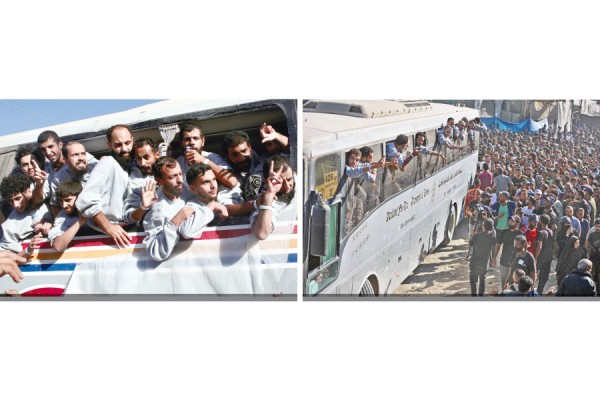
The Al-Qassam Brigades, the military wing of Hamas, executed the first phase of a prisoner exchange deal with the Israeli occupation by releasing 20 Israeli prisoners on Monday, handing them over to the International Committee of the Red Cross. 13 were released at a designated point in Khan Younis, after 7 were released earlier in the central Gaza Strip.
Sources indicated that recovering the bodies of some deceased prisoners may take a long time as some burial sites are unknown. Most of these prisoners were killed in Israeli airstrikes on Gaza.
Meanwhile, the Israeli occupation authorities released 96 Palestinian prisoners from Ofer prison west of Ramallah as part of the first phase of the ceasefire agreement between the Palestinian resistance and Israeli authorities, which includes a simultaneous exchange of prisoners under Red Cross supervision.
According to the Palestinian Prisoners and Freed Prisoners Affairs Commission and the Palestinian Prisoners Club, the occupation released 250 prisoners today: 83 serving life sentences from Ofer prison and 167 from Negev prison (Ketziot). Some of the released prisoners will be transferred to Gaza and Egypt under the agreement terms.
The list included 24 prisoners from Jerusalem governorate serving various sentences. The oldest Jerusalemite prisoner to be freed is Samir Abu Na’ma, detained since 1986. Among the 24 released, 15 will be forcibly deported outside Palestine, with Egypt as their first destination after transfer from Gaza, while 9 will return to their homes in Jerusalem. With the release of these 24 prisoners on Monday, the Palestinian resistance in Gaza has freed 199 prisoners from Jerusalem in three exchange deals, 48 of whom were forcibly deported outside Palestine, some reaching Turkey months ago after Egypt.
The occupation army fired live bullets and tear gas at Palestinians who gathered near Ofer prison to celebrate the prisoners’ release as part of the exchange deal.
Eyewitnesses reported that occupation forces, accompanied by a military bulldozer, stormed Beitunia town west of Ramallah, dispersing Palestinians and journalists gathered since early dawn to welcome the prisoners of the Al-Aqsa Flood deal.
The forces fired tear gas, smoke bombs, and live ammunition to prevent coverage of the release operation, causing several cases of suffocation treated on site.
The Al-Aqsa Flood deal includes releasing 1,718 prisoners arrested from Gaza during the extermination war on the Strip, including two female prisoners and three Jordanian prisoners: Munir Abdullah Mar’i, Hisham Ahmed Kaabi, and Walid Khaled Mansour, bringing the total number of freed prisoners to 1,966.
The occupation forces informed families of the Jerusalemite prisoners to be released under the Al-Aqsa Flood deal of harsh restrictions aimed at limiting their freedom celebrations, including banning any organized celebrations, gatherings outside homes, and raising flags or banners.
Additionally, occupation intelligence vehicles will transport each released prisoner to their home to maintain control over their movements and those of their families.
Most of the released Jerusalemite prisoners are serving life sentences, with the oldest being Al-Qassam commander Ayman Abdul Majid Ashour Sidr from Ras al-Amoud, detained since May 13, 1995, serving life plus 30 years.
This deal reduced the number of prisoners serving life sentences in Israeli prisons from 608 to only 121, reflecting the significant releases made during the three exchange deals within the Al-Aqsa Flood battle.
The deals resulted in freeing more than 3,985 Palestinian prisoners from various factions and affiliations, one of the largest releases in Israeli prisons in years.
The deals included releasing 486 prisoners sentenced to life, 319 with long sentences, 33 expected to receive life or long sentences, 144 female prisoners, and 297 children detainees.
They also included releasing 2,724 prisoners from Gaza arrested after October 7, marking a fundamental shift in the Palestinian prisoners’ file and a significant reduction in those with heavy sentences in Israeli prisons.



Recommended for you
Al-Jaghbeer: The Industrial Sector Leads Economic Growth
Egypt Post: We Have Over 10 Million Customers in Savings Accounts and Offer Daily, Monthly, and Annual Returns
Alternative to UNIFIL Forces
Talib Al-Rifai Chronicles Kuwaiti Art Heritage in "Doukhi.. Tasaseem Al-Saba"
Exhibition City Completes About 80% of Preparations for the Damascus International Fair Launch
Trump Advisor: Disarming Hamas is Central.. Palestinian Authority to Take Over Gaza After Required Reforms