



The United Arab Emirates strongly responded to the false claims of the Port Sudan Authority during the high-level joint briefing organized by the UN Office for the Coordination of Humanitarian Affairs (OCHA) at the UN headquarters in Geneva, reaffirming its stance calling for an immediate ceasefire and protection of civilians without any external guardianship.
In a statement delivered by Sheikha Shihab, Deputy Permanent Representative and Chargé d’Affaires at the UAE Permanent Mission to the UN and other organizations in Geneva, the UAE stated that Sudan has become a land of atrocities and humanitarian disasters where the most basic fundamental principles are violated daily. The UAE emphasized that no party to the conflict should lecture or dictate to UN agencies the basic humanitarian principles that must be adhered to. The statement confirmed the UAE’s focus on what truly matters: alleviating the suffering of the Sudanese people by continuing to provide humanitarian aid and supporting the life-saving efforts of the UN High Commissioner for Refugees, praising the importance of the UNHCR’s work in international protection and displacement.
The UAE stressed the urgent need to enhance international cooperation to address unprecedented levels of displacement and meet the increasing protection needs today. Amid the multiple areas where UNHCR contributes to confronting this uncertain situation, the UAE expressed deep concern about the devastating impact of the conflict on the Sudanese people and the ongoing humanitarian crisis and repeated violations of international humanitarian law by the parties to the conflict, namely the Sudanese Armed Forces and the Rapid Support Forces.
As a member of the “Sudan Quartet,” the UAE confirmed it will continue to work constructively with international partners to ensure the continuity of relief operations. It reiterated that the future governance of Sudan is decided by the Sudanese people through a comprehensive and transparent transitional process free from control by any party to the conflict.
The UAE’s statement pointed out that the parties to the conflict, especially representatives of the Port Sudan Authority, care only about politicizing humanitarian work and spreading misleading narratives instead of bearing their legal and moral responsibilities. Due to this behavior, the conflict has devastating humanitarian consequences on civilians, depriving thousands, including women and children, of access to food, water, and medical supplies, forcing them to leave their homes. There is a constant disregard for the conditions faced by the Sudanese people, who continuously suffer from widespread famine due to ongoing fighting. The UAE statement also confirmed that Sudan has become a theater of atrocities where the most basic fundamental principles are violated daily, while the clear demand is that fighting must stop and civilians must be protected.
This statement responds to false allegations promoted by the “Port Sudan Authority” through systematic media and political campaigns targeting the UAE and its humanitarian role in standing with the brotherly Sudanese people. The UAE’s position is based on a firm belief in the necessity to end the suffering of Sudanese people, with a firm rejection of any attempts to impose external solutions or agendas on the Sudanese, affirming that the solution can only be political through a purely Sudanese path away from guardianship.
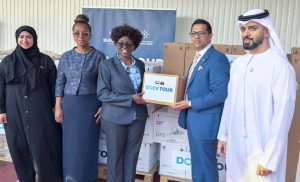
Despite attempts to distort and misrepresent facts, the UAE continues to provide urgent humanitarian aid through UN channels and international partnerships, focusing on alleviating suffering and saving lives without any political consideration. It continues to provide effective support to the Sudanese people and host communities in the region through relief and development programs focusing on urgent needs and improving living conditions for those affected.
The value of UAE aid to Sudan between 2014 and 2025 reached about $3.95 billion, including relief and development projects inside Sudan and in several neighboring countries. Since the outbreak of the conflict in 2023, the UAE has provided $681.8 million in direct humanitarian aid benefiting more than two million people, alongside a pledge to provide $200 million during the high-level humanitarian conference for the Sudanese people held in Addis Ababa on February 14, 2025.
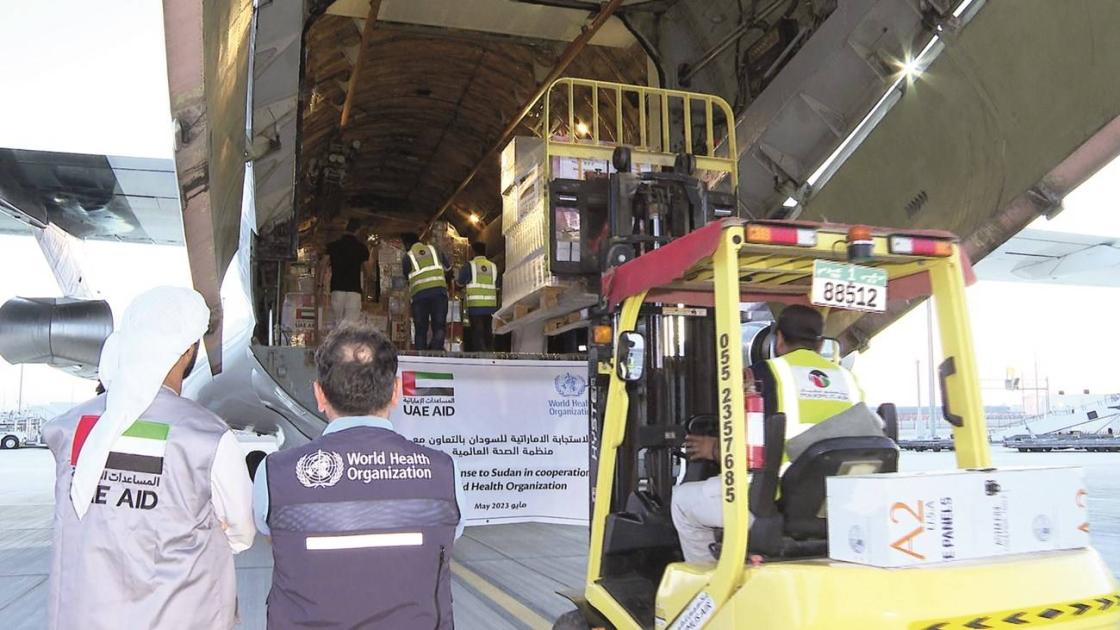
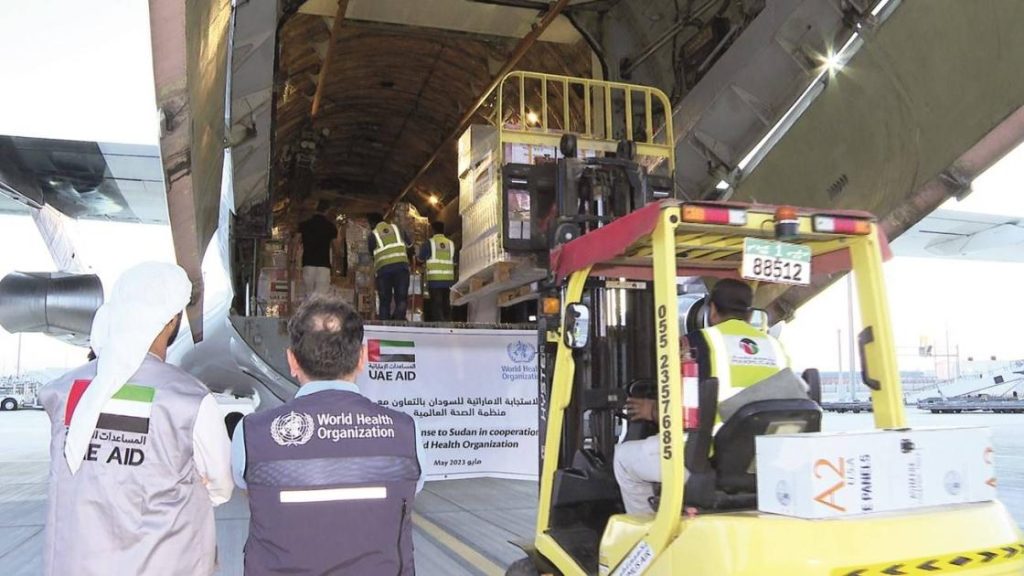
As part of ongoing humanitarian support, the UAE dispatched 162 aircraft and one ship transporting 12,710 tons of food, medical, and relief materials, distributing 6,388 tons of food aid and 280 tons of medical supplies inside Sudan to support those affected by the conflict. Additionally, 5,542 tons of aid reached Chad to support Sudanese refugees, 200 tons to Uganda to provide food, relief, dig three wells, and establish 10 health facilities, and 300 tons to South Sudan to meet urgent needs of refugees. UAE efforts included building two field hospitals in the cities of Amdjarass and Abéché in Chad, which provided medical services to more than 90,889 cases, opening a hospital in the Madhol area of Bahr el Ghazal state in South Sudan, and providing direct support to 127 health facilities across 14 Sudanese states.
The UAE also allocated $70 million to UN agencies and humanitarian organizations operating in Sudan, and $30 million to support refugees in neighboring countries, including $25 million to the World Food Programme, $20 million to the UN High Commissioner for Refugees, $8 million to the World Health Organization, $5 million to the Food and Agriculture Organization, $5 million to the UN Office for the Coordination of Humanitarian Affairs, and $7 million to UNICEF. The UAE announced a contribution of $10.25 million to support Sudanese refugee women affected by the ongoing crisis, distributed among WHO ($3 million), UNFPA ($2 million), the Gender-Based Response Program in Chad ($250,000), UNHCR ($3 million), and the Women’s Peace and Humanitarian Fund ($2 million). Additionally, the UAE provided $4 million to support education for Sudanese refugees in Chad in cooperation with UNICEF, enhancing educational and protection opportunities for children affected by the conflict.



Recommended for you
Al-Jaghbeer: The Industrial Sector Leads Economic Growth
Alternative to UNIFIL Forces
Egypt Post: We Have Over 10 Million Customers in Savings Accounts and Offer Daily, Monthly, and Annual Returns
Talib Al-Rifai Chronicles Kuwaiti Art Heritage in "Doukhi.. Tasaseem Al-Saba"
Exhibition City Completes About 80% of Preparations for the Damascus International Fair Launch
Trump Advisor: Disarming Hamas is Central.. Palestinian Authority to Take Over Gaza After Required Reforms