









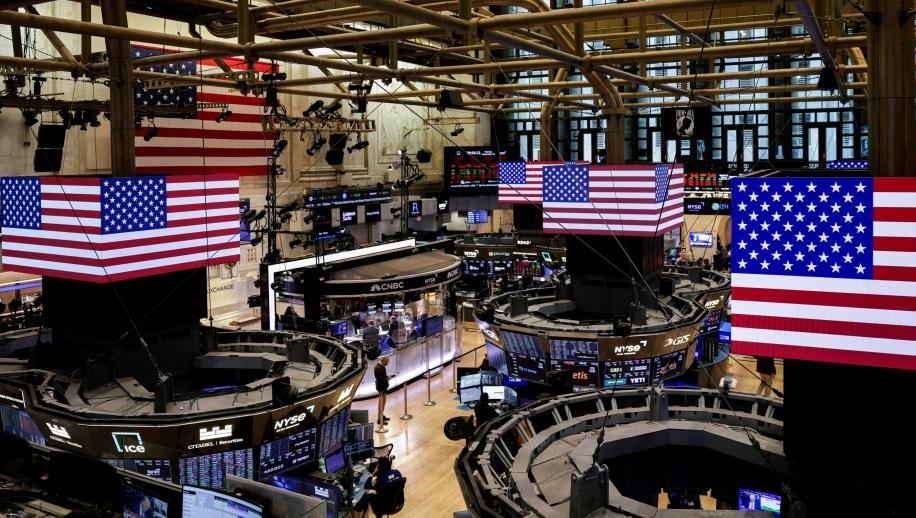
US stocks closed lower on Thursday as investors took the opportunity to consolidate positions ahead of the third-quarter earnings season amid a lack of economic data or significant market-moving catalysts.
The S&P 500 and Nasdaq indices retreated from their record highs reached on Wednesday, while the Dow Jones Industrial Average posted the largest percentage decline.
Matthew Kittur, managing partner at Kittur Group, a wealth management firm in Lenox, Massachusetts, said, “The earnings cycle has started, and there is a sense of anticipation and waiting to see if we will witness stability in earnings growth in the next quarter similar to what we saw in the past two quarters.”
He added, “Considering the uncertainty surrounding the lack of data from Washington and how the Federal Reserve will handle it, a slight pullback is natural.”
The US government shutdown entered its ninth day with little progress. As a result, market participants remain deprived of key economic data. With the third-quarter earnings season approaching, the scarcity of market-moving catalysts focuses investors’ attention on central bank policymakers’ statements for clues on interest rate cuts by year-end.
The S&P 500 fell 18.50 points, or 0.27%, to close at 6735.22, while the Nasdaq Composite dropped 18.75 points, or 0.08%, to 23023.95. The Dow Jones Industrial Average declined 238.58 points, or 0.51%, to 46363.20.
European stocks fell Thursday, dragged down by sharp losses in HSBC and Ferrari shares, causing the Stoxx 600 index to retreat from its record high as investors cautiously monitored escalating political unrest in France.
The Stoxx 600 closed down 0.4%, retreating from its record level reached in the previous session.
Ferrari shares recorded their worst daily drop ever, closing at their lowest level since April after disappointing long-term financial targets dampened investor enthusiasm and overshadowed the launch of the Italian luxury carmaker’s first electric vehicle.
The automotive sector posted its worst daily performance since March, with Michelin shares also adding to losses. The French tire maker’s stock fell 3.8% after it said its third-quarter sales volume would decline compared to the previous year.
HSBC shares plunged 5.4%, leading European index losses, after the British bank announced plans to acquire minority shareholders’ stakes in its Hang Seng Bank unit in a deal worth about $13.6 billion.
Market analyst Ipek Ozkardeskaya from Swissquote said, “Clearly, there are concerns about the timing of the deal and changes to some of its terms.”
Investors are closely watching France as President Emmanuel Macron seeks a sixth prime minister in less than two years, hoping to pass the budget in a parliament facing a crisis.
French assets were negatively affected this week after Sebastian Lecornu, the fifth French prime minister in two years, resigned along with his government just hours after announcing the cabinet formation.
The regional blue-chip index erased early gains to close down 0.2%. The benchmark index remains one of the few declining indices in 2025, rising about 9.2% compared to double-digit percentage gains in other major countries.
Maersk shares fell Thursday amid investor expectations that a Gaza ceasefire agreement could reopen container shipping routes through the Red Sea and Suez Canal, easing the capacity crisis that supported freight rates.
Israel and Hamas agreed Wednesday on the first phase of US President Donald Trump’s Gaza plan, raising hopes that the Iran-aligned Houthi group in Yemen would stop attacks on commercial shipping in the Red Sea. These attacks forced shipping companies to reroute around southern Africa since late 2023.
However, the Houthis have yet to comment on the ceasefire agreement or indicate any policy change. The group claimed responsibility for an attack on a Dutch-operated vessel last week.
By 1025 GMT, Danish Maersk shares had fallen 2%, marking their lowest level since July 8.
Michael Emil Jensen, an analyst at Sydbank, said, “Maersk’s share decline is due to expectations of further freight rate decreases related to the increased likelihood of safe passage through the Red Sea.”
Analysts warned that even if the ceasefire holds, shipping companies are expected to wait months for guarantees that attacks will not resume.
A Maersk spokesperson confirmed the company will not consider resuming operations through the Red Sea until a long-term and effective security solution is reached.
The company added, “There is a clear link between security risks in the Bab el-Mandeb Strait and the Gaza conflict, although it is too early to assess the impact of Gaza developments on the Red Sea situation.”
It also stated, “We hope this agreement is the first step toward ending the conflict and achieving lasting peace.”
According to analyses by Sydbank and ABG Sundal Collier, a return to the Suez Canal would increase available shipping capacity, putting further pressure on freight rates that have already fallen from record highs earlier this year.




Recommended for you
Talib Al-Rifai Chronicles Kuwaiti Art Heritage in "Doukhi.. Tasaseem Al-Saba"
Exhibition City Completes About 80% of Preparations for the Damascus International Fair Launch
Al-Jaghbeer: The Industrial Sector Leads Economic Growth
Unified Admission Applications Start Tuesday with 640 Students to be Accepted in Medicine
Egypt Post: We Have Over 10 Million Customers in Savings Accounts and Offer Daily, Monthly, and Annual Returns
His Highness Sheikh Isa bin Salman bin Hamad Al Khalifa Receives the United States Ambassador to the Kingdom of Bahrain