







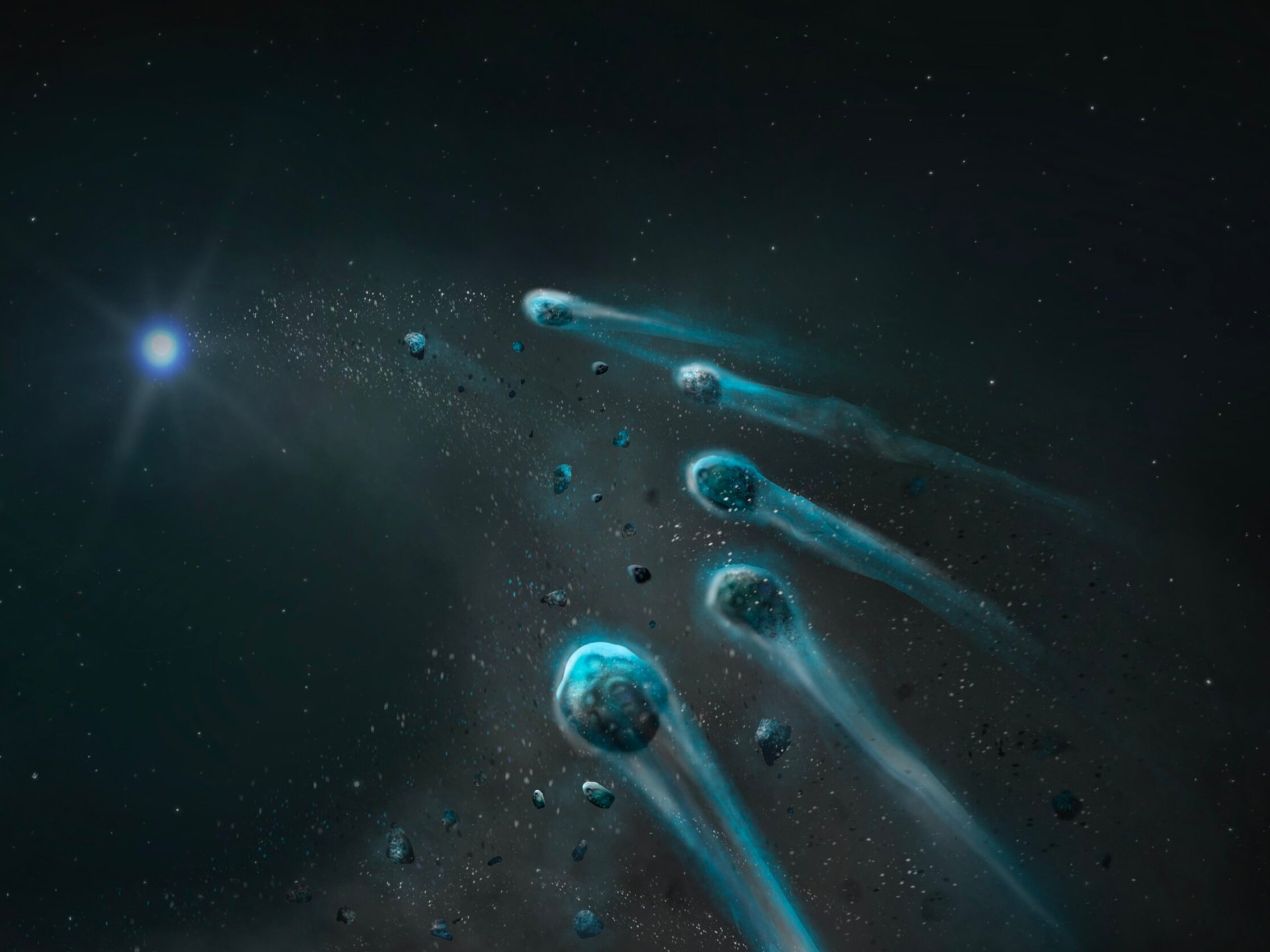
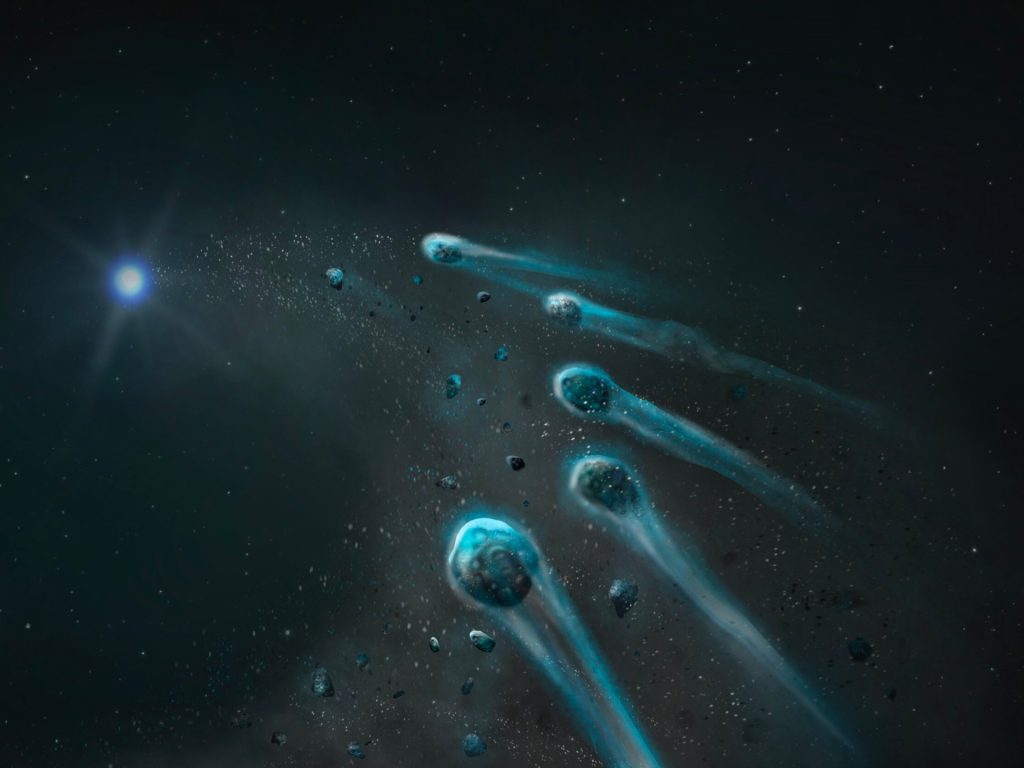
Dans un système stellaire lointain, des scientifiques étudiant un nain blanc nommé “WD 1647+375” ont trouvé des preuves solides que cette étoile avale des débris d’une planète ou d’un astéroïde glacé riche en volatils tels que l’eau et l’azote.
Les nains blancs représentent la dernière étape de la vie de la plupart des étoiles, y compris notre soleil à l’avenir. Lorsque le combustible nucléaire d’une étoile est épuisé et que la fusion de l’hydrogène et de l’hélium dans son cœur cesse, elle perd son équilibre et s’étend en une géante rouge massive, puis éjecte ses couches externes sous forme de nébuleuse planétaire colorée, ne laissant que le cœur de l’étoile, appelé “nain blanc”.
Habituellement, les enveloppes des nains blancs sont composées d’hydrogène ou d’hélium après l’épuisement du combustible nucléaire, donc la présence d’éléments comme le carbone, l’oxygène, le soufre, ainsi qu’une grande quantité d’azote dans l’atmosphère de l’étoile est une preuve que l’étoile accumule de la matière provenant d’un corps proche détruit.
Grâce au télescope spatial Hubble
En utilisant la lumière ultraviolette via le télescope spatial Hubble, les chercheurs ont analysé le spectre chimique de l’atmosphère de l’étoile. Ils ont découvert que la teneur en azote dans la matière absorbée de la planète avalée est d’environ 5 % de la masse, le niveau d’azote le plus élevé jamais observé dans des débris absorbés d’un corps céleste autour d’un nain blanc.
La quantité d’oxygène dépasse également ce qui serait attendu si les débris étaient uniquement rocheux, confirmant sa nature glacée et sa teneur en volatils, selon l’étude publiée dans la revue “Monthly Notices” de la Royal Astronomical Society au Royaume-Uni.
Les calculs estiment que le corps glacé a fourni à l’étoile de la matière à un rythme d’environ 200 000 kilogrammes par seconde au cours des 13 dernières années d’observation.
Importance de la découverte
Cette découverte scientifique est importante pour plusieurs raisons. Premièrement, elle fournit une preuve claire de l’existence de corps glacés et de ressources en eau dans des systèmes planétaires en dehors de notre système solaire, soutenant l’idée que l’eau et les composés essentiels à la vie peuvent être courants dans l’univers, et pas seulement limités à notre système.
Deuxièmement, la détection de corps riches en azote nous aide à comprendre les composants volatils qui constituent les petites planètes ou les comètes dans des corps célestes lointains, contribuant à cartographier la diversité des petites planètes parmi différentes étoiles.
Enfin, les nains blancs agissent comme une “scène de crime cosmique” : lorsqu’ils avalent des objets proches, ils laissent leurs résidus chimiques dans leur atmosphère, permettant aux scientifiques de “reconstruire” la nature de ces corps contenant de l’eau ou des gaz volatils.
Questions restantes
Cependant, des questions importantes subsistent : ce corps glacé faisait-il partie d’un système planétaire antérieur de l’étoile ? Ou est-il venu de l’extérieur du système, comme une comète interstellaire capturée par la gravité de l’étoile ? Quel a été le processus de sa destruction et de son absorption qui a conduit à la diffusion de ces matériaux dans l’atmosphère de l’étoile ?
Les chercheurs de l’Université de Warwick, qui ont dirigé l’étude, ont ajouté dans un communiqué officiel qu’il est nécessaire de poursuivre la surveillance et l’imagerie spectroscopique pour découvrir plus de cas similaires, que ce soit autour d’autres nains blancs ou d’étoiles à d’autres stades d’évolution.


Recommended for you
طالب الرفاعى يؤرخ لتراث الفن الكويتى فى "دوخى.. تقاسيم الصَبا"
مدينة المعارض تنجز نحو 80% من استعداداتها لانطلاق معرض دمشق الدولي
الجغبير: القطاع الصناعي يقود النمو الاقتصادي
تقديم طلبات القبول الموحد الثلاثاء و640 طالبا سيتم قبولهم في الطب
البريد المصري: لدينا أكثر من 10 ملايين عميل في حساب التوفير.. ونوفر عوائد يومية وشهرية وسنوية
سمو الشيخ عيسى بن سلمان بن حمد آل خليفة يستقبل سفير الولايات المتحدة الأمريكية لدى مملكة البحرين