









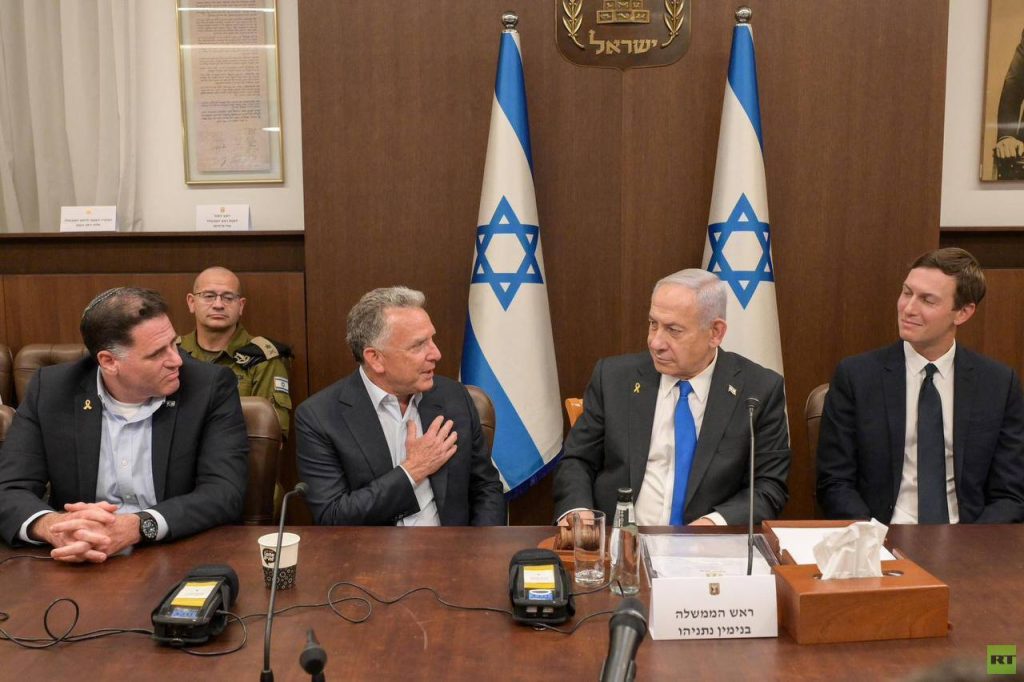
Israel’s Kan Broadcasting Corporation revealed that the agreement between Israel and Hamas includes a secret annex that activates if the prisoner exchange terms cannot be fulfilled on time.
According to the report, one possible scenario is Hamas’s inability to deliver all prisoners, alive or dead, within the allocated 72 hours.
If this scenario occurs, the secret clause comes into effect, essentially posing a direct threat to Hamas and obliging the Israeli government to approve it as an integral part of the agreement. This annex is seen as an Israeli guarantee to prevent Hamas from exploiting timing or logistical loopholes in executing the deal.
Besides the prisoner file, the agreement faces other practical challenges, notably the entry of humanitarian aid trucks into Gaza starting tomorrow, amid Israeli concerns about the presence of Al-Qassam Brigades members accompanying the convoys, which raises internal security debates in Israel.
Also, the issue of opening the Rafah crossing emerges as a sensitive point of contention. According to sources, the Israeli General Security Service (Shin Bet) will monitor the crossing, aiming to maintain indirect Israeli security control over the movement of people and goods, even under international supervision.
In an analytical article published by Israeli writer Jazira Gior on the Walla website, he warned that the anticipated “national joy” following the return of prisoners could be marred by three core issues:
- First: The fate of the 28 deceased hostages. So far, it is unlikely Hamas will deliver all their bodies on time or in the near future due to lack of incentive, as the “bargaining value” is focused on living prisoners. Despite the formation of an international mechanism (involving Qatar, Egypt, and Turkey) to search for the prisoners’ bodies, Gior doubts its seriousness.
- Second: The gap between political rhetoric and field reality. Trump’s original plan, published 11 days ago, clearly states that phase two of the agreement must include the complete disarmament of Hamas and transferring authority in Gaza to a civilian, non-military body. But Gior believes “no party, including the United States, has a real interest in pressuring Hamas to surrender its weapons,” threatening Hamas’s continued military presence and keeping the Israeli army in constant friction along the so-called “modified yellow line.”
- Third: The risk of reconstruction without disarmament. The writer asserts that “Israel has no interest in rebuilding Gaza” unless it coincides with the complete dismantling of Hamas’s military infrastructure, including tunnels and rocket factories. He points out that an international conference is held today in Paris to raise funds for reconstruction, warning that “rebuilding Gaza under armed Hamas control will reproduce the conditions that led to the October 7 war.”
Gior concludes that “Israel’s only advantage at this stage is control over all crossings leading to Gaza, including Rafah.” He calls on the government not to relinquish this leverage and stresses that “any reconstruction process must be conditional on implementing phase two of Trump’s plan.”
He ends his article with a clear warning: “If the war ends only with the return of prisoners, without disarmament or a change in the security reality, the question will arise: what did the government achieve by rejecting a similar deal over a year ago? Dozens of soldiers were killed, prisoners’ conditions deteriorated, and some bodies were buried under rubble that will never be cleared.”
However, if Israel succeeds in enforcing phase two, it can then claim to have achieved “a strategic achievement that was impossible in the past.”
Source: Israeli Broadcasting Corporation + Hebrew site “Walla”

Recommended for you
Talib Al-Rifai Chronicles Kuwaiti Art Heritage in "Doukhi.. Tasaseem Al-Saba"
Al-Jaghbeer: The Industrial Sector Leads Economic Growth
Exhibition City Completes About 80% of Preparations for the Damascus International Fair Launch
Unified Admission Applications Start Tuesday with 640 Students to be Accepted in Medicine
Egypt Post: We Have Over 10 Million Customers in Savings Accounts and Offer Daily, Monthly, and Annual Returns
His Highness Sheikh Isa bin Salman bin Hamad Al Khalifa Receives the United States Ambassador to the Kingdom of Bahrain