








Since the beginning of the Arab-Israeli conflict, Egypt has always borne the greatest burden and cost, positioning itself as the defender of Palestine, considering it not just an Arab issue but an existential matter directly linked to Egypt’s national security and regional stability. With the recent Gaza war igniting, Cairo reemerged as the first line of defense against attempts to liquidate the Palestinian cause or impose coercive solutions on the Palestinian people, affirming that its role is no longer just traditional support but an active leadership in the political and humanitarian process, crafting a new equation that places an independent Palestinian state at the core of any just settlement.
Under President Abdel Fattah El-Sisi’s leadership, Egypt chose the more difficult path: preserving peace in a time fueled by violence. War can ignite by a hasty decision but only creates deep wounds and generations of despair, while peace requires patience, vision, and an unbreakable will against international and regional pressures. President El-Sisi was clear when he stated that Egypt “works with all strength and sincerity to stop the war” and will not allow forced displacement of Palestinians, as this threatens the security of the entire region. His stance was directed not only internally but to the whole world, sending a message that Egypt will not accept the liquidation of the Palestinian cause at the expense of innocent lives or the future of the region’s peoples.
Cairo acted on multiple fronts simultaneously: on the ground, it opened the Rafah crossing to bring in aid despite security risks and political pressure, sending massive convoys of medical and food relief to emphasize that the humanitarian aspect of the cause is inseparable from its political dimension. Diplomatically, President El-Sisi intensified communications with the United States, Europe, and the Arab world, relying on Egypt’s historical legitimacy and geographic weight, making it an indispensable player. This effort went beyond just a ceasefire; it placed the international community before its responsibilities, resulting in an increasing number of European countries recognizing the Palestinian state – a development that would not have happened without Egypt’s continuous defense of Palestinians’ right to their state.
International recognition of Palestine is not an isolated event but a purely Egyptian achievement skillfully and patiently woven by Cairo’s diplomacy. Over the years, Egypt has redirected the international compass, affirming that any real settlement begins with recognition of the Palestinian state within the June 4, 1967 borders with East Jerusalem as its capital. This shift is a direct result of Egypt’s insistence that peace is built on justice and legitimacy, not force. Thus, Cairo has not only protected the cause from attempts at erasure but elevated it to an international recognition level that ushers in a new phase.
Amid all this, President El-Sisi’s wisdom shone in balancing Egypt’s national security needs with its historic duty toward Palestine. At the same time, he did not compromise on the fundamental stance supporting Palestinian rights. His principled position, when he said, “I will not gamble with the lives of our children to bring aid by force,” is proof that Egyptian leadership manages the crisis rationally without abandoning its humanitarian and political responsibilities. This ability to combine realism and firmness earned Egypt the world’s respect and proved it an indispensable partner in any solution.
Egypt has transformed from a mere regional mediator to a new international legitimacy maker for Palestine. Today, the world understands that there is no peace without Palestine, no Palestine without a state, and no state without Egypt as a guarantor and key actor. Regardless of the number of initiatives or changes in international stances, it remains constant that Cairo is the pivotal center that cannot be bypassed. The international recognition of the Palestinian state is a testament to Egypt’s success in imposing its vision on the global stage.
Including the clause “prohibition of displacement” in the Gaza agreement is a clear and explicit acknowledgment by former US President Donald Trump of the success of presidential diplomacy in protecting Palestinian rights and blocking one of the most dangerous plans aimed at emptying the Gaza Strip of its population. This development did not happen by chance but is the fruit of a comprehensive Egyptian political and diplomatic movement led by President Abdel Fattah El-Sisi since the early days of the Gaza war, when he clearly stated that displacement is a red line and Egypt will not allow harm to national security or changes to the demographic geography in Palestinian territories.
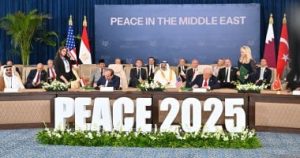
The success of the Sharm El-Sheikh agreement reflects the presidential diplomacy’s ability to effectively manage the Gaza crisis, where Cairo succeeded in reaching a ceasefire and ending the war after two years of suffering, ensuring civilian protection and facilitating humanitarian aid access. The agreement, backed by Egypt’s strength, demonstrated Cairo’s ability to maintain balance among parties and convince them to commit to the truce, giving confidence in the continuity of peace and opening horizons of hope for the region’s peoples toward a future of stability and justice.
Maintaining peace is harder than war, but Egypt accepted this challenge and pushed toward shaping a new reality that guarantees Palestinians their right to a state and spares the region from recurring cycles of violence. Cairo proved it does not seek a transient role or temporary gains but aims to establish a historic equation: Palestine will not be lost as long as Egypt remains the first and last line of defense. Thus, under President El-Sisi’s leadership, Egypt redrew the conflict map and transformed international recognition of Palestine into a purely Egyptian achievement that will remain etched in the memory of modern political history.


Recommended for you
Talib Al-Rifai Chronicles Kuwaiti Art Heritage in "Doukhi.. Tasaseem Al-Saba"
Exhibition City Completes About 80% of Preparations for the Damascus International Fair Launch
Al-Jaghbeer: The Industrial Sector Leads Economic Growth
Unified Admission Applications Start Tuesday with 640 Students to be Accepted in Medicine
Egypt Post: We Have Over 10 Million Customers in Savings Accounts and Offer Daily, Monthly, and Annual Returns
His Highness Sheikh Isa bin Salman bin Hamad Al Khalifa Receives the United States Ambassador to the Kingdom of Bahrain