










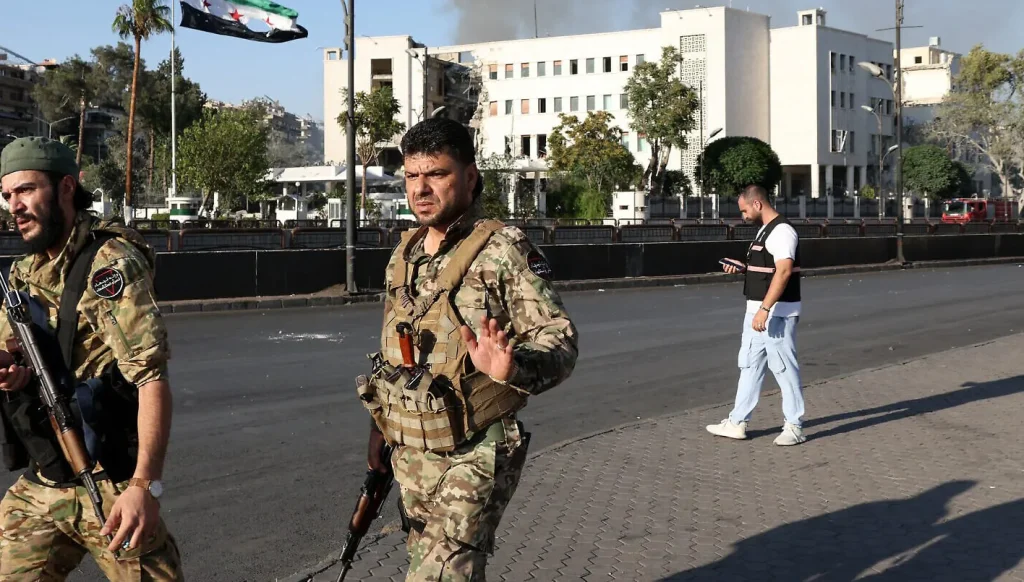
The Syrian Ministry of Defense during its bombing (AFP).
The prospects for Syria and Israel reaching a security agreement related to southern Syria seemed imminent. It was said that the agreement was supposed to be signed on the sidelines of the United Nations summit, during the presence of Israeli Prime Minister Benjamin Netanyahu and Syrian President Ahmed Al-Shara in New York. However, the agreement did not materialize, with Reuters attributing the cause to a clause added by the Israeli side regarding the establishment of a humanitarian corridor to Sweida, which the Syrian side rejected.
According to the current scenario, Israel is neither in a hurry nor compelled to make the agreement with Syria, as it has firmly established a safe and buffer zone in the south through military strength, which does not pose a threat to it. On the other hand, Syria sees no benefit in an agreement that appears “one-sided,” guaranteeing Israel’s security without reciprocity, allowing Israel freedom of movement in Syrian airspace and opening a corridor to Sweida that would permit arms transfer.
There is a conviction that Israel does not intend to create a “humanitarian” corridor to Sweida because if it truly wanted to, it would have dropped aid by air, but it only did so in small quantities. Nanar Hawash, senior researcher on Syrian affairs at the International Crisis Group, speaks about the failure of the agreement between Tel Aviv and Damascus and the “humanitarian corridor,” telling An-Nahar that the corridor apparently “was an element of disagreement without basis.”
Hawash points to a flaw in the agreement favoring Israel at Syria’s expense, and in his view, the “core problem” lies in the proposal as presented, which “was not built on mutual security,” but on arrangements that consolidate “Israeli dominance” and keep Syria’s sovereignty “impaired,” through clauses such as the airspace ban and rules that may be permanent on Syrian territory, suggesting a formula that Damascus likely “does not accept.”
Will the Agreement Return?
The failure of the agreement raises questions about the future relationship between Tel Aviv and Damascus and the future of the current Syrian authorities. The expected agreement was seen as a guarantee for Syria so that Israel would not attack, weaken, or seek to topple its new regime. It was also expected to serve as an entry point to economic relations and oil and gas pipeline projects from the Gulf to the Mediterranean.
Therefore, the question arises about the possibility of reactivating diplomatic efforts to conclude the agreement. In this context, Hawash excludes reaching a comprehensive agreement in the foreseeable future. In his opinion, the strategic goals of both parties are “contradictory”; Israel sees its interest in Syria remaining “weak and fragmented,” while the Syrian government “cannot” make concessions that affect the “core of sovereignty” without losing its internal legitimacy.
The absence of the agreement may mean a return to escalation in southern Syria, especially in Sweida. It is not unlikely that the escalation could expand to include the Syrian interior. Israel has targeted various Syrian provinces. From this standpoint, Hawash says any future talks “will likely be limited” to “managing tensions and preventing escalation,” not a comprehensive solution.
Impact of the Agreement’s Failure
The failure to reach an agreement will affect Syria more than Israel, as the latter imposes a surplus of military and political power. The Syrian researcher sketches the scenario, describing the regime as in a state of “strategic paralysis: impaired sovereignty, shackled economy, and fragile southern borders,” remaining vulnerable to Israeli military interventions. Failure to reach an agreement “will hinder” the ability of countries supporting Syria to inject the investments it needs.
Israel does not want a strong Syria on its borders, capable of securing its own safety and economy, preferring the continuation of weakness, fragmentation, and even controlled chaos, especially as it is in the midst of redrawing regional borders and a continuous state of war. However, Israeli interests may change when the new regional borders are finalized, calling for a stable Syria that attracts investments, at which point talks about the agreement may resume.


Recommended for you
Talib Al-Rifai Chronicles Kuwaiti Art Heritage in "Doukhi.. Tasaseem Al-Saba"
Exhibition City Completes About 80% of Preparations for the Damascus International Fair Launch
Al-Jaghbeer: The Industrial Sector Leads Economic Growth
Unified Admission Applications Start Tuesday with 640 Students to be Accepted in Medicine
Egypt Post: We Have Over 10 Million Customers in Savings Accounts and Offer Daily, Monthly, and Annual Returns
His Highness Sheikh Isa bin Salman bin Hamad Al Khalifa Receives the United States Ambassador to the Kingdom of Bahrain