









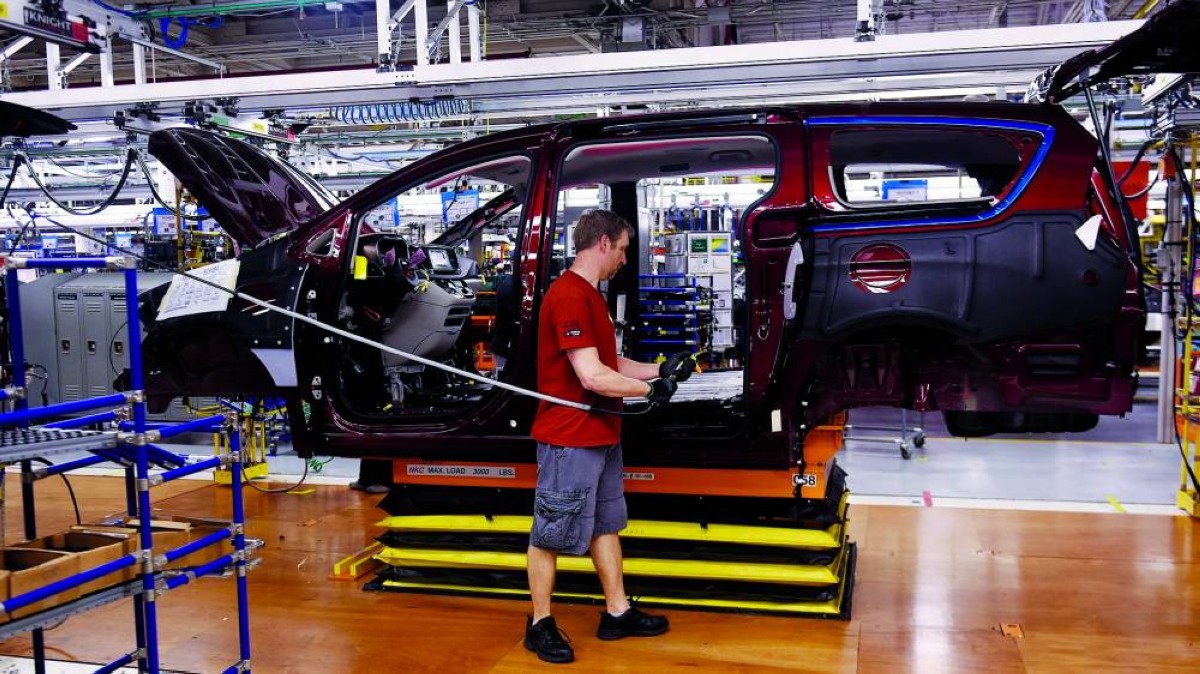
Last March, Tim 1 Plastics, a Michigan-based auto parts supplier, ordered an injection molding machine worth $300,000 from Japan.
By the time it arrived, U.S. President Donald Trump’s tariffs had increased the price by 15% to $345,000.
Gary Grzegofski, Vice President and co-founder of Tim 1 Plastics, said: “This is a cost that has to be compensated for somehow.”
Trump’s tariffs were supposed to boost the U.S. auto industry by protecting it from foreign competition, correcting trade imbalances, and encouraging reshoring of jobs moving to Asia, according to the White House.
Therefore, Ford, General Motors, and Stellantis—the three major automakers—expect their combined profits to be hurt by up to $7 billion due to tariffs in 2025, while thousands of their suppliers suffer from supply chain disruptions, reduced cash flow, and higher product prices.
Detroit, the industrial capital of Michigan, is the historic cradle of the U.S. auto sector. Since Henry Ford built the world’s first moving assembly line there in 1913, Detroit has symbolized U.S. technological and manufacturing prowess.
But this expertise is tied to complex global supply chains that are difficult to replace.
Suppliers watch anxiously as the big three struggle under the disruptions caused by tariffs, especially the 25% tax on imported auto parts.
Jim Farley, CEO of Ford, said last month: “This $2 billion headwind is constraining our future investments.”
Lisa Lansford, CEO of GS3, which manufactures aluminum and steel alloy parts, said: “The auto sector is bleeding, and the question is: if it doesn’t survive, what will happen to all of us?”
Her company’s CEO said it has been “heavily impacted” by U.S. tariffs.
She added, “The ironic tragedy is that the chaos of national tariffs does the exact opposite of the administration’s goal: companies are cutting production, not creating jobs in Michigan.”
Glenn Stevens, CEO of the lobbying group MichAuto, said, “The industry’s situation is unprecedented. We’ve been through many turning points, but I don’t think I’ve seen anything like what’s happening now.” Tariffs are the latest setback for a sector already facing turmoil.
First came the pandemic that shook global supply chains. Then, declining demand for electric vehicles disrupted automakers’ expansion plans.
Now, companies face increasing threats from Chinese competitors challenging U.S. global dominance even in traditional markets.
Pat Dieramo, CEO of Canadian parts supplier Martinrea International, with engineering facilities in Michigan, pointed to the U.S. administration’s sudden August decision to expand tariffs on steel and aluminum derivative products.
Dieramo said, “This caused prices of some goods to rise by as much as 400%.”
Tariffs have also created illogical distortions, many say.
Dieramo explained that his company casts stainless steel in Indiana, then ships it to Canada to be made into pipes.
He added, “When it returns, we have to pay tariffs on both the stainless steel—made in America—and the pipes themselves.” He concluded, “So, there is a system flaw.”
Alpha USA negotiates with its clients for compensation, but some automakers refuse to cover all tariff-related costs incurred by their suppliers.
Some major automakers demand suppliers source more raw materials and parts from the U.S., but that can be difficult.
Alpha USA said it contacted many American manufacturers of nuts and bolts, but “in 99.9% of cases,” their prices were higher than Taiwanese products even after tariffs.
The smaller the company, the greater the potential disruption.
Karen Harris, head of Blitz Proto, a prototyping company based in Farmington Hills, Michigan, said stainless steel component prices used by her company rose 21% between April and September.
Other parts prices are now 50% higher than before tariffs were imposed.
This negatively affected the company’s pricing estimates. Harris explained that any project quote used to be valid for 30 days.
Now, it expires after a week. She added, “Costs change daily due to tariff fluctuations. So, we can no longer accurately fix costs.”
While tariffs have not yet affected car prices, analysts say it is only a matter of time, especially after dealers exhaust stockpiles accumulated before tariffs.
Gabriel Ehrlich, an economist at the University of Michigan, expects domestic and imported car prices to rise by an average of 9.6% over the years it will take supply chains to adjust to Trump’s tariffs. He wrote in September: “Using 2024 prices, the average car cost will rise by about $4,500 if profit margins remain unchanged.”
He also expects tariffs to reduce domestic car production, with light vehicle output dropping by 313,000 units, or 3.1%, annually.
He forecast light vehicle sales to fall by about 780,000 units yearly and exports to decline by 320,000 units.
He emphasized that the tax on imported steel and aluminum is the main driver of cost increases affecting the industry.
Ehrlich said, “Overall, there is a net cost to Michigan, as these materials are key inputs in the auto and light truck industry.”
Meanwhile, auto parts suppliers yearn for more stability. Dieramo of Martinrea said, “When will we get a break? Five years of consecutive struggles have shrunk our profit margins throughout.”




Recommended for you
Talib Al-Rifai Chronicles Kuwaiti Art Heritage in "Doukhi.. Tasaseem Al-Saba"
Exhibition City Completes About 80% of Preparations for the Damascus International Fair Launch
Al-Jaghbeer: The Industrial Sector Leads Economic Growth
Unified Admission Applications Start Tuesday with 640 Students to be Accepted in Medicine
Egypt Post: We Have Over 10 Million Customers in Savings Accounts and Offer Daily, Monthly, and Annual Returns
His Highness Sheikh Isa bin Salman bin Hamad Al Khalifa Receives the United States Ambassador to the Kingdom of Bahrain