





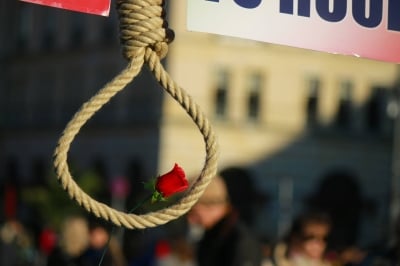
Human rights organizations revealed that Iranian authorities executed over 1,000 people during 2025, the highest number recorded in the country in more than 15 years. These organizations call for an immediate moratorium on executions as a first step towards abolition, urging the international community to take urgent action to pressure Tehran.
According to the organizations, since the outbreak of protests in 2022 under the slogan “Women, Life, Freedom,” Iranian authorities have used the death penalty as a political tool to suppress dissenting voices. In 2025, executions increased especially after military tensions between Iran and Israel in June, with the government using national security as a justification for new sentences.
Human rights groups confirmed that the rise in executions reached alarming levels, noting that Iranian authorities use the death penalty as a weapon to intimidate society and crush opposition. These sentences are often carried out after swift trials lacking justice, representing a blatant violation of the right to life.
Reports show that Iran’s revolutionary courts, responsible for security and drug-related cases, issue death sentences after trials lacking transparency, where defendants are deprived of basic defense rights. In September 2025, citizen Babak Shahbazi was executed after a trial in which authorities did not investigate allegations of torture.
Data indicates that ethnic and religious minorities, such as Baluchis, Kurds, and Afghans, are the most affected by Iran’s execution policy. Human rights organizations accuse the authorities of systematically targeting these groups through arbitrary trials.
There was a notable increase in the number of Afghans executed in Iran in 2025, rising from 25 in 2023 to over 80 in 2024, with the upward trend continuing this year. This coincided with an escalation of official anti-foreigner rhetoric and forced mass deportation campaigns, including those born in Iran.
Among those sentenced to death are two prominent Kurdish women: Bakhshan Azizi, a relief worker, and political dissident Risheh Moradi. Human rights groups described their sentences as unjust and part of a repressive policy targeting women involved in civil and political activism.
Many death sentences in Iran are carried out on vague charges such as “enmity against God,” “corruption on earth,” and “espionage.” These charges are used to silence opponents and justify repression. Since June, at least ten men have been executed on political charges, including eight accused of spying for Israel.
Iran continues to carry out executions related to drug offenses, despite international law prohibiting the death penalty for non-violent crimes. Rights activists affirm that authorities use these cases as a cover to justify the high annual execution numbers.
Human rights organizations have called on the international community to apply political and economic pressure on Iran to immediately halt executions. They also demand the use of universal jurisdiction to hold Iranian officials accountable for issuing and carrying out arbitrary death sentences.
Human rights groups view the continued use of the death penalty in Iran as a flagrant violation of the human right to life, as stated in the Universal Declaration of Human Rights. They emphasize that mass executions after unfair trials entrench a culture of impunity.
Observers stress the need to reform Iran’s judicial system and ensure fair trials independent of security apparatus influence. They consider a moratorium on executions a first step towards justice, but the path remains long to end this punishment that has become a tool of political and social repression.


Recommended for you
Al-Jaghbeer: The Industrial Sector Leads Economic Growth
Alternative to UNIFIL Forces
Egypt Post: We Have Over 10 Million Customers in Savings Accounts and Offer Daily, Monthly, and Annual Returns
Talib Al-Rifai Chronicles Kuwaiti Art Heritage in "Doukhi.. Tasaseem Al-Saba"
Exhibition City Completes About 80% of Preparations for the Damascus International Fair Launch
Trump Advisor: Disarming Hamas is Central.. Palestinian Authority to Take Over Gaza After Required Reforms