









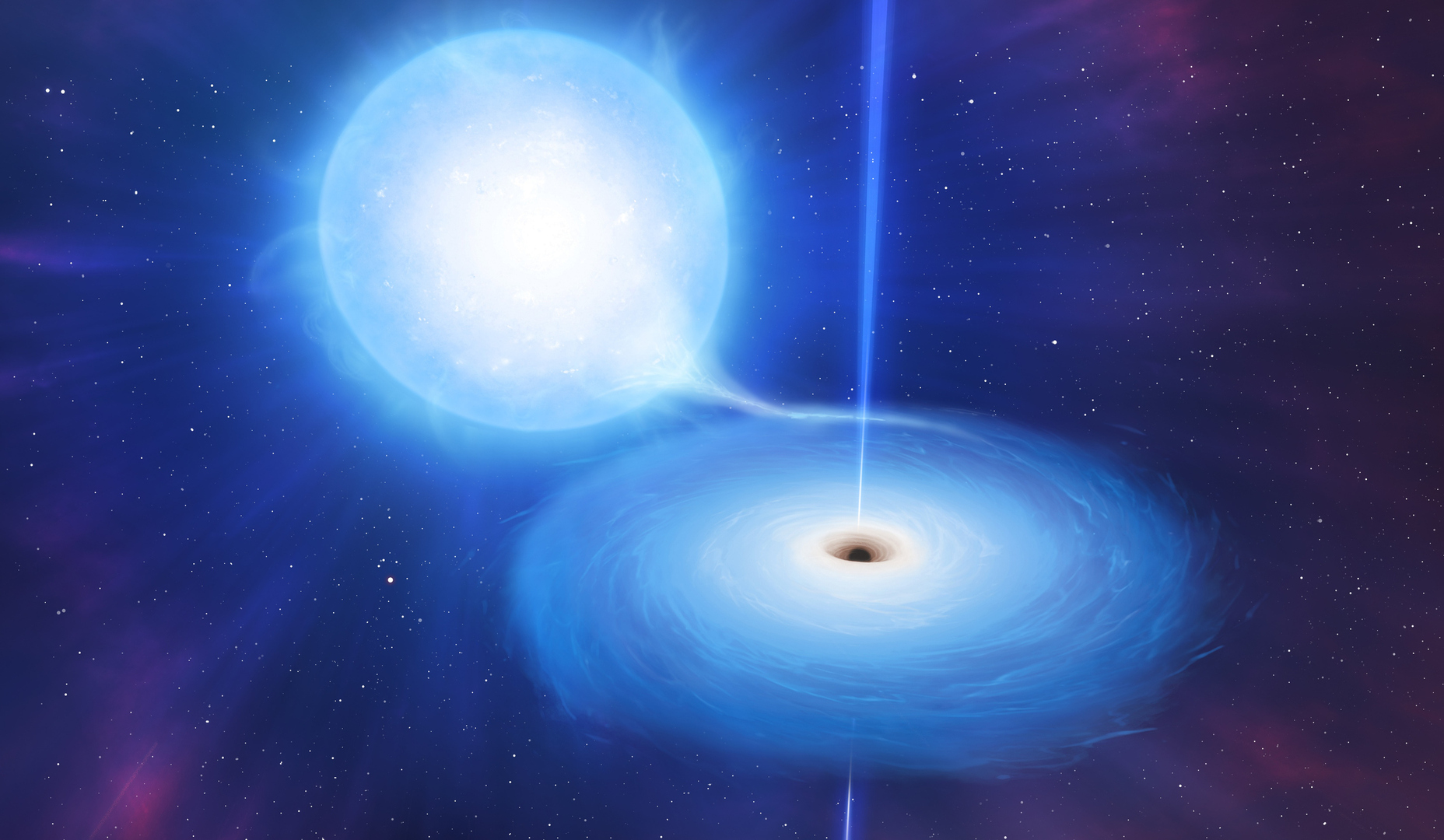
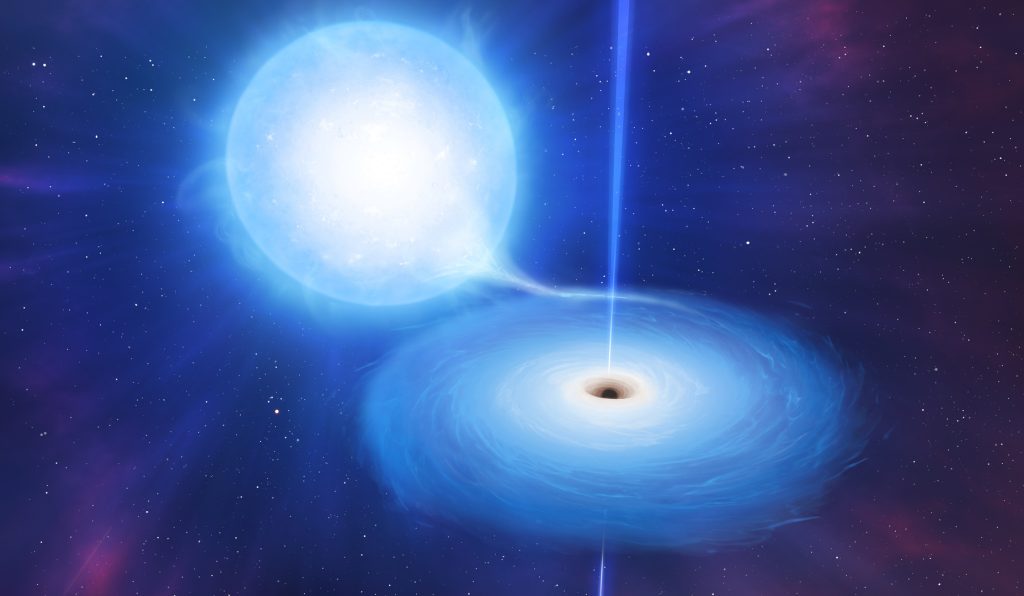
Astronomers have, for the first time ever, observed a binary system of black holes orbiting each other at the heart of galaxy OJ287, located about 5 billion light-years from Earth.
Scientists had long suspected that this galaxy contained two black holes, but lacked sufficiently powerful telescopes to distinguish them separately. Now, a research team from the University of Turku in Finland has provided the first direct evidence of a black hole binary.
To achieve this breakthrough, the scientists combined ground-based antennas with a satellite positioned halfway to the Moon, creating a virtual radio telescope with a size equivalent to 15 times the diameter of Earth. This enabled them to capture an image with a resolution over 100,000 times better than any previous observation of OJ287.
Professor Mauri Valtonen, lead researcher at the University of Turku, Finland, explains: “For the first time, we were able to obtain an image of two black holes orbiting each other.”
Galaxy OJ287 belongs to the class of quasars, which are extremely bright galactic nuclei containing supermassive black holes at their centers. Although the black hole itself emits no light, the gas and dust falling into it heat up to extremely high temperatures, producing vast amounts of radiation observable by astronomical observatories.
This quasar is unique in that its light fluctuates in a regular pattern repeating every 12 years. Professor Valtonen attributes this phenomenon to the presence of two black holes orbiting each other in a 12-year period, explaining the clear periodic pattern in the galaxy’s light intensity changes.
To capture a clearer image of this complex cosmic system, the scientists used Very Long Baseline Interferometry (VLBI), a technique that combines signals from radio telescopes spread across Earth and space to form a giant virtual telescope. With the help of the RadioAstron satellite, the team captured the first precise radio image of quasar OJ287, opening the door to deeper understanding of binary black hole phenomena in the universe.
The image revealed that one black hole is vastly larger than the other, with the larger one having a mass about 18.35 billion times that of the Sun, while the smaller one has a mass not exceeding 150 million solar masses. The smaller black hole orbits erratically around its giant companion, colliding with the dense accretion disk surrounding it on each orbit due to immense gravitational forces.
Scientists observed unique behavior in the energy jets emitted from the smaller black hole, noting they sway and twist chaotically, similar to a fire hose whipping under high water pressure. They named this phenomenon the “waving tail,” likening it to a violently shaking tail in space.
Researchers suggest this unusual behavior results from the smaller black hole’s tremendous orbital speed around its larger partner, causing the energy jets to bend and continuously change direction. Scientists expect to observe significant changes in the movement of this “cosmic tail” over the coming years as the orbit and rotation speed in this unique binary system evolve.
These important findings were published in the Astrophysical Journal.




Recommended for you
Al-Jaghbeer: The Industrial Sector Leads Economic Growth
Alternative to UNIFIL Forces
Egypt Post: We Have Over 10 Million Customers in Savings Accounts and Offer Daily, Monthly, and Annual Returns
Talib Al-Rifai Chronicles Kuwaiti Art Heritage in "Doukhi.. Tasaseem Al-Saba"
Exhibition City Completes About 80% of Preparations for the Damascus International Fair Launch
Trump Advisor: Disarming Hamas is Central.. Palestinian Authority to Take Over Gaza After Required Reforms