






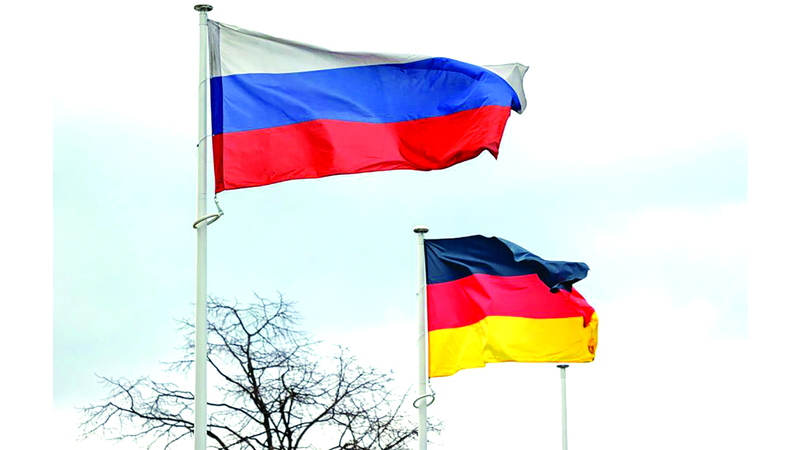
A new book titled “Versagen” (Failure) by authors Georg Mascolo and Katja Gloger will soon be published in Germany. The authors discuss what they describe as the “neglect by several successive German governments of early warnings about the aggressive approach of Russian President Vladimir Putin, and these governments’ continued reliance on the possibility of cooperation with Russia.”
The authors added that these governments also ignored warnings from German intelligence agencies, which had recommended a firm response to Russia’s annexation of Crimea in 2014, such as closing Russian consulates.
The authors quoted Thomas Haldenwang, former head of the German domestic intelligence agency (Federal Office for the Protection of the Constitution), saying: “A firm response should have been taken much earlier, but it always remained without real consequences. I never understood why the Russians were allowed to get away with so much. Every red line was crossed.”
Haldenwang also criticized the German state’s handling of the tangible threats against Russian opposition leader Alexei Navalny during his stay in Germany after being poisoned with the “Novichok” nerve agent. He said: “It was not a theoretical threat, but a very real threat to him, and we were very occupied with this matter. I wondered: what more could the German state tolerate?”
The book, which will be released this week, analyzes German policy towards Russia over past decades.
Wolfgang Ischinger, chairman of the Munich Security Conference Board of Trustees, commented: “It has long been necessary to conduct a comprehensive critical review of German policy towards Russia over recent decades.”
He added that the book is “an indispensable read for anyone interested in the hoped-for goals, illusions, and idealistic deviations in our foreign policy.”
The authors cover several milestones, starting from the background of Putin’s famous speech before the German parliament in 2001, which was widely welcomed at the time, through his “worrying” participation in the Munich Security Conference in 2007, up to the period following the Russian-Ukrainian war.
The authors note that even after the Munich speech in 2007, German government scenarios still assumed that the likelihood of Russia turning into an “imperialistic authoritarian state” was unlikely. They also quoted prominent German diplomat Emily Haber saying: “All indications show that Putin deceived us very early on, and many allowed themselves to be deceived by him.”
Thomas Haldenwang:
- I never understood why the Russians were allowed to get away with so much. Every red line was crossed.


Recommended for you
Al-Jaghbeer: The Industrial Sector Leads Economic Growth
Alternative to UNIFIL Forces
Egypt Post: We Have Over 10 Million Customers in Savings Accounts and Offer Daily, Monthly, and Annual Returns
Talib Al-Rifai Chronicles Kuwaiti Art Heritage in "Doukhi.. Tasaseem Al-Saba"
Exhibition City Completes About 80% of Preparations for the Damascus International Fair Launch
Trump Advisor: Disarming Hamas is Central.. Palestinian Authority to Take Over Gaza After Required Reforms