










Amid overwhelming joy, thousands of Gaza Strip residents returned to their homes today after the ceasefire agreement officially came into effect, in a scene filled with happiness and relief following weeks of tension and battles.
Eyewitnesses reported that families began gradually returning to the neighborhoods they had been displaced from, while civil defense and relief teams worked to assess damages and provide urgent humanitarian aid.
These developments coincide with the implementation of the Sharm El-Sheikh agreement, reached through Egyptian-Qatari-Turkish mediation and under the auspices of the United Nations and several international powers, described as a new beginning towards calm and stability in the Strip.
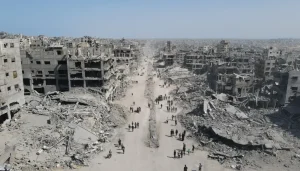
On Friday morning, large waves of Palestinian displaced persons began returning to northern Gaza following the ceasefire agreement between Israel and Hamas coming into effect, ending a war that lasted nearly two years and resulted in the deaths of more than 67,000 Palestinians.
The returning crowds streamed on foot towards Gaza City via Al-Rashid and Salah al-Din streets, carrying their children and what remained of their personal belongings, in a scene mixing joy, nostalgia, and sorrow over the destroyed homes. One returnee from Al-Nuseirat camp said, “There is no house, but we are coming back… the land is ours even if it is on top of the rubble.”
The Gaza Interior Ministry announced the deployment of security and police forces in areas from which the Israeli army withdrew, aiming to restore order and secure roads for civilian return.
This development is part of a comprehensive political agreement sponsored by the United States, Egypt, Qatar, and Turkey, forming the first phase of former US President Donald Trump’s plan to end the war. The current phase includes a comprehensive ceasefire, partial withdrawal of Israeli forces, prisoner exchanges, and opening crossings for humanitarian aid.
Meanwhile, the Israeli army announced it had begun repositioning its forces inside the Strip, confirming that “forces withdrew from city centers to eastern border sites,” preparing to implement the agreement’s terms and the return of hostages.
The army warned residents via official statements to avoid approaching the areas of Beit Hanoun, Beit Lahia, Al-Shujaiya, Khan Younis, and Rafah crossing, as these remain dangerous zones.
Israeli Prime Minister Benjamin Netanyahu confirmed his government will monitor Hamas’s implementation of disarmament clauses, noting that any violation will be met with a firm response.
US envoy Steve Witkoff explained that the Israeli army completed the first phase of its withdrawal, starting a 72-hour period before the prisoner exchange begins, according to the US Department of Defense.
In this context, Qatari Prime Minister and Foreign Minister Sheikh Mohammed bin Abdulrahman Al Thani praised the agreement’s entry into force, describing it as “a first step towards ending an unprecedented humanitarian tragedy,” affirming Qatar’s commitment to its humanitarian and diplomatic duties towards the Palestinian people.
The United Nations and international humanitarian organizations called for the full reopening of crossings to ensure the flow of aid to residents. UNRWA spokesperson Juliet Touma said relief efforts would not have continued without the work of about 12,000 Palestinian staff in the agency despite the Israeli boycott.
The International Committee of the Red Cross emphasized the necessity of carrying out prisoner releases “safely and with dignity,” urging all parties to facilitate humanitarian aid access to all areas without delay.
Despite the atmosphere of relief, questions remain about the future governance of the Strip and the next phases of the agreement, but many Gaza residents see the most important thing today is that the sounds of artillery have ceased and they are walking back to their homes—even if under rubble.



Recommended for you
Al-Jaghbeer: The Industrial Sector Leads Economic Growth
Egypt Post: We Have Over 10 Million Customers in Savings Accounts and Offer Daily, Monthly, and Annual Returns
Alternative to UNIFIL Forces
Talib Al-Rifai Chronicles Kuwaiti Art Heritage in "Doukhi.. Tasaseem Al-Saba"
Exhibition City Completes About 80% of Preparations for the Damascus International Fair Launch
Trump Advisor: Disarming Hamas is Central.. Palestinian Authority to Take Over Gaza After Required Reforms