









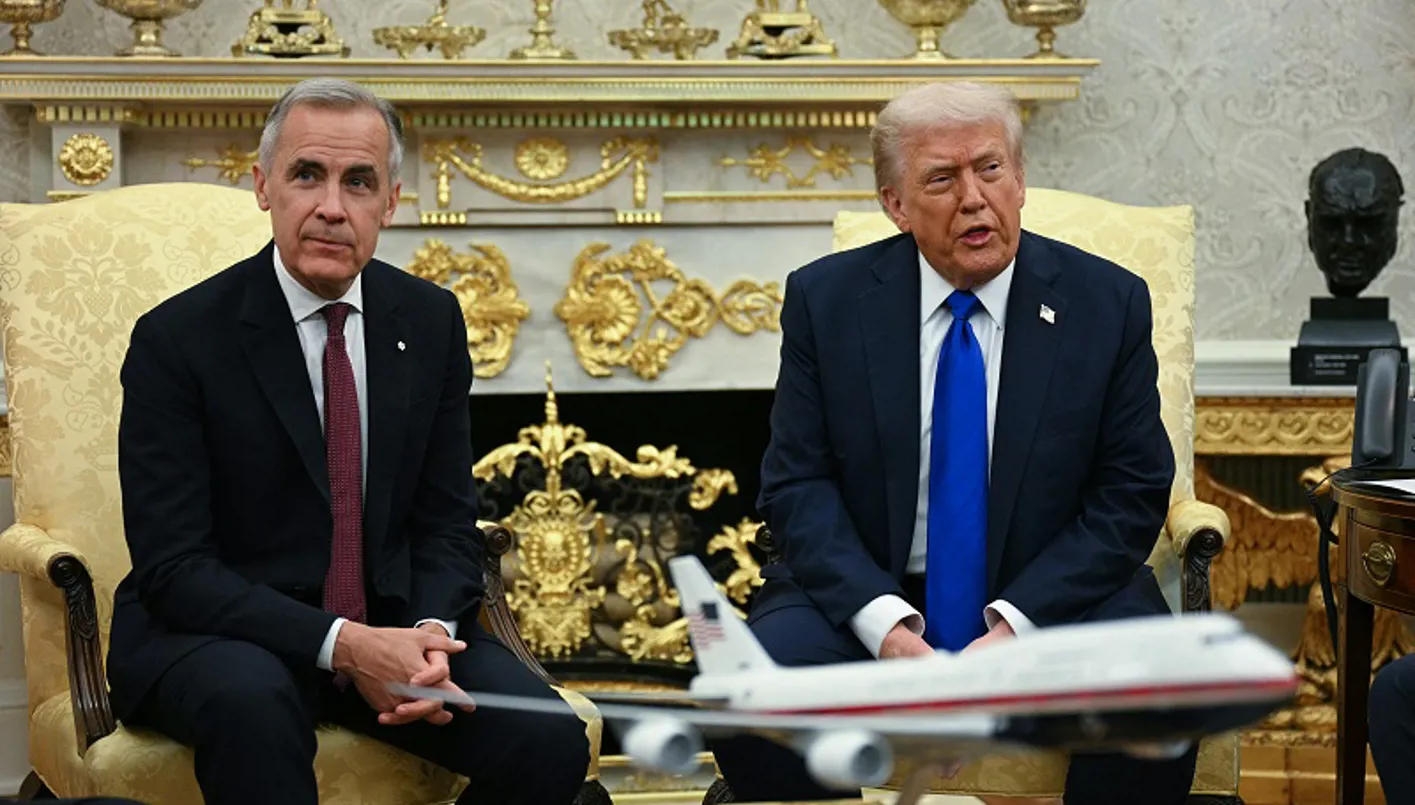
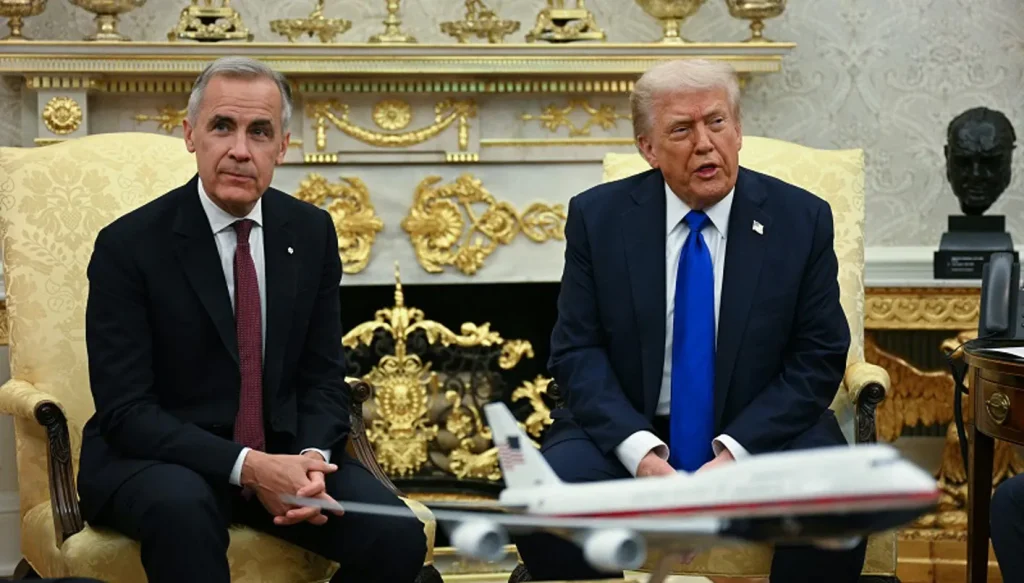
In a visit marked by caution and diplomacy, Canadian Prime Minister Mark Carney sought to ease tensions with U.S. President Donald Trump and win his favor, while the outcome of the meeting remained unclear, revealing the deep current disagreements between the traditional allies.
Carney left nothing to chance when packing for his Washington visit this week, including his tie. He told Trump, “I wore red for you,” referring to the tie symbolizing the U.S. Republican Party.
After months of trade disputes and largely unsuccessful attempts to neutralize Trump’s threats to annex Canada, Carney continues to seek alignment with the U.S. president.
Carney’s visit goals were clear: to soften the tone of his first meetings with Trump, avoid implying Canada would become the 51st state, and start talks on tariffs.
CNN reported that Carney made some initial progress. He entered talks on Tuesday amid modest expectations that he could convince Trump to ease high tariffs on Canadian goods, including steel, aluminum, cars, and lumber. He left after receiving assurances from Trump that his delegation “would leave happy.”
At the end of the meeting, Canadian officials expressed satisfaction with the change in tone and said they now expect progress on tariffs on steel, aluminum, and energy, which reach up to 50 percent. Although they left without tangible results beyond a commitment to negotiate, the change in tone, rather than tariff rates, was their primary goal, according to The New York Times.
Canada is now the only G7 member without a trade deal to avoid punitive tariffs, which negatively impact the Canadian economy and Carney’s political standing.
Since taking office last spring, Carney has walked a tightrope with Trump. He tried to soften the harsh stance of his predecessor Justin Trudeau, who called Trump’s tariffs “very stupid” and accused him of appeasing Russian President Vladimir Putin.
Carney exchanged text messages with Trump on global affairs and has so far avoided sharp criticism. At the same time, he firmly opposed Trump’s regional ambitions, telling him during their first Oval Office meeting in May that Canada “is not for sale.”
On Tuesday, Carney praised his host’s foreign policy savvy, listing conflicts Trump successfully intervened to resolve. He described Trump as a “transformational president,” then mentioned conflicts between India and Pakistan, Azerbaijan and Armenia, before concluding with Trump’s recent efforts to mediate peace in Gaza.
Trump, meanwhile, again suggested Canada would be much better off as part of the United States, although he only hinted at this idea when discussing how to remove car tariffs. He said the two countries were in a “natural conflict” and described Carney, the former central bank governor of England and Canada, as a “nice guy who can be very bad.”
Trump seemed to realize he has much work to repair relations. In what appeared to be an acknowledgment of his poor reputation north of the border, he told reporters, “The people of Canada will love us again,” and predicted Canadians would travel to the U.S. again after a trade deal is reached.
Trump’s talk of making Canada the 51st state to avoid tariffs angered Canadians, who canceled trips to the U.S. in large numbers. According to the Canadian National Statistics Office, Canadian visits to the U.S. dropped by 23% in the first seven months of the year compared to the same period in 2024, according to the Associated Press.
North American Trade Agreement
Carney seeks to preserve and improve the North American trade agreement ahead of its review next year. Trump expressed hesitation about the agreement, hinting at possible alternative deals with Canada and Mexico.
Despite Canada’s growing concern about the agreement’s future, which is vital for its exports, Carney preferred to avoid public confrontation during his meeting with Trump. While Trump hinted at renegotiation, uncertainty surrounds the agreement’s fate, especially with ongoing tariffs affecting sensitive Canadian sectors.
Despite the lack of tangible results, Carney’s visit was seen as a step toward easing tensions. The Canadian delegation left with a better impression, while unresolved issues remain open. The calmer tone itself appears to be a gain in a relationship marked by political friction.



Recommended for you
Al-Jaghbeer: The Industrial Sector Leads Economic Growth
Alternative to UNIFIL Forces
Egypt Post: We Have Over 10 Million Customers in Savings Accounts and Offer Daily, Monthly, and Annual Returns
Talib Al-Rifai Chronicles Kuwaiti Art Heritage in "Doukhi.. Tasaseem Al-Saba"
Exhibition City Completes About 80% of Preparations for the Damascus International Fair Launch
Trump Advisor: Disarming Hamas is Central.. Palestinian Authority to Take Over Gaza After Required Reforms