






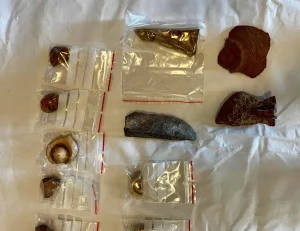



The Egyptian Museum’s collections include jewelry that adorned the hands and feet of the mummy of Psusennes I, consisting of golden remnants for the fingers and toes. Each finger is decorated with a thin ring bearing one of his royal names. These artifacts date back to the 21st Dynasty during the reign of Psusennes I (circa 1039-991 BC).
This pharaoh was the second king of Egypt during the 21st Dynasty. He experienced an unfortunate event reminiscent of that which befell Pharaoh Tutankhamun—the recent discovery of his tomb found intact. However, this discovery brought him from obscurity to fame due to the furniture found with him, which also disturbed his eternal rest, as happened with other Egyptian kings whose mummies were uncovered, according to Selim Hassan’s Encyclopedia of Ancient Egypt.
Selim Hassan states that he will first discuss Psusennes from a historical perspective, then describe his recently discovered tomb.
Psusennes had two wives, both daughters of “Smendes,” who were either his half-sisters from both parents or just from his father. The first was named “Isetemkheb,” whose name was combined with the town of Khabait where “Hor Khabait,” son of a high Delta minister, was born. The second wife was a devotee of Hathor, Lady of the Two Lands, better known than the first; she was the daughter of Tentamun, Smendes’ wife when he was still a minister. Her titles included: daughter, wife, royal mother, divine adoratrice of Amun, priestess of the goddess Mut, and mother of the child god Khonsu.
These titles reflect a unique devotion to Amun, his consort, and their son (the Theban triad). Her husband shared her sentiments entirely; when he was appointed High Priest of Amun, this title appeared on his cartouches. The inscriptions and titles engraved on his jewelry, staffs, and vessels demonstrate his devoted loyalty to the goddess Mut. In his tomb, a gold cup was found that had been gifted by Pinedjem, the High Priest and son of Piankhi.
This indicates that the two dynasties ruling the country maintained excellent relations and peace. However, it is noted that King Psusennes ruled Upper Egypt and its countryside entirely. His titles clearly indicate this; his throne name means “the brave bull, the gift of Amun,” the wealthy one appearing in Thebes, and his emblematic name symbolized by the vulture and the sed festival is “Great of monuments in Luxor.” His coronation name was straightforward: High Priest of Amun or Akheperre, and his emblematic name was Pasebakhaenut, meaning “the star appearing in the city” (i.e., Thebes). His activities were particularly notable in Tanis, where he repaired the royal enclosure walls that had been breached during recent wars.




Recommended for you
Al-Jaghbeer: The Industrial Sector Leads Economic Growth
Alternative to UNIFIL Forces
Egypt Post: We Have Over 10 Million Customers in Savings Accounts and Offer Daily, Monthly, and Annual Returns
Talib Al-Rifai Chronicles Kuwaiti Art Heritage in "Doukhi.. Tasaseem Al-Saba"
Exhibition City Completes About 80% of Preparations for the Damascus International Fair Launch
Trump Advisor: Disarming Hamas is Central.. Palestinian Authority to Take Over Gaza After Required Reforms