









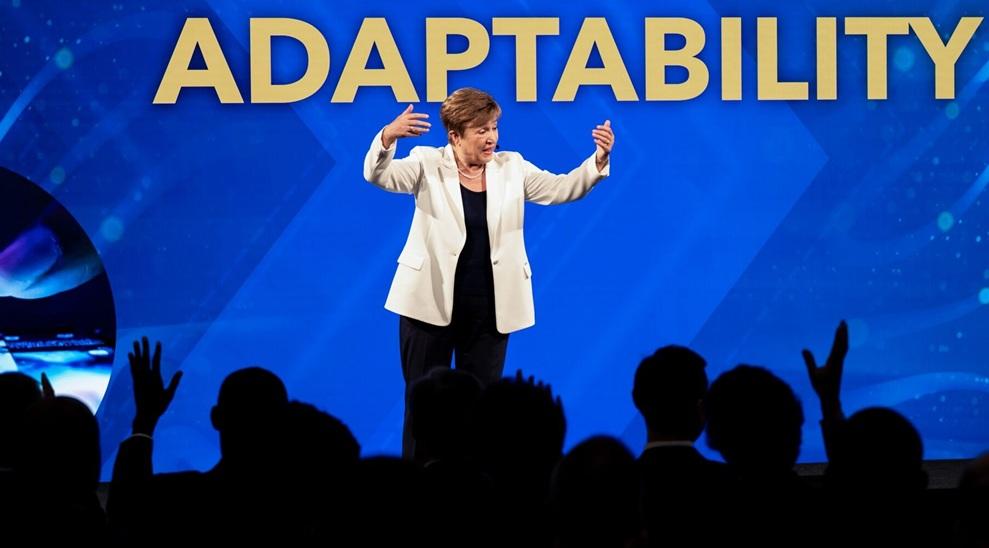
IMF Managing Director Kristalina Georgieva revealed on Wednesday that the global economy is “in better shape than feared” but still insufficient, warning of a “severe correction” in stock prices related to companies developing artificial intelligence whose “market capitalization is heading to levels unseen for 25 years” since the internet bubble.
In her opening remarks for the IMF and World Bank annual meetings scheduled next week, Georgieva affirmed that the global economy “has generally withstood sharp tensions” and is “better than feared but worse than it should be.”
Global growth is expected to be “around 3% in the medium term,” consistent with rates in recent years but below the “3.7% rate before the COVID-19 pandemic,” according to Georgieva quoting data from the IMF’s new annual World Economic Outlook report to be released Tuesday.
She reminded that in April many experts, excluding the IMF, predicted a short-term recession in the United States with negative repercussions globally. However, the US economy held firm, as did several advanced and emerging economies.
Factors preventing deterioration included lower-than-expected US tariffs, despite the US imposing some of the highest tariffs on imports, favorable financial conditions for economic activity, an adaptable private sector, and solid political foundations.
Despite economic resilience, warning signs are mounting, including “rising global demand for gold” and inflation risks due to tariffs, Georgieva said.
The IMF chief expressed concern that financial market confidence could “suddenly reverse,” potentially depriving companies of necessary funding.
She also warned of a “severe correction” in stock prices for AI-related companies, whose “market capitalization is reaching levels not seen in 25 years” since the internet bubble.
Given these risks, Georgieva called on countries to preserve global trade as a “growth engine” and invest in “sustainable growth” based on informed decisions.
She urged countries to “put their domestic affairs in order,” especially by reinstating fiscal margins to face future shocks and “putting an end to excessive imbalances” such as overconsumption in the US and excessive investment in China.
Global public debt continues to rise and could reach 100% of global GDP by 2029, driven mainly by the US, China, and European countries amid shrinking bond markets and sharply rising borrowing in countries like Japan, France, and the UK.
Georgieva warned of consequences including “rising interest rates and increased borrowing costs that affect other expenditures and limit governments’ ability to respond to shocks.”
She stressed the necessity of “fiscal correction in both rich and poor countries,” acknowledging the difficulty due to social tensions but affirming that with well-organized, informed approaches, deficits can be significantly reduced.




Recommended for you
Al-Jaghbeer: The Industrial Sector Leads Economic Growth
Egypt Post: We Have Over 10 Million Customers in Savings Accounts and Offer Daily, Monthly, and Annual Returns
Alternative to UNIFIL Forces
Talib Al-Rifai Chronicles Kuwaiti Art Heritage in "Doukhi.. Tasaseem Al-Saba"
Exhibition City Completes About 80% of Preparations for the Damascus International Fair Launch
Unified Admission Applications Start Tuesday with 640 Students to be Accepted in Medicine