








Minister of Social Development, Wafaa Bani Mustafa, affirmed that placing the social protection sector at the heart of the comprehensive modernization process was a direct response to the directives of His Majesty King Abdullah II, reflecting His Majesty’s belief in this sector as a fundamental lever to empower individuals and communities to actively participate in the national production cycle.
She stated that the royal directives included in the Supreme Commissioning Letter to Dr. Jafar Hassan’s government granted the social protection sector a primary and pivotal position in the economic modernization vision, as this sector serves as a safety valve for families and the most vulnerable groups. The government committed to launching the National Social Protection Strategy for 2025-2033 earlier in May.
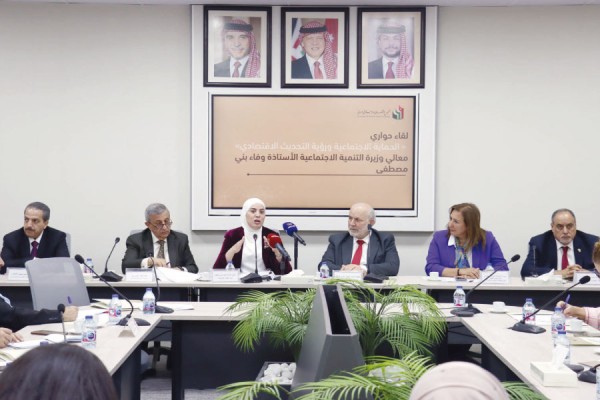
This came during a dialogue held by the Economic and Social Council titled “Social Protection and the Economic Modernization Vision” on Wednesday, as part of a series of dialogues conducted by the council on the executive plans for the economic, administrative, and political modernization visions for 2025-2029.
She emphasized that the vital interconnection between economic and social policies is not merely an option but a strategic necessity to ensure social justice, citizen dignity, and quality of life.
Bani Mustafa also affirmed that Jordan’s social protection system is not a burden on the budget but a strategic national investment in the citizen and their future, and it is a fundamental pillar for achieving social stability that paves the way for sustainable economic growth.
She explained that the National Social Protection Strategy aligns with the three reform tracks: political, economic, and administrative, and is reinforced by linking the strategy with the economic modernization vision.
She pointed out that the strategy underwent extensive national consultations with various relevant entities and sectors, in addition to holding dialogue sessions in all governorates of the kingdom to reach a consensual strategy that achieves the desired goals in social protection.
The ministry, in cooperation with partners, continues its efforts to establish an integrated, effective, and flexible social protection system capable of responding to changing needs and translating strategic goals into tangible executive programs.
Bani Mustafa indicated that the social protection sector has witnessed a strategic transformation in recent years, gradually shifting from the care and relief model to the empowerment and sustainable development model. This was manifested through expanding housing alternatives for persons with disabilities, launching active aging programs via day clubs for the elderly, launching the unified social registry, activating electronic services and early warning systems to ensure protection systems respond to crises, in addition to the gradual transition to productive programs empowering and training families of the National Aid Fund, and improving social security services to enhance economic participation, especially for women.
She noted that the social protection strategy is based on four main pillars: “Dignity,” focusing on coordinated social assistance programs and inclusive services; “Empowerment,” enhancing economic empowerment and comprehensive healthcare; “Opportunity,” aiming to provide decent job opportunities and effective labor market programs; and “Resilience,” focusing on strengthening the protection system’s response to crises and shocks.
The executive plan for the strategy includes a package of initiatives, including launching the unified social registry, enhancing the “Takaful Plus” program, expanding development centers and “Makani” centers, and institutionalizing social work.
She pointed to tangible achievements within the strategy framework, most notably the establishment of the unified cash support program, improving targeting mechanisms, issuing the Social Development and Child Rights laws, enhancing alternative care and school feeding programs, launching the “Himaya” platform to receive labor complaints, and developing the national employment program to encourage the private sector to provide job opportunities.
Jordan is among the first countries to issue regulations organizing the professionalization of social work and granting licenses to practitioners.
Regarding the progress of the strategy’s implementation, she indicated the completion of developing reference documents and work mechanisms required to implement the strategy, such as the executive plan, monitoring and evaluation plan with an electronic system, communication plan, sharing these documents with concerned parties for final review and approval, and starting to staff the monitoring and evaluation unit within the Ministry of Social Development with the required expertise to implement the strategy.
Strategy activities have been included in the general budgets of institutions, and the priorities of the executive plan have begun implementation, including launching an awareness campaign, creating a unified page on social protection, and completing the preparatory phase of the capacity-building project and enhancing communication mechanisms.
The ministry has started implementing initiatives to enhance access to early childhood services, promote women’s economic participation, execute a joint project with the National Center for Security and Crisis Management on crisis-responsive social protection, in addition to initiatives to enhance the participation of associations and civil society institutions, preparing instructions for accrediting social work training programs and providers, enhancing services provided by development centers and “Makani” centers affiliated with the Ministry of Social Development, launching the tender for the unified social registry, one of the most prominent enablers within the updated strategy, and enhancing the “Takaful Plus” program implemented by the National Aid Fund and partners.
The minister noted that the strategy committee and its subcommittees and pillar teams will hold meetings to follow up on implementation, meetings with donors and partners to support strategy activities, coordination meetings on the monitoring and evaluation framework, and training sessions to ensure activating the electronic system for monitoring strategy implementation and completing awareness campaign activities.
She also confirmed ongoing coordination with institutions within the stages of the public budget cycle to ensure the inclusion of allocations for activity implementation within the general budget projects for 2025-2028, and preparing quarterly reports through the strategy monitoring unit on the progress of implementation.
For his part, Dr. Mousa Shtayyeh, Chairman of the Economic and Social Council, in the presence of Motaz Abu Roman, Chairman of the Parliamentary Labor, Social Development and Population Committee, Haider Murad, Chairman of the Labor and Social Development Committee in the Senate, and several committee members and council groups, said the meeting comes as a continuation of a series of dialogue sessions held by the council with several partners and institutions in the public and private sectors concerned with implementing the economic modernization vision, supporting government efforts aimed at reinforcing the executive program of the vision for 2026-2029.
Shtayyeh emphasized the importance of social protection in providing a safety net for citizens as a fundamental pillar to achieve sustainable social development, explaining that it is a living embodiment of the state’s and society’s commitment to ensuring a decent life for community members, especially the poorest or those at risk of poverty and marginalization.
He pointed to the role of social protection in reducing poverty and hardship, providing support means to face potential risks such as illness and aging, confirming its clear contributions to enhancing economic stability and sustainability, and the growth and prosperity of society.




Recommended for you
Al-Jaghbeer: The Industrial Sector Leads Economic Growth
Alternative to UNIFIL Forces
Egypt Post: We Have Over 10 Million Customers in Savings Accounts and Offer Daily, Monthly, and Annual Returns
Talib Al-Rifai Chronicles Kuwaiti Art Heritage in "Doukhi.. Tasaseem Al-Saba"
Exhibition City Completes About 80% of Preparations for the Damascus International Fair Launch
Trump Advisor: Disarming Hamas is Central.. Palestinian Authority to Take Over Gaza After Required Reforms