









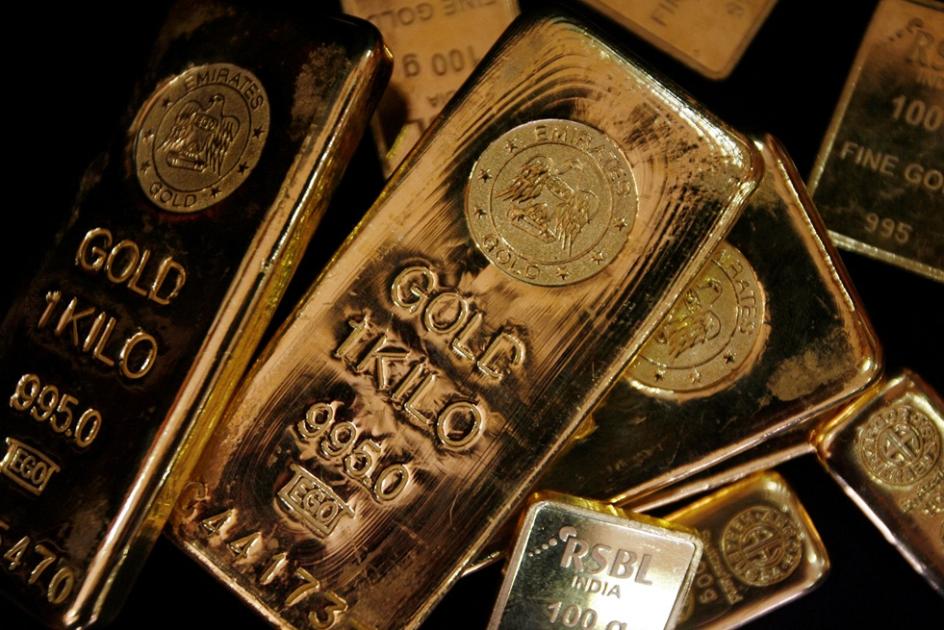
Gold reached a new record level just below $4000 per ounce amid the ongoing U.S. government shutdown and volatility in tech stocks, which boosted investors’ interest in other assets.
After rising 0.6% in the previous session, the spot gold price reached $3992.27 per ounce in midweek trading, up 0.1% on Wednesday morning. Gold rose in spot trading on Tuesday to a high of $3988.59.
December gold futures also increased 0.34% to $4,017.90, after surpassing $4000 for the first time on Tuesday and reaching a peak of $4,011.30.
The U.S. government shutdown delayed key data releases, negatively impacting expectations for Federal Reserve interest rate cuts, while political crisis in France and leadership changes in Japan added to uncertainty.
Gold prices have risen more than 51% this year, as former President Donald Trump made changes in the trade and geopolitical landscape, pushing prices toward the biggest annual gain since 1979.
Central banks have been enthusiastic buyers, while last month’s Federal Reserve rate cuts encouraged investors to invest in gold-backed ETFs, with September recording the strongest monthly inflows ever, according to the World Gold Council.
Data from the People’s Bank of China showed the central bank continued buying gold in September for the eleventh consecutive month.
Goldman Sachs raised its December 2026 gold price forecast to $4900 per ounce from $4300 on Monday.
Peter Grant, Vice President and Chief Metals Expert at Zaner Metals, said, “There are ongoing flows into safe-haven assets partly due to the U.S. government shutdown and no clear sign of a near-term resolution. Therefore, there remains strong demand for gold.”
Gold prices, which do not yield income, typically rise during periods of low interest rates and economic uncertainty.
Gold prices rose supported by several factors, including expectations of rate cuts, ongoing political and economic uncertainty, strong central bank purchases, inflows into gold-backed ETFs, and a weaker dollar.
The ongoing government shutdown, now in its seventh day, delayed key economic indicators, pushing investors to rely on secondary non-government data to assess the timing and size of U.S. rate cuts.
Investors now expect a 25 basis point rate cut at this month’s Federal Reserve meeting, followed by another cut of the same size in December.



Recommended for you
Al-Jaghbeer: The Industrial Sector Leads Economic Growth
Alternative to UNIFIL Forces
Egypt Post: We Have Over 10 Million Customers in Savings Accounts and Offer Daily, Monthly, and Annual Returns
Talib Al-Rifai Chronicles Kuwaiti Art Heritage in "Doukhi.. Tasaseem Al-Saba"
Exhibition City Completes About 80% of Preparations for the Damascus International Fair Launch
Trump Advisor: Disarming Hamas is Central.. Palestinian Authority to Take Over Gaza After Required Reforms