




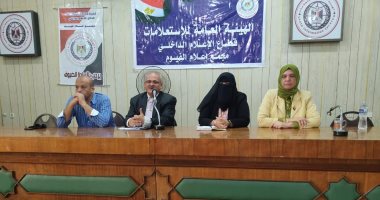
Today, the Fayoum Media Complex, affiliated with the Internal Media Sector of the General Authority for Information, in cooperation with the Population Unit of the governorate, held an extensive meeting titled “Financial Inclusion and Supporting Women’s Economic Empowerment.” This was part of the population media axis of the Internal Media Sector’s strategy, under the patronage of journalist Dr. Diaa Rashwan, head of the authority, and the supervision and guidance of Dr. Ahmed Yehia, head of the Internal Media Sector.
The meeting, held in the conference hall of the complex, was attended by many representatives from service directorates, women’s and youth departments, including Engineer Abeer Abdel Moneim, director of the Population Unit in the governorate, Mohamed Hashem, director of the complex, Hanan Hamdy, program coordinator at the complex, Hany Nabil from the Small Projects Development Agency, representatives of Banque Misr in Fayoum, and the Good Makers Foundation.
The meeting began with an opening speech by Hanan Hamdy, emphasizing the importance of activating partnerships and cooperation between Fayoum Media Complex and all institutions to support sustainable development issues and enhance the capabilities of women and youth in economic empowerment and entrepreneurship. She stressed the importance of benefiting from national initiatives aimed at improving quality of life.
Mohamed Hashem highlighted the active role of the Internal Media Sector through media complexes nationwide in raising awareness, education, skill development, and enhancing communication with all partners to explain national issues and clarify the state’s vision and direction in achieving economic, social, and political development. He confirmed coordination and cooperation among all institutions.
Engineer Abeer Abdel Moneim introduced the Population Unit in Fayoum Governorate, established in 2021 by the Ministry of Local Development, which works on several axes including education, health, investment in human capital, supporting women’s roles, economic empowerment, and sustainable development.
She pointed out that the economic empowerment and financial inclusion initiative, launched in Fayoum during its second phase, aims to support small projects and achieve economic development for all groups, especially women and youth. It also contributes to obtaining financial funding for these projects in cooperation with the Good Makers Foundation and Banque Misr, as well as supporting entrepreneurship programs. The initiative targets expanding to all villages in the governorate by identifying problems and providing solutions in cooperation with relevant authorities. She noted that the Population Unit cooperates with all entities to solve citizens’ problems in Fayoum.
The services provided through this initiative, whether financial or technical, were explained in detail, in cooperation with partner entities. The concept of financial inclusion and the importance of digital transformation in financial dealings via Visa cards or digital applications were introduced, aiming to reduce manual cash transactions to facilitate citizens’ dealings.
Banque Misr, as a main partner in the initiative, was introduced for its services supporting small projects and the “Mashrouak” program in cooperation with the Ministry of Local Development. The program finances projects ranging from 30,000 to 80,000 Egyptian pounds, with the possibility of increasing the funding to 150,000 pounds if the project succeeds and continues. The procedures for obtaining financing require a personal ID and a first-degree relative as guarantor, provided the project is active.
Procedures and guarantees for projects with commercial registration and tax card were also presented, with financing ranging from 150,000 to 400,000 pounds, emphasizing the importance of project continuity and success.
During his speech, Hany Nabil highlighted the significant role of the Small Projects Development Agency in supporting small, medium, and micro projects. He detailed how to obtain the necessary financing for small projects and the required procedures. He confirmed that the agency provides technical support through training and guidance if there is no existing project but a desire to establish one. He noted that the agency’s entrepreneurship unit offers technical support and training necessary to establish successful projects contributing to the country’s economic development.
In conclusion, attendees emphasized the state’s interest in achieving economic empowerment for targeted groups of women and youth, activating entrepreneurship programs, and recommended the necessity of training on how to establish a project, studying market needs, and the importance of having permanent exhibitions for small project products.

Recommended for you
Al-Jaghbeer: The Industrial Sector Leads Economic Growth
Alternative to UNIFIL Forces
Egypt Post: We Have Over 10 Million Customers in Savings Accounts and Offer Daily, Monthly, and Annual Returns
Talib Al-Rifai Chronicles Kuwaiti Art Heritage in "Doukhi.. Tasaseem Al-Saba"
Exhibition City Completes About 80% of Preparations for the Damascus International Fair Launch
Trump Advisor: Disarming Hamas is Central.. Palestinian Authority to Take Over Gaza After Required Reforms