







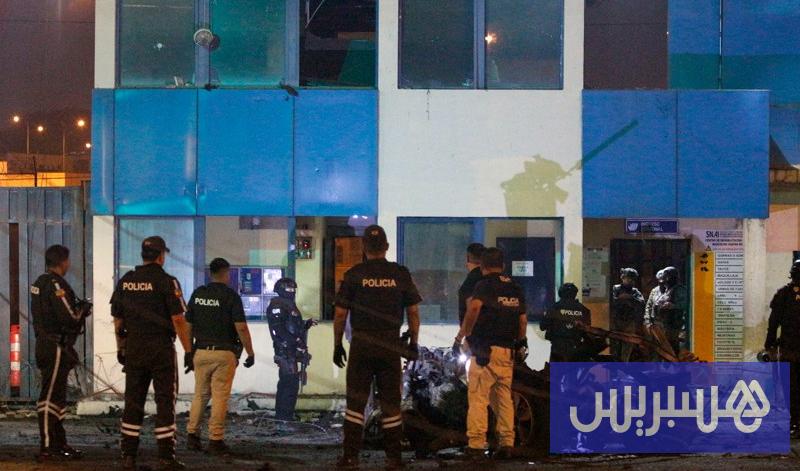
One person was killed and 17 soldiers were taken hostage following violent clashes on Sunday between protesters and authorities in northern Ecuador.
The army fired “three times” at Efrain Fuertes, who died in a hospital in Cotacachi, about 100 kilometers north of Quito, according to CONAIE, the country’s largest indigenous organization.
Neither the police nor the Ecuadorian armed forces have commented on the incident.
Earlier this month, President Daniel Noboa announced a reduction in fuel subsidies, a measure he said would save the state $1.1 billion.
The move caused diesel prices to rise from about $1.80 per gallon to $2.80 (48 to 74 cents per liter) in a country where about a third of the population lives in poverty.
CONAIE said, “We hold Daniel Noboa responsible and demand an immediate investigation and justice for Efrain and his community,” adding that Fuertes was “a father of two and the backbone of his family.”
Photos circulating on social media showed two men on the ground, one appearing injured while the other tried to help him, moments before soldiers emerged from a tank and kicked them.
Another human rights organization, INREDH, was the first to announce the death and said another person was seriously injured and remains “in critical condition.”
The Ecuadorian Attorney General’s office said it would open an investigation into the “alleged killing.”
Hours later in the same town, the Ecuadorian armed forces accused protesters of injuring 12 soldiers and taking 17 others hostage, stating on X that the soldiers “were escorting a food convoy” and “were ambushed violently by terrorist groups that infiltrated Cotacachi.”
The post included images of bloodied soldiers and a video showing one soldier facing dozens of attackers, some armed with sticks, heard saying, “Don’t hit me.”
Ecuador’s Interior Minister, Zaida Rivera, said on X that “what happened in Cotacachi was not a protest, it was a cowardly ambush carried out by criminal – terrorist – groups that attacked our armed forces.”
Noboa has struggled to quell the protests, declaring a state of emergency on September 16 in eight of the country’s 24 provinces, imposing a nightly curfew in five of them, accusing the “Tren de Aragua” gang of being behind the protests, and warning that protesters who break the law “will face terrorism charges and be imprisoned for 30 years.”
CONAIE, which called for an open-ended national strike, led violent protests that toppled three presidents between 1997 and 2005.
Indigenous people make up about eight percent of Ecuador’s 17 million population, according to the latest census.
Community leaders say the real figure is closer to 25 percent.

Recommended for you
Al-Jaghbeer: The Industrial Sector Leads Economic Growth
Alternative to UNIFIL Forces
Egypt Post: We Have Over 10 Million Customers in Savings Accounts and Offer Daily, Monthly, and Annual Returns
Talib Al-Rifai Chronicles Kuwaiti Art Heritage in "Doukhi.. Tasaseem Al-Saba"
Exhibition City Completes About 80% of Preparations for the Damascus International Fair Launch
Trump Advisor: Disarming Hamas is Central.. Palestinian Authority to Take Over Gaza After Required Reforms