



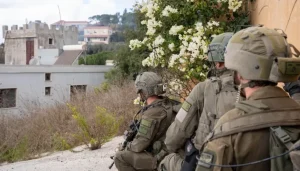




The Israeli army announced that five soldiers were seriously injured due to an explosive device north of the Gaza Strip.
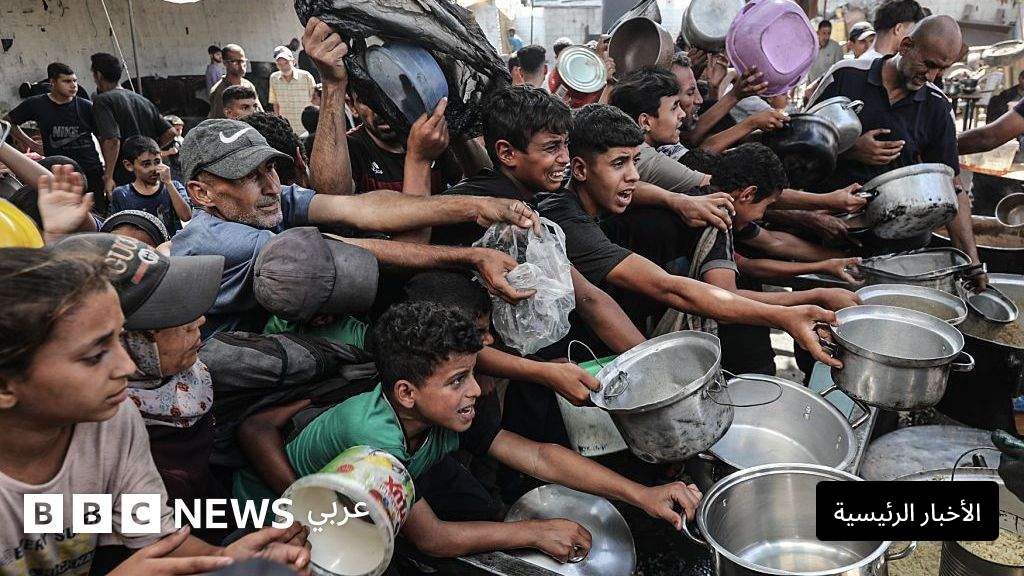
Meanwhile, residents of northern Gaza suffer from a severe shortage of food supplies, which, if available, are sold at high prices after many traders fled to the southern part of the Strip.
A resident in northern Gaza told BBC that she wants to stay in the north and not to relocate, but struggles to find food to buy.
She explained, “Today I want to buy a kilo of flour, so I will travel a long distance to get it, if it exists at all… We want to buy canned food and rice to have something to eat, and we want to charge our mobile phones, but unfortunately most shops have closed and prices have become very high.”
Iman from Gaza city in the north said she and her family still live there, noting that “food supplies in Gaza city are no longer as available as before; they have gradually decreased and now are unavailable, such as cheese and powdered milk… Only a few food items remain that we can eat to get some energy to resist and survive.”
Mohammed Abdullah from the north said, “The traders’ displacement from the north to the south and the closure of the Zikim crossing, which used to bring goods into northern Gaza, worsened the situation.”
Meanwhile, Reuters reported that two injured people were transferred to Al-Shifa Hospital in Gaza City on Monday following Israeli airstrikes that produced smoke columns over the city.
Palestinian paramedics said the Israeli army killed at least 18 people across Gaza on Monday, most of them in Gaza City.
Israeli tanks advanced to within hundreds of meters of Al-Shifa Hospital, where doctors say hundreds of patients are still receiving treatment despite Israeli orders to evacuate, according to the agency.
Health ministry officials said tanks also surrounded the area around Al-Helo Hospital nearby, which shelters 90 patients, including at least 12 infants in incubators. Paramedics reported the hospital was shelled on Sunday night.
Paramedics told Reuters the site was shelled, and video obtained by the agency showed hospital rooms and beds scattered with debris.
Ricardo Perez, UNICEF spokesperson, told Reuters: “It is time to move them because Gaza City has become a combat zone again, but where do we move them? There is no safe place for them.”
One child was receiving treatment on a bed inside Al-Shifa Hospital without a mattress.
Many overcrowded Gaza hospitals have been attacked and damaged and are facing shortages of medicines.
Israel launched one of the largest attacks in the war this September, a comprehensive assault on Gaza City, with Prime Minister Benjamin Netanyahu stating the aim is to “eliminate Hamas in its last strongholds.”
On the ground, Adnan Abu Hasna, media advisor to the United Nations Relief and Works Agency for Palestine Refugees (UNRWA), warned that conditions in Gaza City are heading towards what he described as a “major humanitarian tsunami,” calling the scene “a state of madness.”
Abu Hasna told BBC that nearly half a million people remain trapped inside the city “in an area no larger than eight square kilometers,” amid a total collapse of the humanitarian system, including health, relief services, and basic infrastructure.
He pointed out that UNRWA aid trucks outside Gaza are prevented from entering, while the agency suffers a financial deficit estimated at $200 million, threatening to reduce its operations across all its areas of work.
Abu Hasna explained that the Israeli army continues to advance inside the city, while dozens of families remain trapped “on small islands” from which it is difficult to escape “without severe risk to their lives.”
Regarding the southern Strip, he noted that 1.2 million people already live in an area no larger than 35 square kilometers, warning that “pushing about another million people into the area will make each square kilometer hold 70,000 people.”
He confirmed that “famine has also spread from Gaza to the central and southern areas with the displaced,” stressing that the entire humanitarian system “is collapsing,” and that the number of trucks entering the Strip “has dramatically decreased to just a few dozen.”
He concluded: “There is now a state of illogicality, a state of madness in Gaza. Trucks are outside the Strip and are not allowed to enter, while people are in the streets, and the health and humanitarian systems are completely collapsed.”


Recommended for you
Al-Jaghbeer: The Industrial Sector Leads Economic Growth
Egypt Post: We Have Over 10 Million Customers in Savings Accounts and Offer Daily, Monthly, and Annual Returns
Alternative to UNIFIL Forces
Talib Al-Rifai Chronicles Kuwaiti Art Heritage in "Doukhi.. Tasaseem Al-Saba"
Exhibition City Completes About 80% of Preparations for the Damascus International Fair Launch
Trump Advisor: Disarming Hamas is Central.. Palestinian Authority to Take Over Gaza After Required Reforms