




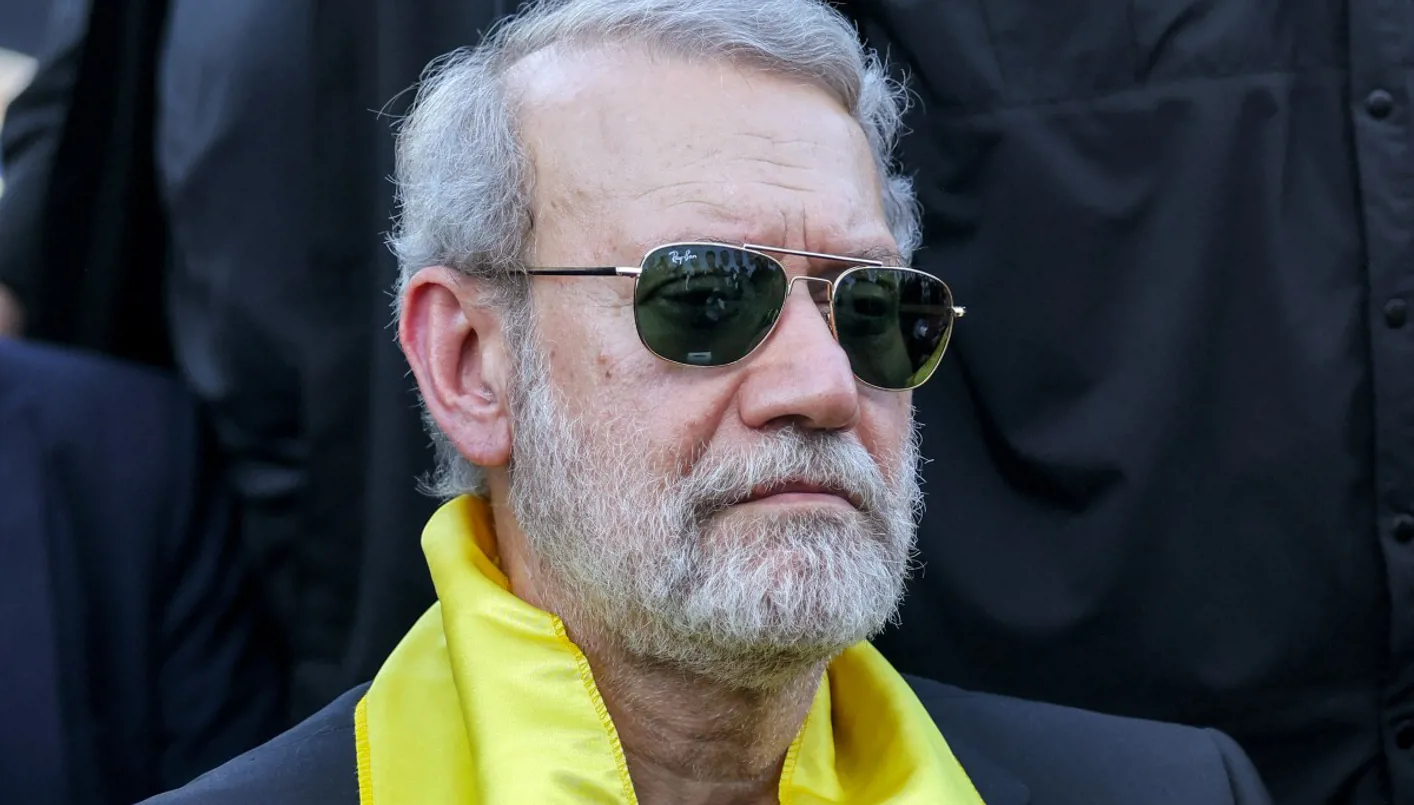
Larijani participating in Nasrallah’s commemoration. (AFP)
Amid the Lebanese government’s attempt to contain Hezbollah and work on disarming it, due to the impact this has on the state’s status, reconstruction attractiveness, investment, and diplomacy, the Supreme Leader of the Islamic Republic, Ali Khamenei, appeared via a speech delivered on his behalf at the celebration held by Hezbollah on the anniversary of the assassination of Aminieh Al-Amin and the two years of Hassan Nasrallah and Hashim Safi al-Din, to inform everyone that Iran supports the party “with all it has.” Thus, Khamenei crowned the supportive stances towards Hezbollah’s military wing issued by hardline figures in Iran, foremost among them the Iranian Revolutionary Guard and Parliament Speaker Mohammad Bagher Ghalibaf.
This position by Khamenei came just hours after Lebanese Prime Minister Nawaf Salam informed the Secretary-General of the Iranian Supreme Council, Ali Larijani, of his objection to Iranian interference in favor of Hezbollah at the expense of the government decision. Larijani himself informed Hezbollah’s Deputy Secretary-General Sheikh Naim Qassem, after meeting Salam, that Iran is present at all levels of support.
Iran “does not joke” in the path of boosting Hezbollah’s morale; it needs all its cards, regardless of its condition, at this stage more than any future stage, because, as shown by the return of UN sanctions against it under the “snapback” mechanism, it has entered its most delicate days ever. These new sanctions arrived at a time when the Islamic Republic suffers severely on all financial, economic, social, and military levels, and it has nothing left but to disrupt all American and European projects in the Middle East region, with Lebanon at its core.
To achieve this goal, Hezbollah does not care about the possibility of Israel returning to intensify its military operations against it, nor about engaging in a battle with the Lebanese state. Some believe that the party has nothing left to offer Iran except readiness for martyrdom, a religiously termed battle: the Karbala battle.
The price Lebanon pays and will pay due to Hezbollah’s alignment with Iran, in what Sheikh Naim Qassem called “conflation” between it and the party, despite everyone’s awareness of its severity, no one in Lebanon is able to confront it; those with the will are powerless, and those with the ability abstain!
The price Lebanon might pay, due to the party’s link to Iran on one hand and the government’s incapacity on the other, has been communicated to everyone, whether in closed meetings or public statements, especially those made by US envoy Tom Breack or Israeli Prime Minister Benjamin Netanyahu from the United Nations General Assembly podium!
Accordingly, Lebanon is destined to live a new phase where the state remains weak despite efforts to strengthen it, destruction increases instead of reconstruction, war renews instead of peace prevailing, investment flees instead of being attracted, and the death toll continues to rise instead of life imposing its rules!
In conclusion, Iran is fighting its last battle against sanctions, a battle that may be short but highly impactful. The more pressure it faces, the more likely it is to use its regional tools, which heralds more tension and collapse in Middle Eastern countries, especially those already suffering from political and economic fragility. Lebanon, in this context, appears most vulnerable to collapse unless a radical reconsideration of its relationship with the Iranian axis occurs.
Recommended for you
Al-Jaghbeer: The Industrial Sector Leads Economic Growth
Alternative to UNIFIL Forces
Egypt Post: We Have Over 10 Million Customers in Savings Accounts and Offer Daily, Monthly, and Annual Returns
Talib Al-Rifai Chronicles Kuwaiti Art Heritage in "Doukhi.. Tasaseem Al-Saba"
Exhibition City Completes About 80% of Preparations for the Damascus International Fair Launch
Trump Advisor: Disarming Hamas is Central.. Palestinian Authority to Take Over Gaza After Required Reforms