









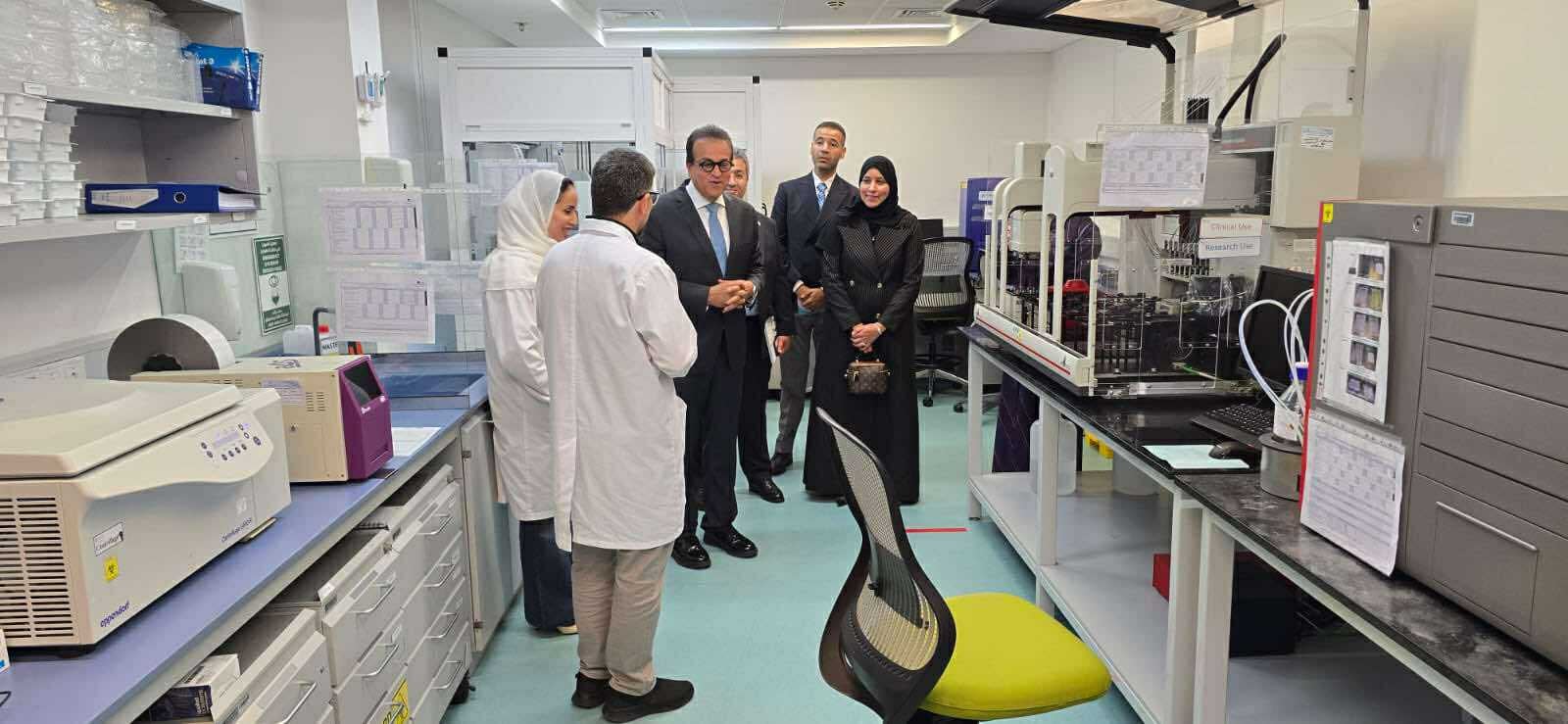
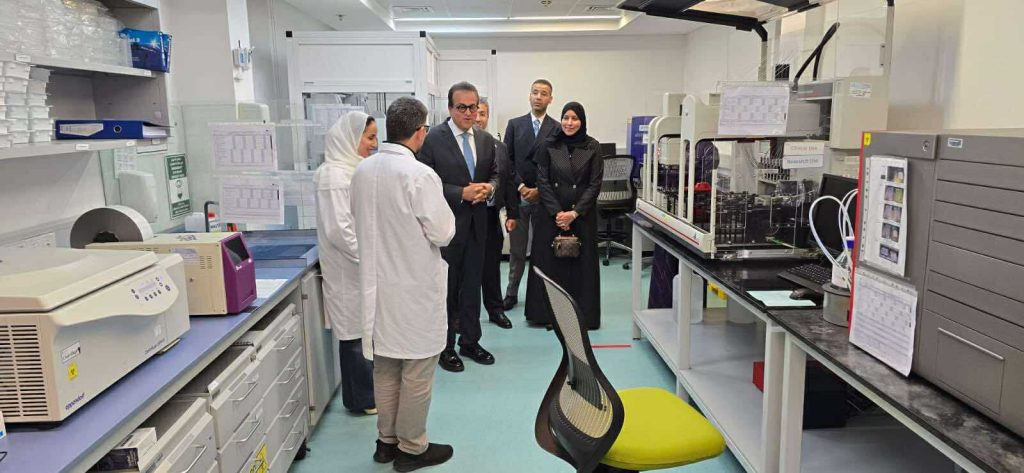
Dr. Khaled Abdel Ghaffar, Egypt’s Deputy Prime Minister for Human Development and Minister of Health and Population, continued his field tour with visits to Hamad Medical Corporation (HMC) and the Qatar Precision Health Institute (QPHI).
This visit was part of his participation in the 6th Global Mental Health Ministerial Summit, hosted by Qatar in Doha from September 28 to 30, 2025, under the theme “Transforming Mental Health through Investment, Innovation, and Implementation.”
The visits aim to strengthen the strategic partnership between Egypt and Qatar in advanced healthcare, precision medicine, and medical research, focusing on knowledge transfer and capacity building to support Egypt’s national strategy to improve healthcare quality and achieve sustainable development goals.
Dr. Hossam Abdel Ghaffar, the official spokesperson for the Ministry of Health and Population, explained that Dr. Khaled Abdel Ghaffar visited Hamad Medical Corporation, the main provider of public healthcare services in Qatar, managing 15 specialized and community hospitals, in addition to the national ambulance service and home and residential care services. The corporation is a non-profit government entity accredited by the Joint Commission International (JCI) for medical quality standards, providing advanced emergency and specialized services to Qatar’s population and the region, focusing on safe and effective care. Its facilities include major hospitals such as Hamad General Hospital (603 beds, offering specialized surgical and medical services for injuries and chronic diseases), Al Wakra Hospital (opened in 2012, providing comprehensive general services), and Aisha Bint Hamad Al Attiyah Community Hospital (north Qatar community hospital).
During the visit, the minister reviewed the management and operational mechanisms within the corporation, which rely on integrated electronic systems for patient management, diagnosis, and treatment, making it one of the leading regional healthcare models. He also toured the Medical Rehabilitation Center, which offers advanced rehabilitation programs for patients after injuries or surgeries, and the Day Surgery Hospital, which includes specialties such as ophthalmology and ENT, using precise surgical techniques like endoscopy and laser.
Dr. Abdel Ghaffar also followed the complete medical procedures, from patient preparation for surgeries, through recovery phases, to integrated rehabilitation programs focusing on rapid recovery and return to normal life.
The minister confirmed that Egypt’s Ministry of Health and Population is discussing a twinning agreement with Hamad Medical Corporation, including joint training programs, expert and medical staff exchanges, and improving medical service quality in Egyptian hospitals by applying global models like those adopted at HMC, which contributes to reducing medical errors and enhancing care efficiency.
The tour also included a visit to the Qatar Precision Health Institute (QPHI), affiliated with Qatar Foundation for Education, Science and Community Development, which is a leading national center for research and application in precision medicine, focusing on genomics and multi-omics.
It is noteworthy that the institute was established in April 2024 by merging the Qatar Biobank and the Qatar Genome Programme, becoming a main platform for collecting and analyzing genomic data from Qatar’s population to enhance personalized healthcare quality through comprehensive studies of the genome and omics (such as proteomics and metabolomics). QPHI aims to utilize large numbers of Qatari participants providing biological samples and to transfer research findings from labs to clinics (bench-to-bedside), focusing on areas such as cancer genomics, cardiovascular diseases, reproductive health, and genetic disorders. In October 2024, the institute issued 25,000 new genomic data sets, enhancing international research collaborations.
During meetings with institute leaders, Dr. Khaled Abdel Ghaffar discussed ways of joint cooperation, including enhancing personalized healthcare by integrating precision medicine into Egypt’s national strategies and expanding research in genomics and multi-omics through joint research platforms representing the Arab region’s populations.
Discussions also included capacity building through joint training programs and fellowships, exchanging medical and research staff, advancing medical education by integrating genomics sciences into Egyptian medical curricula, alongside public awareness campaigns to promote personalized medicine practices and their benefits in prevention and treatment.
These visits reflect Egypt and Qatar’s commitment to strengthening partnership in the health sector, opening new horizons for exchanging scientific and technological expertise.




Recommended for you
Talib Al-Rifai Chronicles Kuwaiti Art Heritage in "Doukhi.. Tasaseem Al-Saba"
Exhibition City Completes About 80% of Preparations for the Damascus International Fair Launch
Al-Jaghbeer: The Industrial Sector Leads Economic Growth
Unified Admission Applications Start Tuesday with 640 Students to be Accepted in Medicine
Egypt Post: We Have Over 10 Million Customers in Savings Accounts and Offer Daily, Monthly, and Annual Returns
His Highness Sheikh Isa bin Salman bin Hamad Al Khalifa Receives the United States Ambassador to the Kingdom of Bahrain