




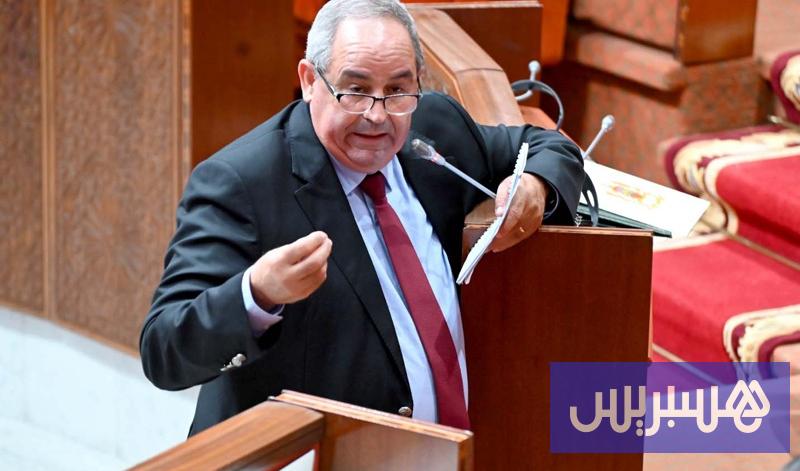
On Monday, the Minister of Higher Education, Scientific Research and Innovation, Ezzedine Midaoui, clarified the truth about the “cancellation of final training research in the bachelor’s and master’s degrees,” confirming that “research projects for the master’s degree are still ongoing, while they were canceled in the bachelor’s degree since 2023.”
Midaoui added during his appearance in the general session for oral questions at the House of Representatives that “the cancellation of research in the bachelor’s degree was due to objective reasons, including lack of knowledge training, the high number of students which poses supervision challenges, and also artificial intelligence tools like ‘ChatGPT’ that can draft a research paper after receiving a question (command) in this regard.”
The minister added that the new pedagogical regulations “gave professors and specialists the ability to impose research in the bachelor’s degree.”
Regarding the master’s degree, the same official stated: “The news about canceling research is completely false; moreover, we have dedicated a full semester to it,” explaining that “research remains varied; in exact sciences it requires training, and in legal sciences, for example, it can be conducted in courts.” He added: “The professor retains full authority. Training was just a general term for these formats.”
On another note, Midaoui confirmed that “improving higher education is an ongoing and dynamic process that cannot be stopped,” saying: “Since my arrival, the ministry has initiated intensive meetings with the network of deans, heads of institutions, and university presidents’ symposium, where there was consensus on the need to improve the 2023 pedagogical regulations, whether concerning limited admission institutions, bachelor’s, or master’s degrees.”
In this regard, “partial amendments were made to the pedagogical regulations for bachelor’s and master’s degrees, introducing new knowledge units and teaching languages,” as well as “establishing a new Bachelor’s diploma for higher technology schools and many other reforms.”
On another front, the Minister of Higher Education and Scientific Research announced “a new approach to university housing, especially since the way this issue was managed in the past has reached its limits,” in his words.
Midaoui pointed out that 10 days ago a call for expressions of interest was launched for a public-private partnership framework for management, mentioning that the approach concerns “127 hectares and 23 university cities, as it is not possible to continue at the same pace as before under public management.”
Additionally, “the ministry opened several university neighborhoods where construction was completed but had minor issues for years, such as the Souissi neighborhood in Rabat, with support from local authorities,” according to the minister, adding: “In this regard, this year, the ‘Researcher House’ in the capital will open with a capacity of 600 beds, as well as the ‘Tilila’ neighborhood in Agadir,” emphasizing that “the new management model in partnership with the private sector will bear fruit.”
Midaoui also announced reconsidering the law governing the Office of University Social and Cultural Affairs, requesting that this office become a tool for monitoring and follow-up, with directorates or services in each university city to fulfill this role.
Regarding the new university academic year, the minister announced that next week research grants in energy for the doctoral level will be launched in partnership with the Ministry of Energy Transition and Sustainable Development. He also mentioned “opening six university institutions this year” after delays, and said the ministry will advocate before the Ministry of Finance to generalize grants, stressing at the same time the “need to diversify funding sources for this social service, with contributions from everyone, including municipalities and regions.”

Recommended for you
Talib Al-Rifai Chronicles Kuwaiti Art Heritage in "Doukhi.. Tasaseem Al-Saba"
Exhibition City Completes About 80% of Preparations for the Damascus International Fair Launch
Al-Jaghbeer: The Industrial Sector Leads Economic Growth
Unified Admission Applications Start Tuesday with 640 Students to be Accepted in Medicine
Egypt Post: We Have Over 10 Million Customers in Savings Accounts and Offer Daily, Monthly, and Annual Returns
His Highness Sheikh Isa bin Salman bin Hamad Al Khalifa Receives the United States Ambassador to the Kingdom of Bahrain