





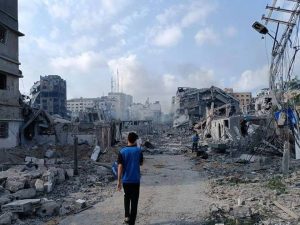




Despite the widespread welcome given to Trump’s plan to end the war on the Gaza Strip, many questions remain about the plan’s success and whether it can go beyond a mere ceasefire to a political track that grants Palestinians some of their legitimate rights and achieves security, peace, and stability in the region.
In principle, the plan contains many contentious clauses open to interpretation, allowing Israel to evade its commitments and resume fighting. This was evident in the first phase agreement of the plan, accompanied by talk of secret clauses that practically permit Israel to return to war if Hamas breaches or fails to meet its commitments, such as handing over the hostages’ bodies within the specified timeframe, among other conditions.
However, the core issue concerns Israel itself and whether the far-right government will accept ending the war and abandoning its dreams of occupation, displacement, and settlement. This seems unlikely, as far-right ministers have openly and clearly demanded resuming the war immediately after the hostages are recovered from Gaza. Many Israelis believe that US President Donald Trump forced Netanyahu to accept his plan, and thus Netanyahu and his far-right allies are looking for any loophole to sabotage the plan. They argue that if the war ends as it is, it contradicts the goals and slogans they have promoted over two years to their right-wing and far-right audiences, painting a picture far from their promises of “absolute victory,” forcibly recovering hostages, and eliminating Hamas and Palestinian factions.
Netanyahu tried to portray such an image but failed because the outcome does not resemble what he promoted two years ago. Ultimately, Netanyahu was forced to make an agreement with Hamas and the Palestinian factions; the hostages were only returned by agreement, and the Palestinians remained on their land. Some Israelis have begun to talk about opening the door to accountability and questioning what the Israeli army achieved over two years, except for “war crimes” against Palestinians, and who bears responsibility for the huge number of Israeli casualties, in addition to the failure to repel the October 7 attack, which Netanyahu still refuses to acknowledge. All these factors push Netanyahu and his allies to obstruct Trump’s plan and find excuses to resume the war.
But the fundamental question is whether Netanyahu and the far-right can face this global momentum and the tsunami of recognitions of the Palestinian state that push towards breaching the Israeli wall, opening the peace track, and achieving the “two-state solution,” not to mention Trump’s apparent commitment to the success of his plan and exploiting the opportune moment to achieve a “historic solution” to the Israeli-Palestinian conflict.

Recommended for you
Talib Al-Rifai Chronicles Kuwaiti Art Heritage in "Doukhi.. Tasaseem Al-Saba"
Exhibition City Completes About 80% of Preparations for the Damascus International Fair Launch
Al-Jaghbeer: The Industrial Sector Leads Economic Growth
Unified Admission Applications Start Tuesday with 640 Students to be Accepted in Medicine
Egypt Post: We Have Over 10 Million Customers in Savings Accounts and Offer Daily, Monthly, and Annual Returns
His Highness Sheikh Isa bin Salman bin Hamad Al Khalifa Receives the United States Ambassador to the Kingdom of Bahrain