








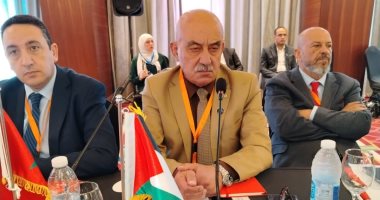
Dr. Abdel Karim Abu Zneid, head of the Palestinian Veterinary Doctors’ Syndicate, affirmed that Palestine is making diligent efforts to develop the veterinary profession despite the challenges it faces. He pointed out that over the past two years, the syndicate has established a new professional practice system in partnership with the Ministry of Agriculture, amid the absence of the legislative council and difficulties in approving laws.
During his speech at the first forum of Arab syndicate heads, deans, and veterinary officials in the Arab region, Abu Zneid said: “We worked on preparing a professional practice system and submitted it to the Prime Minister’s office and the Fatwa and Legislation Bureau, requiring veterinarians after graduation to complete a full year of training in recognized institutions, whether governmental or private, followed by a professional practice exam in partnership between the syndicate and the Ministry of Agriculture.” He emphasized that this approach aims to ensure the competence of veterinarians and continuously develop their knowledge and skills.
He explained that the Egyptian model for organizing the professional practice and board exams represents a pioneering experience that should be generalized across the Arab world, stating: “It is important to maintain veterinarians with updated knowledge throughout their careers. It is unreasonable for a veterinarian to graduate, obtain a license, and then continue practicing for 30 or 40 years without updating their information, while scientific developments in this field are accelerating.”
Abu Zneid also addressed academic education in veterinary faculties, noting that specialization has become an urgent necessity due to the expanding fields of the profession. He said: “Previously, veterinarians worked in all specialties: pets, horses, poultry, and cattle, but this is no longer possible with the significant expansion and development of the profession. Therefore, we encourage the new approach started by some universities, such as Jordan University of Science and Technology, where the first three years cover basic subjects, and then in the fourth and fifth years, students specialize in subfields.” He pointed out that this model helps graduate specialized veterinarians capable of keeping up with developments in their precise fields.
The head of the Palestinian Veterinary Doctors’ Syndicate expressed gratitude to the Egyptian Veterinary Doctors’ Syndicate, Mansoura University, and all those involved in organizing the forum, saying: “We highly appreciate the efforts of our brothers in Egypt to support the veterinary profession in the Arab world, and we look forward to further cooperation and integration that serves veterinarians and the health and economic sectors in our Arab homeland.”




Recommended for you
Talib Al-Rifai Chronicles Kuwaiti Art Heritage in "Doukhi.. Tasaseem Al-Saba"
Exhibition City Completes About 80% of Preparations for the Damascus International Fair Launch
Al-Jaghbeer: The Industrial Sector Leads Economic Growth
Unified Admission Applications Start Tuesday with 640 Students to be Accepted in Medicine
Egypt Post: We Have Over 10 Million Customers in Savings Accounts and Offer Daily, Monthly, and Annual Returns
His Highness Sheikh Isa bin Salman bin Hamad Al Khalifa Receives the United States Ambassador to the Kingdom of Bahrain