








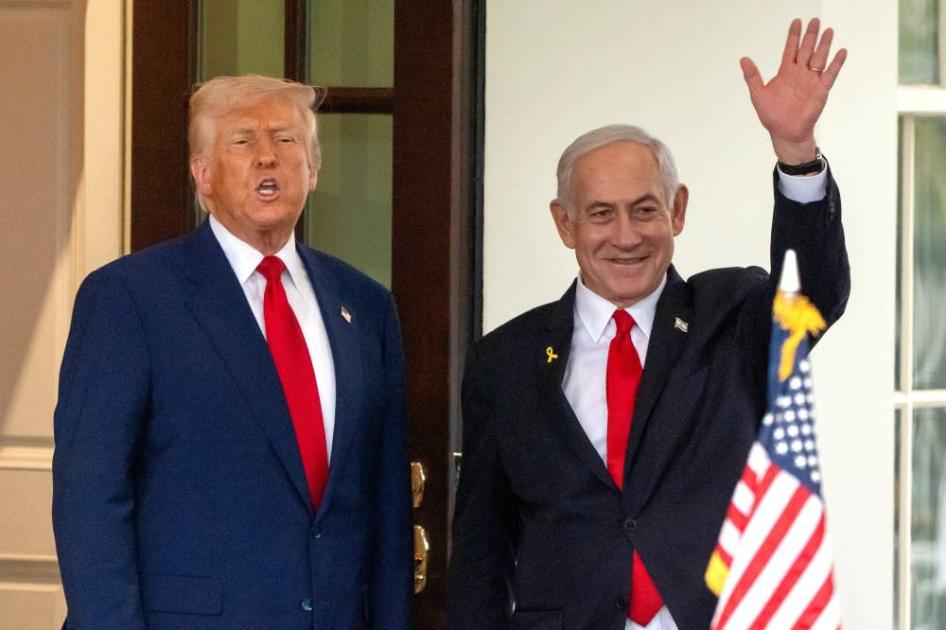
Israeli Prime Minister Benjamin Netanyahu is meeting with former U.S. President Donald Trump on Monday. Israeli Channel 12 cited an Israeli source saying Netanyahu would not say “no” to Trump, and it appears final agreements have been reached on the wording of a plan to end the war in Gaza.
The Hebrew channel added, quoting its sources, that “it can be said that all outstanding issues between Israel and the United States were resolved before the Netanyahu-Trump meeting.”
A senior U.S. official stated that following talks between U.S. envoy Steve Witkoff, Jared Kushner, Trump’s former advisor, and Netanyahu, the U.S. and Israel have come very close to reaching an agreement on a plan to end the Gaza war. The official added that Hamas still needs to approve.
Reports quoting a U.S. official confirmed that Hamas’s approval is a key condition for a final ceasefire agreement.
Meanwhile, Israel Hayom newspaper quoted Israeli security sources saying that “Trump’s plan includes dismantling Hamas militarily and politically, returning all hostages, and completely removing Hamas from the Gaza Strip.”
It emphasized that Trump’s plan includes all principles set by Israel’s political leadership to end the military operation in Gaza.
The meeting between Trump and Netanyahu comes days after the U.S. president revealed a 21-point plan aimed at ending the war in Gaza, during talks with Arab and Muslim leaders on the sidelines of the UN General Assembly meetings in New York.
On Sunday, Trump hinted that “something remarkable” would happen in Middle East crisis talks, adding on his social media platform Social Truth, “We will achieve it.”
On Friday, Trump told reporters in Washington: “I think we have a deal on Gaza.” Netanyahu pledged at the UN General Assembly to “complete the mission” in Israel’s war against Hamas in Gaza.
No Choice for Netanyahu
Eitan Gilboa, an expert on U.S.-Israel relations at Bar-Ilan University in Israel, said, “He has no choice but to accept Trump’s ceasefire plan.” He added this is because “the U.S. and Trump are simply his only allies in the international community.”
In Israel, tens of thousands of protesters urged Netanyahu to accept a ceasefire, and on Saturday they urged Trump to use his influence.
A diplomatic source said Trump’s plan calls for a permanent ceasefire, release of all hostages, Israeli withdrawal from Gaza, and large-scale humanitarian aid deliveries.
Hamas Has Not Received Proposals
Hamas Political Bureau member Hossam Badran confirmed on Sunday that “the movement has not yet received any official proposals through Qatari and Egyptian mediators.” Jordan’s King Abdullah II confirmed on Sunday there is “broad consensus” among Arab and Muslim leaders on the U.S. president’s proposal.
The agreement includes other points that Netanyahu may find difficult to accept and which could lead to the collapse of the right-wing government coalition in Israel. Among the most prominent is the participation of the Palestinian Authority, based in Ramallah in the occupied West Bank, in governing Gaza in the future.
While the U.S. plan requires reform of the Palestinian Authority before any return to Gaza governance, Gilboa warned these reforms “could take years” to materialize.
Broad Consensus
Many far-right ministers in Netanyahu’s coalition threatened to topple the government if he agrees to the Palestinian Authority’s return to govern Gaza or ends the war without defeating Hamas.
However, opposition leader Yair Lapid offered a parliamentary ‘safety net,’ pledging his centrist party Yesh Atid would support a ceasefire agreement and the release of hostages, though it is unclear if other opposition parties will follow suit.
Ksenia Svetlova, a former Knesset member and head of the Regional Organization for Peace, Economy, and Security (ROPES), said such broad plans will require wide consensus.
Svetlova predicted Netanyahu would agree to parts of the deal while seeking to negotiate or postpone decisions on other elements “that seem difficult at this moment.”
One of the contentious points in the U.S. plan remains the identity of the party that will guarantee security in Gaza after the Israeli army withdraws and Hamas is disarmed. The plan envisions establishing an international security force including Palestinians alongside troops from Arab and Muslim countries. However, key details related to command structure and operational control remain unclear.


Recommended for you
Talib Al-Rifai Chronicles Kuwaiti Art Heritage in "Doukhi.. Tasaseem Al-Saba"
Exhibition City Completes About 80% of Preparations for the Damascus International Fair Launch
Al-Jaghbeer: The Industrial Sector Leads Economic Growth
Unified Admission Applications Start Tuesday with 640 Students to be Accepted in Medicine
Egypt Post: We Have Over 10 Million Customers in Savings Accounts and Offer Daily, Monthly, and Annual Returns
His Highness Sheikh Isa bin Salman bin Hamad Al Khalifa Receives the United States Ambassador to the Kingdom of Bahrain