





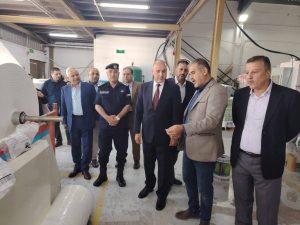


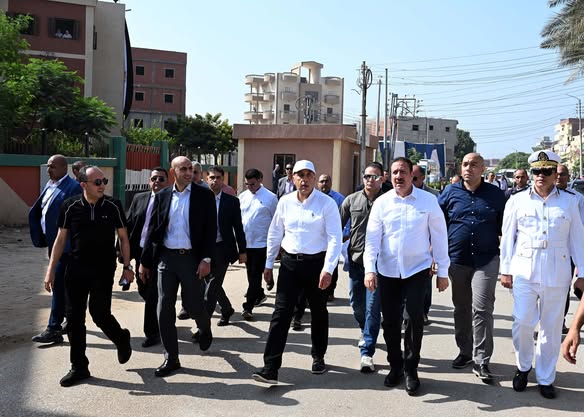
Dr. Mostafa Madbouly, Egypt’s Prime Minister, during his visit to Menoufia Governorate today, reviewed a presentation by Major General Ibrahim Abou Lemon, Governor of Menoufia, on the achievements made in the governorate from 2014 to 2025 across various sectors, including projects implemented under the presidential initiative “Decent Life” to develop the Egyptian countryside.
The presentation was attended by Mohamed Abdel Latif, Minister of Education and Technical Education, Dr. Sayed Ismail, Deputy Minister of Housing, Utilities and Urban Communities, Mohamed Mousa, Deputy Governor, and several executive leaders of the governorate.
The governor began by noting that Menoufia witnessed many projects during 2014-2025 focusing mainly on infrastructure and the development of centers and villages to improve the quality of services provided to citizens in various sectors, in line with Egypt’s Vision 2030 and the goals of the New Republic.
These projects include public utilities such as drinking water, sanitation, and central road networks, as well as services including healthcare, pre-university and university education, development of unplanned areas, the presidential initiative “Housing for All Egyptians,” and investment plan projects including paving, road development, urban development, and environmental improvement.
The presentation also covered the governorate’s investment and self-resources through industrial activity development, heritage and handicraft industries, alongside the presidential initiative “Decent Life” projects to develop rural areas, and meeting local and community service needs in the governorate’s centers, cities, and districts.
Regarding the execution status of drinking water, sanitation, and central road projects from 2014 to 2025, the governor pointed out that in full coordination with the Ministry of Housing, Utilities and Urban Communities, strategic projects were implemented to secure water needs efficiently and with high quality, in addition to the “Decent Life” initiative projects.
The projects included the construction of 24 water stations, 17 reservoirs and artesian wells, and 35 iron and manganese removal stations to improve water quality and achieve 98% coverage in the governorate’s cities and villages, as well as completing coverage in new urban expansions, with a total cost of 6 billion Egyptian pounds.
Abou Lemon addressed sanitation projects, explaining that the sector witnessed a qualitative leap during 2014-2025, focusing on completing ongoing projects in the governorate’s villages to improve infrastructure efficiency and accommodate urban expansion. The works, costing 10 billion Egyptian pounds, included connecting services to 80 new villages, building and expanding 13 treatment plants, and implementing 53 pumping stations, resulting in 100% coverage of cities and 70% of villages, with ongoing efforts to achieve comprehensive coverage to enhance citizens’ quality of life and public health.
Regarding central road network projects executed by the General Authority for Roads and Bridges, the governor explained that as part of the state’s comprehensive plan to develop roads and bridges and enhance regional connectivity, 150 km of new pivotal roads and bridges were built to link the local road network with the national and regional networks, at an investment cost of 7.6 billion Egyptian pounds.
The governor also discussed public services implemented from 2014 to 2025, starting with healthcare services. The governorate coordinated with the Ministry of Health and Population to advance the healthcare system through a comprehensive plan to upgrade medical facilities, provide land for new hospitals, and follow up on project implementation and overcoming obstacles, with a cost of 7 billion Egyptian pounds. Among these projects is the new Ashmoun Hospital, with an investment cost of 1.5 billion Egyptian pounds, whose construction works were inspected during the Prime Minister’s tour.
Abou Lemon also highlighted achievements in pre-university education, noting a significant leap in educational infrastructure projects as part of the state’s strategy to develop pre-university education to improve quality, reduce overcrowding, and achieve equitable service distribution. Projects included expansion of new schools such as international, official language, and Japanese schools to meet modern requirements and support sustainable development goals.
From 2014 to 2025, 338 schools were built, expanded, or replaced, providing about 5,132 classrooms, in addition to upgrading and maintaining 464 schools with about 8,894 classrooms. Additionally, 42 new schools are under construction to add 910 new classrooms, with a total cost of 4 billion Egyptian pounds.
University education in Menoufia also witnessed an unprecedented leap during this period, with new universities established and existing ones developed to meet labor market needs and support modern allocations, at a cost of 11 billion Egyptian pounds.
Regarding the governorate’s investment plan during the same period, Abou Lemon indicated that the developmental investments cost reached 5.2 billion Egyptian pounds. The plan included paving 57% of roads, improving the environment by 24%, supporting units by 10%, electricity sector by 6%, security, firefighting, and traffic by 3%, and developing non-urban areas in six locations in cooperation with the Urban Development Fund.
The governor also spoke about projects under the presidential initiative “Housing for All Egyptians,” noting the completion of 1,672 housing units distributed over 19 residential buildings, built to the highest construction and planning standards.
Road paving allocations in the governorate were increased to 2.362 billion Egyptian pounds, in addition to 700 million from the Slum Development Fund, alongside the development of squares, parks, markets, and parking lots.
Leading executive steps were also taken in environmental improvement and integrated waste management, with project costs reaching 750 million Egyptian pounds. The governor reviewed the main projects under the environmental improvement system and discussed measures to develop the governorate’s self-resources, available investment opportunities, industrial activity, and heritage and handicraft industries.
Regarding the “Decent Life” presidential initiative projects, the governor noted the implementation of the first phase in Ashmoun and El Shohada centers to improve quality of life in 81 villages benefiting 1.2 million citizens, with a total of 1,609 projects (1,080 in Ashmoun and 529 in El Shohada) across health units, government service complexes, water and sanitation projects, with an overall implementation rate of 93%.


Recommended for you
Talib Al-Rifai Chronicles Kuwaiti Art Heritage in "Doukhi.. Tasaseem Al-Saba"
Exhibition City Completes About 80% of Preparations for the Damascus International Fair Launch
Al-Jaghbeer: The Industrial Sector Leads Economic Growth
Unified Admission Applications Start Tuesday with 640 Students to be Accepted in Medicine
Egypt Post: We Have Over 10 Million Customers in Savings Accounts and Offer Daily, Monthly, and Annual Returns
His Highness Sheikh Isa bin Salman bin Hamad Al Khalifa Receives the United States Ambassador to the Kingdom of Bahrain