








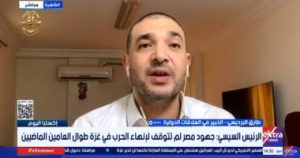

Former Foreign Minister and Ambassador Mohamed Kamel Amr confirmed that the US announcement of a plan to end the war in Gaza and a promise of an “exceptional event” requires careful examination of the term and detailed scrutiny of the plan’s provisions.
During his interview with Extra News TV on Monday evening, he explained that the press conference involving the US President and the Israeli Prime Minister revealed a plan consisting of four main points with specific subpoints: first, ceasefire and release of detainees; second, the security and political situation in Gaza; third, humanitarian aid and reconstruction; and finally, economic development.
He detailed that the ceasefire clause includes an initial period of “70 hours” during which Hamas is expected to release detainees in its custody, including missing bodies, while Israel would release about 250 prisoners serving life sentences and approximately 700 detainees arrested after the October events, including children and women.
The next phase involves a gradual withdrawal of Israeli forces to agreed positions, Hamas handing over its weapons and dismantling military infrastructure—trenches, underground tunnels, and weapon manufacturing facilities—with amnesty granted to cooperating Hamas members, and allowing those wishing to leave to do so without restrictions, with the assurance they can return.
Amr discussed the transitional administration of Gaza, noting a proposal for a non-political technocratic Palestinian committee under the supervision of an international body called a “Council” chaired by Trump with support from world leaders. This council is expected to include global figures and international organizations such as the World Bank, with Trump mentioning individuals like Tony Blair interested in participating.
The ambassador also praised the US President’s thanks to Egyptian President Abdel Fattah el-Sisi for his efforts to stop the war in Gaza, highlighting this as notable, but stressed that “the devil is in the details” and the plan’s success depends on how Israel handles those details.
He pointed out that the role of the Palestinian Authority in the transitional phase remains unclear. The plan includes restructuring the authority to be more efficient and capable of management, and if implemented, the authority might have a role in Gaza’s joint administration later, although this aspect is not clear in the available texts.
Regarding displacement, Amr affirmed that the US plan stipulates no one should be forced to leave Gaza, and those who leave will return. He emphasized Egypt’s and Arab countries’ rejection of any forced displacement or so-called “voluntary displacement” under current conditions, stating that “so-called voluntary displacement under these circumstances is not voluntary.”
Amr sees the biggest obstacle to the plan’s success as the internal Israeli stance, not just Netanyahu’s approval. He explained that the ruling coalition includes figures opposed to the settlement path or granting comprehensive amnesty, and Netanyahu, if he accepts the plan, may have an alternative plan or bet on ways to sabotage it within his coalition.
He added that Netanyahu might call for early elections if he faces strong opposition within his coalition, hoping that the return of detainees and remains to their families could grant him wide popular support and an escape from his internal crisis, noting this possibility is in Netanyahu’s background thinking.
He clarified that the public announcement of the plan’s provisions is insufficient to evaluate its feasibility, and implementation depends on details and the parties’ commitment. He noted that internal conditions in Israel and the political scene’s complexities may be the decisive factor in accepting or thwarting the plan.



Recommended for you
Talib Al-Rifai Chronicles Kuwaiti Art Heritage in "Doukhi.. Tasaseem Al-Saba"
Exhibition City Completes About 80% of Preparations for the Damascus International Fair Launch
Al-Jaghbeer: The Industrial Sector Leads Economic Growth
Unified Admission Applications Start Tuesday with 640 Students to be Accepted in Medicine
Egypt Post: We Have Over 10 Million Customers in Savings Accounts and Offer Daily, Monthly, and Annual Returns
His Highness Sheikh Isa bin Salman bin Hamad Al Khalifa Receives the United States Ambassador to the Kingdom of Bahrain