









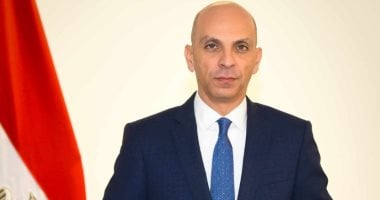
Ambassador Tamim Khalaf, the official spokesperson for the Ministry of Foreign Affairs, Migration, and Egyptian Expatriates Affairs, detailed Egypt’s high-level participation in the 80th session of the United Nations General Assembly, emphasizing that Egypt’s speech was a clear and explicit message to the world, including a precise assessment of international conditions and a decisive vision to resolve regional crises, foremost among them the Palestinian issue.
In response to a question about the key messages in Foreign Minister Dr. Badr Abdel Aati’s speech, Ambassador Khalaf said in a phone interview on Extra News channel: “The truth is that the speech by Foreign Minister Dr. Badr Abdel Aati at the UN General Assembly was comprehensive and frank, in which Egypt’s assessment of the current international system and the severe challenges and crises threatening international peace and security were reviewed.”
He added that the speech addressed in detail Egypt’s position on urgent regional crises, clarifying: “The speech certainly included Egypt’s stance on several regional crises, foremost the developments in Gaza, Libya, Sudan, and Somalia, as well as other highly important files, including the Egyptian water security file and the Iranian nuclear file.”
Ambassador Khalaf pointed out that Egypt expressed deep concern over the erosion of the international system, saying: “There was a keen effort to explicitly and clearly express our deep concerns about several troubling manifestations in the international system, most notably the lack of respect for international law, the absence of justice in decision-making at the international level, and the double standards and hypocrisy in international relations… All of these are certainly worrying elements as they undermine the chances of achieving peace, stability, and development.”
Regarding the Palestinian issue, the spokesperson affirmed Egypt’s steadfast position: “Egypt’s speech touched on our stance regarding the tragic developments in Gaza… The Foreign Minister renewed the necessity of an immediate ceasefire, the passage of humanitarian aid, and the categorical rejection of any scenarios involving the displacement of Palestinians from their land.”
Regarding the meetings held by the Foreign Minister on the sidelines of the General Assembly, Ambassador Khalaf described the Egyptian diplomatic activity as intensive and diverse, saying: “The UN General Assembly annually provides an opportunity for leaders, ministers, and officials to gather under the UN umbrella, offering a unique chance to conduct numerous bilateral and multilateral meetings.”
Analyzing the importance of the current General Assembly session, Ambassador Khalaf explained that it carries an exceptional character for two main reasons: “The first reason is that it marks the 80th anniversary of the founding of the United Nations, naturally providing an opportunity for a comprehensive review of the international system, its shortcomings, and how to address them… The second reason concerns the unprecedented international momentum to support the Palestinian cause.”
Khalaf emphasized the pivotal role of Egyptian diplomacy in this context, saying: “Egyptian diplomacy has been very active in pushing many countries to recognize the Palestinian state… I can confirm to you that the wave of recognition we witnessed is not the end but actually just the beginning.”
In conclusion, Ambassador Tamim Khalaf confirmed that the Egyptian vision presented was not limited to managing the current crisis but offered a comprehensive concept for the future of the conflict, emphasizing “the necessity of a political horizon for the Palestinian cause, and the need to work towards establishing a Palestinian state along the lines of June 4, 1967, with East Jerusalem as its capital,” in addition to “developing a comprehensive governance plan for the Gaza Strip and security measures based on the Arab-Islamic plan approved by the Arab summit.”


Recommended for you
Talib Al-Rifai Chronicles Kuwaiti Art Heritage in "Doukhi.. Tasaseem Al-Saba"
Exhibition City Completes About 80% of Preparations for the Damascus International Fair Launch
Unified Admission Applications Start Tuesday with 640 Students to be Accepted in Medicine
Al-Jaghbeer: The Industrial Sector Leads Economic Growth
Egypt Post: We Have Over 10 Million Customers in Savings Accounts and Offer Daily, Monthly, and Annual Returns
His Highness Sheikh Isa bin Salman bin Hamad Al Khalifa Receives the United States Ambassador to the Kingdom of Bahrain