










Click here to share on social media
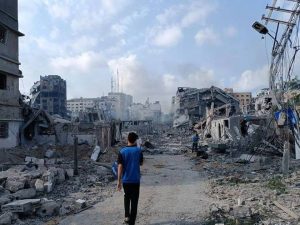
Khartoum – The war between the Sudanese army and the Rapid Support Forces since mid-April 2023 has caused a widespread collapse of the national economy, with entire sectors halting work and production due to confrontations and looting, reflected in declining macroeconomic indicators and worsening living crises.
The outbreak of fighting on April 15, 2023, cast a dark shadow over economic sectors, as the local currency experienced an unprecedented deterioration against the dollar, reaching over 3000 Sudanese pounds per dollar compared to 600 pounds before the war. Inflation rates rose and industrial production shrank. A report by the Ministry of Finance issued in early January 2025 confirmed that the war hit key sectors, primarily oil and industry, deepening the crisis.
Exchange Rate Challenges and Industrial Infrastructure
Economic analyst Nayir Mohamed Al-Nour believes the economy was already suffering from high inflation and growing unemployment before the war, noting that the conflict worsened these conditions and deepened imbalances. He told Al Jazeera Net, “Exchange rate stability is the primary pillar the state must focus on for the economy to begin recovering.”
He also considered the Central Bank’s December 2024 currency replacement step “positive but incomplete,” pointing out that states such as Khartoum, Al Jazirah, and Sennar still circulate the old currency, requiring additional efforts to strengthen the new currency and encourage electronic transactions.
Regarding the industrial situation, Mohamed Al-Nour explained that the industrial infrastructure in the capital was almost completely damaged despite its significant contribution to the general budget. He expects the sector to gradually return to work but will need a longer period to regain vitality and resume normal production.
Economic analyst Haitham Mohamed Fathi compared the industrial situation before and during the war, stating that industry represented about 12% of GDP and provided jobs for 15 to 20% of the workforce, concentrated in Khartoum, Al Jazirah, and South Darfur, especially in food, pharmaceutical, and metal industries.
However, he confirmed that the war “completely destroyed this distribution,” noting that more than 40% of industrial facilities were completely destroyed and production dropped to half its 2022 levels. Pharmaceutical industries stopped by more than 60%, and food industries declined due to fuel and electricity shortages. He added, “Any industrial recovery requires political, security, and social stability, which will not be achieved as long as the war continues.”
Billions of Dollars in Losses
Meanwhile, the head of the Federation of Chambers of Industry, Muawia Al-Barir, revealed that the industrial sector suffered heavy losses, including the destruction of about 550 factories in Khartoum, Bahri, and Omdurman, estimating losses exceeding 50 billion dollars, including factories, equipment, and raw materials.
He said that the return of some factories to production does not mean full sector recovery, calling for a clear plan to rebuild and repair what the war destroyed, considering that “the private industrial sector is a key lever through providing jobs and boosting local production.”
Against the bleak picture, individual initiatives reflect hope for a gradual return. Mohamed Al-Sheikh, owner of a perfume factory in Omdurman, told Al Jazeera Net about his readiness to restart his factory soon despite losses estimated at over one million dollars due to looting of machines and belongings. He confirmed that the rising dollar might reduce the competitiveness of imported products and give a boost to local production, adding that state support and reassurances from the Ministry of Industry encouraged him to try again.
Government Efforts and Recovery Options
On her part, Minister of Industry and Trade Mohasen Ali Yacoub explained that the war took industrial areas in Khartoum, Al Jazirah, and part of Sennar out of production, leading to widespread destruction and looting of raw materials and products. She pointed out that Khartoum alone recorded damage to 3,493 large and medium industrial facilities, while 125 large facilities were damaged in Al Jazirah. She confirmed that losses extended beyond industrial infrastructure to workers who lost their income sources, noting that the ministry seeks to fill gaps through production in safe states.
The minister added that her ministry is conducting a comprehensive survey of damaged facilities to prepare an accurate database and study the reality of factories and the possibility of returning them to production, alongside establishing a unified window to simplify procedures and speed up the return to work.
The ministry had formed a technical committee last May to identify the needs of damaged factories, and its report revealed extensive damages including theft of cables, electrical transformers, and general infrastructure damage.
Despite the billions in losses and near-total destruction of vital sectors, hope remains that government efforts and private initiatives will lead to gradual recovery, as the overall scene is governed by the duality of heavy losses and aspirations to restore the economic wheel if a more stable political and security environment is established.



Recommended for you
Talib Al-Rifai Chronicles Kuwaiti Art Heritage in "Doukhi.. Tasaseem Al-Saba"
Al-Jaghbeer: The Industrial Sector Leads Economic Growth
Exhibition City Completes About 80% of Preparations for the Damascus International Fair Launch
Unified Admission Applications Start Tuesday with 640 Students to be Accepted in Medicine
Egypt Post: We Have Over 10 Million Customers in Savings Accounts and Offer Daily, Monthly, and Annual Returns
His Highness Sheikh Isa bin Salman bin Hamad Al Khalifa Receives the United States Ambassador to the Kingdom of Bahrain