








Multinational corporations are facing an unprecedented period of anticipation and concern amid radical shifts in US economic policies. With the rise of protectionism taking center stage and the increase in sudden decisions in Washington, the business environment in the United States has become less stable compared to what investors have been accustomed to for decades.
Concerns are growing that these shifts will have ripple effects on global trade networks and international supply chains. With political directions unclear, executives find themselves facing the dilemma of reconsidering their expansion strategies and investments within the US market.
In this context, a report by the British newspaper “Financial Times” notes:
The report quotes a senior executive at a European multinational company saying, “This increases the cost of capital, leading to more short-term investments and minimal commitments, which ultimately means less investment in the United States.”
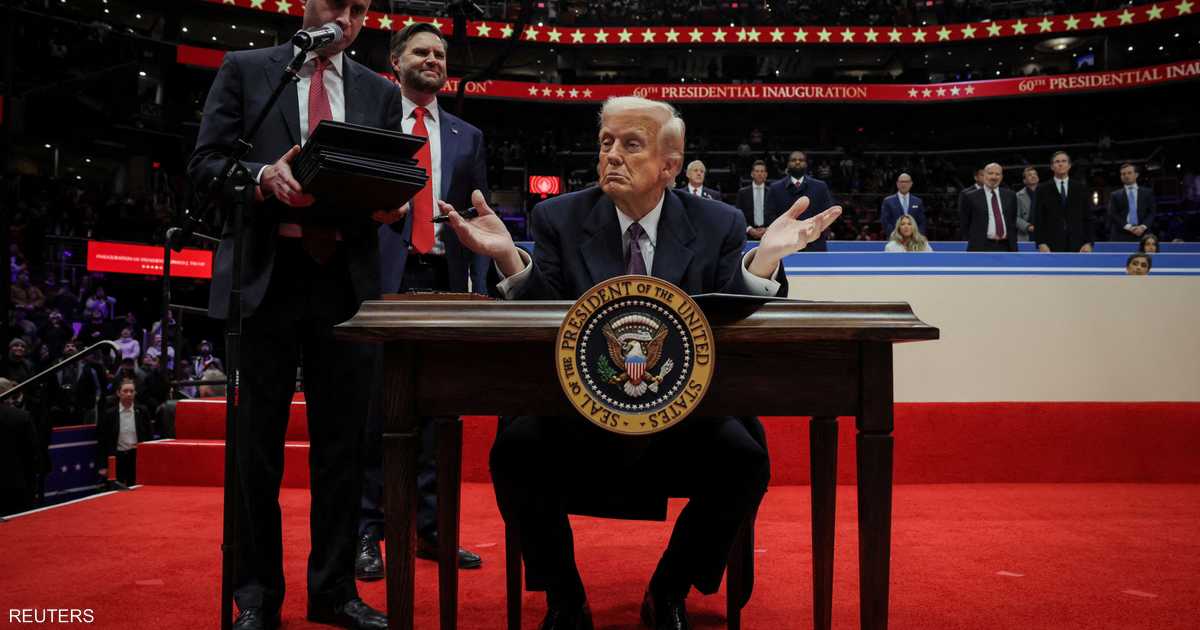
This wave of concern comes at a time when the Trump administration bets that its policies, including reducing regulatory restrictions and imposing trade barriers, will spark a boom in investments and job opportunities. Trump cited record levels in the US stock market as evidence that executives support his vision.
Joe Yaraq, Head of Global Markets at Cedra Markets, told Sky News Arabia’s Economy site in an exclusive statement that:
“On the other hand, some of these companies may partially benefit from the tax cuts enacted by the US administration, giving them the opportunity to pay less tax and achieve higher profits.”
Yaraq points out that “companies linked to countries engaged in trade disputes with the United States, such as China and India—especially China—remain the most vulnerable to pressures, sanctions, and stringent regulatory measures, negatively affecting their performance.”
He continues: “These policies are redrawing the global trade map, forcing many companies to reconsider their strategies, build new structures and markets, and innovate alternative ways to reach consumers. For example, the Chinese market was a primary source of products re-exported to America, but US measures have caused enormous pressure, forcing companies to restructure and adapt to the new reality.”
A report by Chatham House notes that American businesses have traditionally relied on relative stability in the US governance system, but this stability is now shaken due to Trump administration policies and measures. This not only poses serious challenges to the United States, international security, and the global economy but also affects American multinational companies and institutional investors.
The report adds:
Nevertheless, American multinational companies and investors still underestimate these challenges and the risks threatening their interests. Instead of defending the structural pillars of their success, most shirk their responsibilities, according to the report.
Meanwhile, financial markets expert Mohamed Said told Sky News Arabia’s Economy site:
“Trump’s policies support local companies, citing as an example his first term, where one of the most positive decisions for these companies was the 2017 tax reform law, which lowered the federal tax, a significant reduction that reflected in increased profits for giant companies like Apple and Microsoft.”
However, Said points out that the challenges now are significant for companies, adding: “Trade wars and high tariffs on imports from China and other countries negatively and directly affect companies dependent on global supply chains.”
He continues: “The automotive, technology, and electronics sectors face rising costs of components and raw materials, while data shows declining sales of multinational companies with significant investments in China, which reflected on their stock prices. This is pushing many to restructure their operations, seek alternative suppliers, and accelerate the ‘China + 1’ strategy to reduce dependence on a single market, increasing logistical complexities and costs.”
He adds: “Political pressure is another factor, as the ‘America First’ policy has placed these companies in a difficult dilemma between continuing production abroad to benefit from lower costs and global markets or moving production domestically to avoid criticism and potential sanctions. Also, the reduction of H-1B work visas affects tech companies’ ability to attract foreign talent.”
On September 19, the US administration announced it would impose a $100,000 fee on H1-B visas, widely used by tech companies to hire skilled foreign engineers and employees. Companies requested visa holders outside the country to return immediately to the US to avoid fees, before the administration later clarified that the fees would apply only to future applications.


Recommended for you
Talib Al-Rifai Chronicles Kuwaiti Art Heritage in "Doukhi.. Tasaseem Al-Saba"
Exhibition City Completes About 80% of Preparations for the Damascus International Fair Launch
Al-Jaghbeer: The Industrial Sector Leads Economic Growth
Unified Admission Applications Start Tuesday with 640 Students to be Accepted in Medicine
Egypt Post: We Have Over 10 Million Customers in Savings Accounts and Offer Daily, Monthly, and Annual Returns
His Highness Sheikh Isa bin Salman bin Hamad Al Khalifa Receives the United States Ambassador to the Kingdom of Bahrain