






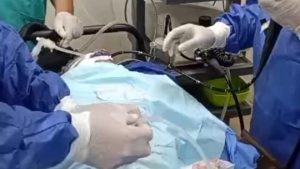


The Syrian Ministry of Foreign Affairs welcomed on Thursday evening the adoption by an international organization of a decision to destroy the remnants of the chemical weapons program from the era of the ousted Assad.
The ministry stated in a statement that Syria “welcomes the adoption by the Executive Council of the Organisation for the Prohibition of Chemical Weapons (OPCW) of Damascus’s decision for the accelerated destruction of any remnants of chemical weapons” in the country.
It explained that the decision, submitted by Damascus to the 110th session of the Executive Council of the organization, is “the first decision Syria has presented in international forums since its liberation (last December), with the cooperation and support of the mission of the sister state of Qatar, which represents the interests of the Syrian Arab Republic at the OPCW.”
The 110th session of the OPCW Executive Council is held between last Tuesday and next Friday.
The Syrian Foreign Ministry pointed out that the decision “was jointly sponsored by 53 countries party to the Chemical Weapons Convention, including Syria and Qatar, and was unanimously approved by the members of the Executive Council.”
According to the Syrian Network for Human Rights, the forces of the ousted President Bashar al-Assad carried out 217 chemical attacks since the revolution began in 2011.
The Assad regime committed the major chemical massacre in Syria in the Eastern Ghouta and Muadamiyat al-Sham (south) areas on August 21, 2013, in a bloody attack that killed more than 1,400 civilians, including hundreds of children and women, and injured more than 10,000 civilians.
Following the attack, the Syrian regime joined the OPCW on September 13, 2013.
In the same month, the UN Security Council adopted Resolution 2118 concerning Syria’s chemical weapons.
The OPCW and the United Nations formed a joint inspection mission on chemical weapons in Syria.
The organization announced the end of the mission in Syria on August 19, 2014, after destroying the Assad regime’s stockpile of chemical weapons.
However, it later became clear that chemical weapons were destroyed only at sites declared by the Assad regime, while its forces later carried out numerous attacks using chlorine and sarin gas in several cities, most notably Aleppo (north).
On April 21, 2021, the States Parties to the OPCW decided to suspend some of Syria’s membership rights in the organization.
This decision came after the organization confirmed the use of chemical weapons in attacks that took place in the town of Latamneh in Hama province (central) in March 2017, and in the city of Saraqib in Idlib province (northwest) in February 2018.
On December 8, 2024, Syrian factions took control of Damascus after other cities, ending 61 years of the Baath Party’s bloody regime and 53 years of Assad family rule.

Recommended for you
Al-Jaghbeer: The Industrial Sector Leads Economic Growth
Talib Al-Rifai Chronicles Kuwaiti Art Heritage in "Doukhi.. Tasaseem Al-Saba"
Exhibition City Completes About 80% of Preparations for the Damascus International Fair Launch
Unified Admission Applications Start Tuesday with 640 Students to be Accepted in Medicine
Egypt Post: We Have Over 10 Million Customers in Savings Accounts and Offer Daily, Monthly, and Annual Returns
His Highness Sheikh Isa bin Salman bin Hamad Al Khalifa Receives the United States Ambassador to the Kingdom of Bahrain