








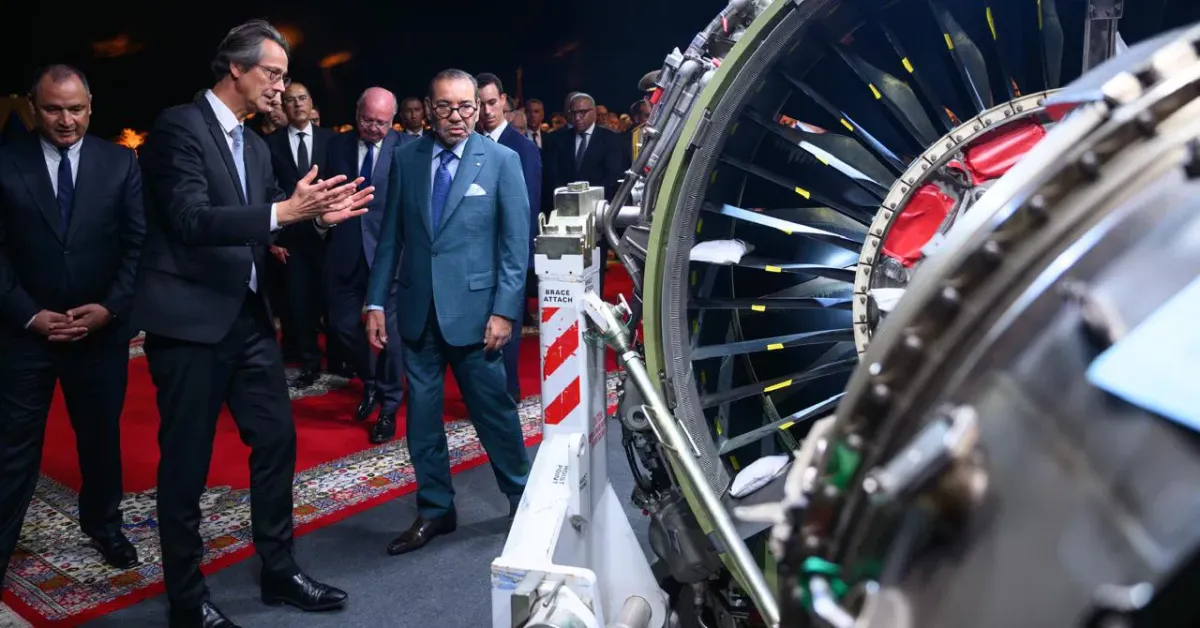
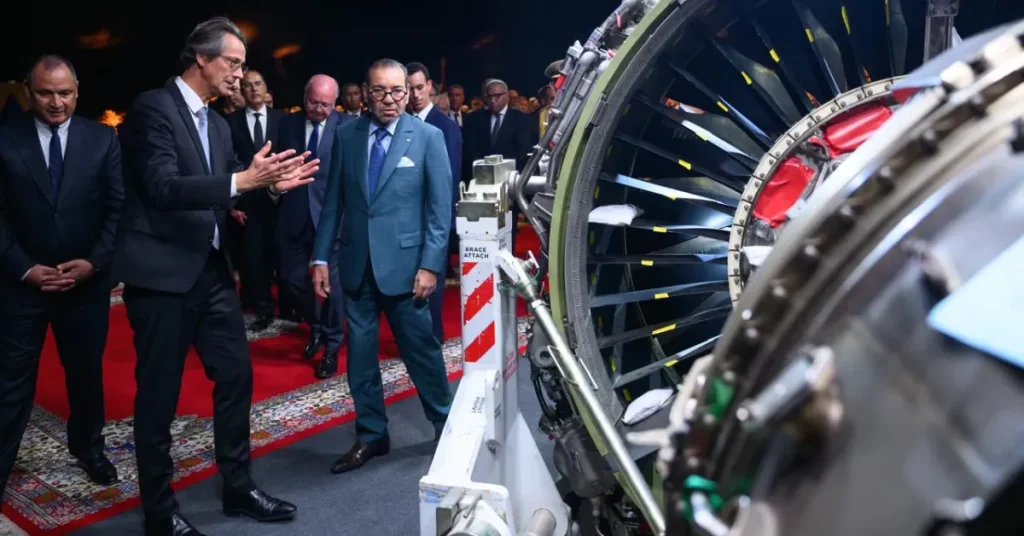
King Mohammed VI was briefed on the project as French aerospace and defense group Safran signed agreements on Monday to establish an Airbus aircraft engine assembly plant and a maintenance and repair facility near Casablanca, Morocco.
Morocco has encouraged investments from aerospace suppliers in recent years to replicate its automotive manufacturing success by creating centers that reduce supply chains and facilitate knowledge exchange.
Safran’s CEO, Ross McInnes, stated the group will invest €200 million ($231 million) to build the assembly line, which will produce 25% of the company’s output related to Airbus aircraft, approximately 350 LEAP-1A engines annually.
Following the signing ceremony attended by King Mohammed VI, McInnes said, “This will be Safran’s only assembly line outside France and will be ready by 2028.”
Safran co-produces LEAP engines with General Electric Aviation through their joint venture CFM International. The LEAP-1A engine competes with Pratt & Whitney’s engine for the Airbus A320neo, while the LEAP-1B is the sole engine for Boeing 737 MAX. The LEAP-1C variant is used by China’s COMAC for its C919 aircraft.
Olivier André, CEO of the partly state-owned Safran group, told Reuters in a phone interview that Morocco was chosen for multiple reasons including its economic stability, remarks likely to resonate in France amid budgetary challenges.
He added that Safran’s workforce in Morocco already possesses high skills, and the expansion aims to enhance the company’s supply chain resilience.
Safran’s Villaroche plant near Paris currently supplies nearly all LEAP-1A engines to Airbus, with a production capacity of 1,000 engines annually across three production lines.
McInnes said the maintenance and repair plant will start operations in 2027 with a total investment of €120 million and an annual capacity of 150 engines.
These new investments follow broader commercial deals signed after French President Emmanuel Macron’s visit to Morocco last year, aiming to strengthen bilateral relations after years of tension.
Moroccan Minister of Industry and Trade, Ryad Mezzour, said Safran’s new investments “place Morocco among a few countries capable of producing complete aircraft engines,” expressing hope that the two new plants would attract other suppliers.
Morocco has one of Africa’s most diversified economies and is the continent’s second-largest industrial country.
The Moroccan aviation sector includes about 150 companies employing around 25,000 people. Sector exports rose to 26 billion dirhams ($2.8 billion) in 2024, up from 21.8 billion dirhams the previous year.
Mezzour added, “The two plants Safran will build will help Morocco double its aviation sector exports.”
To encourage investors, Morocco offers incentives covering up to 30% of capital expenditure and provides land in specialized industrial zones such as Midparc, where Safran will build the two plants near Casablanca airports.
Moroccan Labor Minister Younes Sekkouri told Reuters that 84% of aviation sector workers are foreign investors.
He noted Morocco has established seven vocational training institutes in the aviation sector and plans to train 10,000 new skilled workers by 2030, including in advanced technology fields.
Boeing is among the leading global aviation companies investing in Morocco’s aviation sector, while Royal Air Maroc is renewing its fleet.



Recommended for you
Talib Al-Rifai Chronicles Kuwaiti Art Heritage in "Doukhi.. Tasaseem Al-Saba"
Exhibition City Completes About 80% of Preparations for the Damascus International Fair Launch
Al-Jaghbeer: The Industrial Sector Leads Economic Growth
Unified Admission Applications Start Tuesday with 640 Students to be Accepted in Medicine
Egypt Post: We Have Over 10 Million Customers in Savings Accounts and Offer Daily, Monthly, and Annual Returns
His Highness Sheikh Isa bin Salman bin Hamad Al Khalifa Receives the United States Ambassador to the Kingdom of Bahrain