









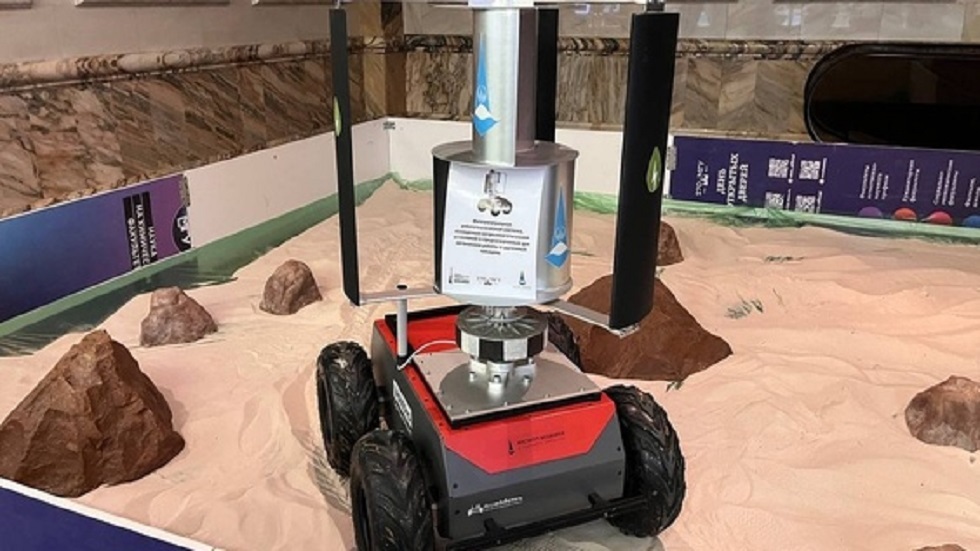
The model will be tested on Russia’s Kamchatka Peninsula, according to Anton Rogatchev, chief engineer at the Mechanics Institute of Moscow State University.
Rogatchev explained that the small rover weighs about 70 kilograms and relies on Savonius turbines as a vertical-axis wind energy generation unit, noting that charging the robot requires wind speeds of about 10 meters per second.
The rover is expected to be used in the future on the surface of Mars to collect soil samples, study the atmosphere, and conduct scientific photography. The project team also plans to test the rover under different wind speed conditions in Kamchatka in the near future.
The project was carried out with the support of the Scientific School of Moscow State University under the title “Basic and Applied Space Studies.”
It is worth mentioning that the international festival “Science 0+” has been held annually since 2006 in Russia and several other countries, initiated by Viktor Sadovnichy, the president of Moscow State University. The current edition took place in ten countries as part of the “Decade of Science and Technology” program launched by Russian President Vladimir Putin.
The festival was organized by the Moscow government, the Russian Ministry of Education and Science, and Moscow State University, with support from the Russian Academy of Sciences.
In Moscow, the festival events were held from October 10 to 12 at more than 100 venues across the Russian capital.




Recommended for you
Talib Al-Rifai Chronicles Kuwaiti Art Heritage in "Doukhi.. Tasaseem Al-Saba"
Exhibition City Completes About 80% of Preparations for the Damascus International Fair Launch
Al-Jaghbeer: The Industrial Sector Leads Economic Growth
Unified Admission Applications Start Tuesday with 640 Students to be Accepted in Medicine
Egypt Post: We Have Over 10 Million Customers in Savings Accounts and Offer Daily, Monthly, and Annual Returns
His Highness Sheikh Isa bin Salman bin Hamad Al Khalifa Receives the United States Ambassador to the Kingdom of Bahrain