





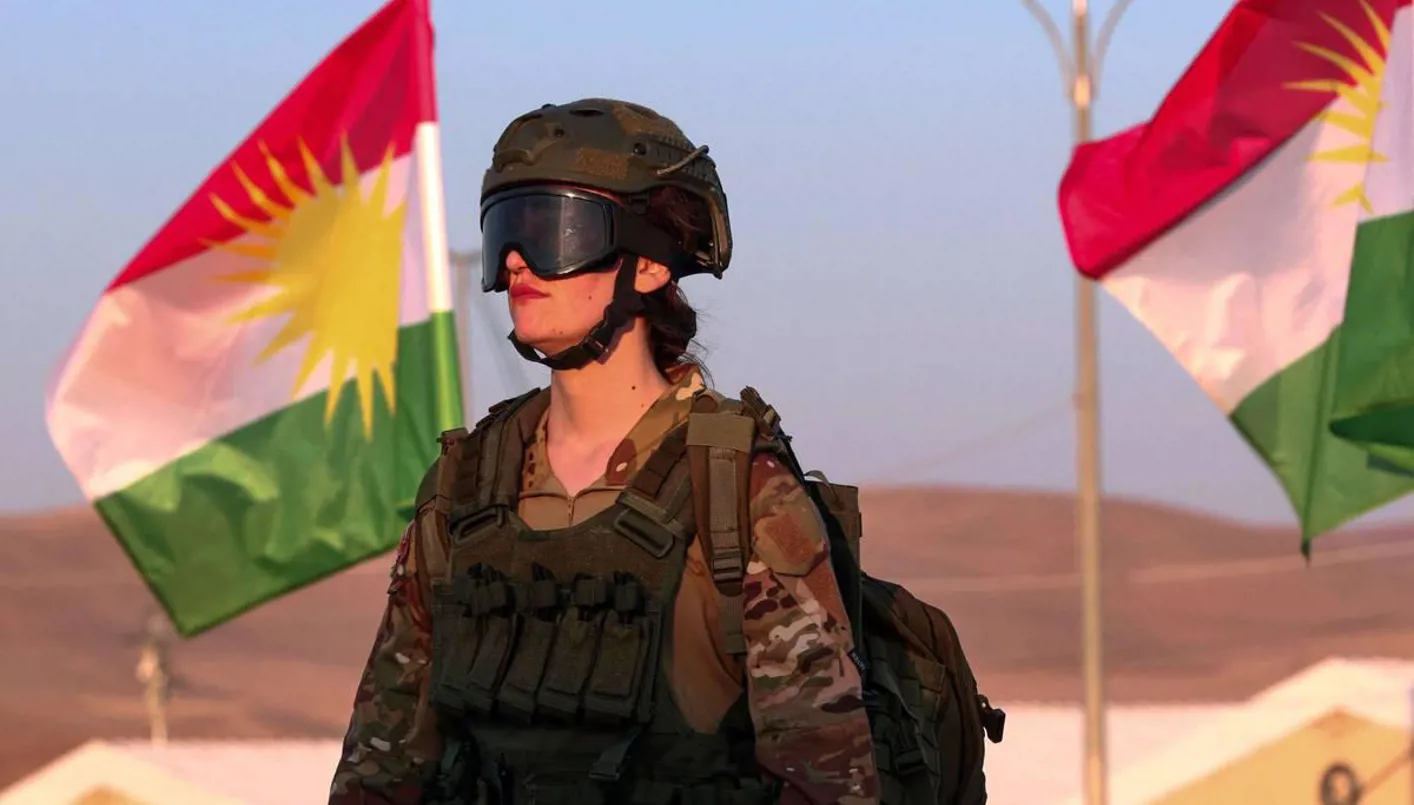
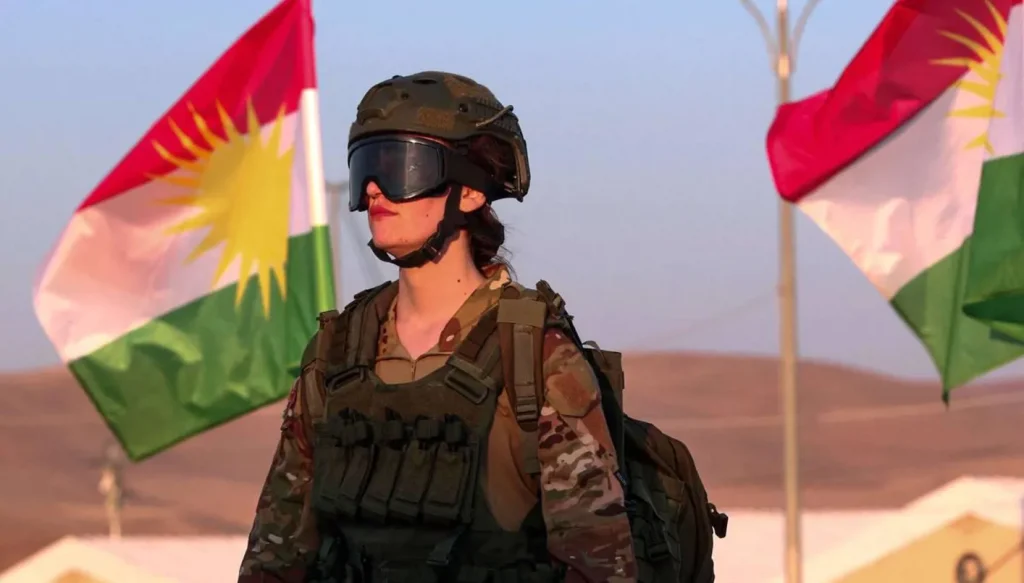
A female recruit from the Kurdish Peshmerga forces. (Agencies)
The United States has called on the federal government in Baghdad to fund the salaries of the Peshmerga forces affiliated with the Kurdistan Region, similar to the Iraqi army; this follows Washington’s halt of funding for some Peshmerga sectors under the U.S. Department of Defense’s 2026 budget law, after years of providing such funding. The American call aligns with similar demands from the Kurdistan Regional Government and its political leadership.
These demands coincide with “positive” indicators in the relationship between Baghdad and Erbil, as the region’s oil exports resumed in recent days after years of suspension, while joint technical committees continue to reach understandings on sustainable funding for the region’s employees’ salaries after more than a decade of disputes over this file. However, this also comes at a time when the United States and the international coalition have ended their presence in most parts of Iraq, maintaining their deployment exclusively in the Kurdistan Region, with a restructuring of their military and logistical missions.
The issue of funding and arming the Peshmerga forces is one of the most prominent unresolved files between the federal government and the regional government, due to chronic political and logistical disputes. A senior Kurdish political source revealed to “An-Nahar” the core of the dispute, saying: “Since the constitution was ratified in 2005, successive Iraqi governments have insisted on full control over the identity, doctrine, and movements of the Peshmerga forces, while the region considers them a joint force subject to the supreme command of the Iraqi army and the regional presidency together.”
The source added: “The Kurdistan Region relies on paragraph five of Article 121 of the constitution, which states that the Peshmerga forces are part of the Iraqi defense forces. The Peshmerga Ministry Law has defined their main tasks, foremost of which is defending the region as part of Iraqi sovereignty. However, federal governments, driven by central parties with known regional orientations, try to treat these regular forces as a local faction, which the region has rejected since the American occupation period.”
The number of Peshmerga fighters is estimated at more than 100,000, spread across the region, equipped with light and medium weapons, and receiving continuous training from the U.S. army and the international coalition forces for years. These forces cooperate with the Iraqi army in military, logistical, and intelligence fields, especially in combating terrorism and protecting borders with Turkey, Iran, and Syria.
The regional government complains about Baghdad’s refusal to fund and arm the Peshmerga forces, while the federal government imposes “complex” conditions for this, the most prominent being organizational control over their movements.
The head of the regional government, Masrour Barzani, said in an official statement that “the Peshmerga, according to the constitution, are part of the Iraqi armed forces, which requires guaranteeing their financial dues and equalizing their salaries with those of the Iraqi army.” Similarly, the leader of the Kurdistan Democratic Union, Bafel Talabani, said during the launch of his election campaign: “The Peshmerga forces must be treated like the Iraqi army in terms of salaries, privileges, and all other rights.”
Political researcher and writer Ahmed Hassan considers that the roots of the crisis go back to the lack of political consensus since the constitution was drafted, explaining to “An-Nahar” that “Iraqi political forces do not truly believe in the new federal system, as they see federalism as a relative division of sovereignty; therefore, they use the slogan of army centralization to dismantle the defense system that consolidates the Kurdistan Region’s position within this federal framework.”
Recommended for you
Talib Al-Rifai Chronicles Kuwaiti Art Heritage in "Doukhi.. Tasaseem Al-Saba"
Exhibition City Completes About 80% of Preparations for the Damascus International Fair Launch
Al-Jaghbeer: The Industrial Sector Leads Economic Growth
Unified Admission Applications Start Tuesday with 640 Students to be Accepted in Medicine
Egypt Post: We Have Over 10 Million Customers in Savings Accounts and Offer Daily, Monthly, and Annual Returns
His Highness Sheikh Isa bin Salman bin Hamad Al Khalifa Receives the United States Ambassador to the Kingdom of Bahrain