








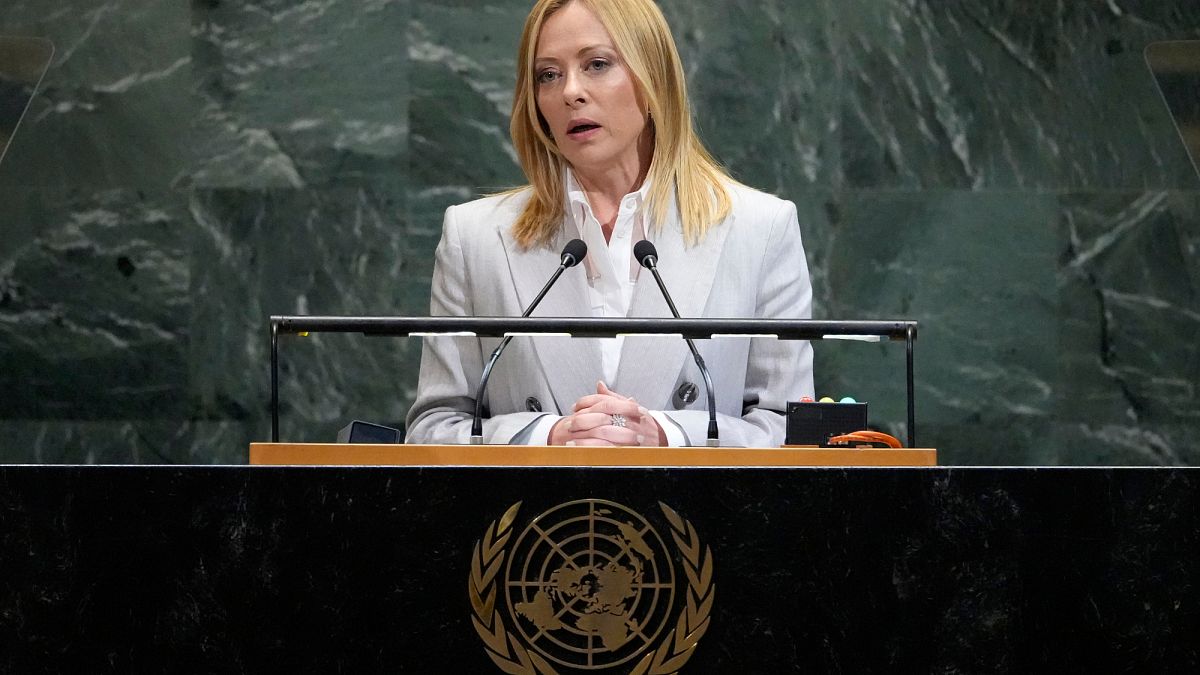
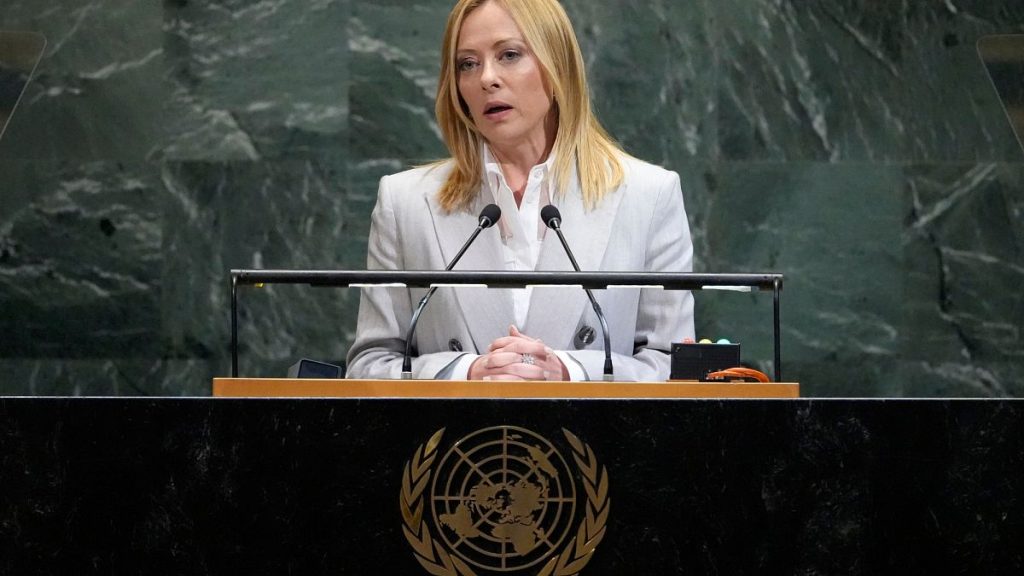
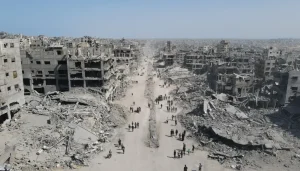
A complaint has been filed with the International Criminal Court accusing Giorgia Meloni and ministers Crosetto, Tajani, and Leonardo Singolani of “complicity in genocide” in Gaza. However, Raffaele Marchetti (Luiss) believes it is unlikely that a trial will take place, saying: “The procedures are long and complex.”
Fifty-eight people signed the petition calling on the ICC to conduct a formal investigation, according to Rights Lawyers and Advocates for Palestine. In addition to the Prime Minister, the accusations were also directed at Defense Minister Guido Crosetto, Deputy Prime Minister and Foreign Minister Antonio Tajani, and Leonardo SpA CEO Roberto Singolani.
On these accusations, Euronews spoke with the director of the Ces Lewis Center for International Strategic Studies.
An official complaint is defined as a request to initiate legal proceedings against a party, which may be preceded by a preliminary investigation and possibly followed by a trial.
Italy is one of the countries that recognize the ICC, established in Rome in 1998, which is tasked with prosecuting those involved in war crimes, crimes against humanity, and genocide.
The Rights Lawyers and Advocates for Palestine website states that the complaint dated October 1 “will be referred in the coming days to the ICC prosecutor.” According to Article 15 of the Rome Statute, the treaty under which the ICC was established, anyone considered a “reliable source” by the court is allowed to submit a complaint requesting the prosecutor to investigate it.
The Italian Prime Minister commented on the complaint, saying: “There is no other similar case in the world,” and regarding arms shipments to Israel, Meloni defended her government’s actions, saying: “Italy did not allow new arms shipments to Israel after October 7; we are among the European countries with the strictest stance.”
Similar cases occurred in France and Australia where complaints were filed against French President Emmanuel Macron and Australian Prime Minister accusing them of complicity in the genocide Israel was accused of.
Compared to the case of Osama al-Masri, whom the ICC accused of war crimes in Libya, this case did not originate inside the court but was brought by an external party. This is an important procedural difference, as Marchetti explained, adding: ‘It is a case still at a very early stage because the petition will now be submitted, followed by an internal two-level evaluation. Only if this evaluation is positive will the judge open the trial, so let’s say these are complex procedures.’
Marchetti continues: “Objectively, I find it difficult for the case to reach trial, but it has political and media value, so it is an important case.” According to the director of the International Strategic Studies Center at Luiss, it will take several months to reach a decision.
Marchetti also explains that another aspect to emphasize is that in this type of crime, the indictment does not concern the entire state or government. “It is not about Italy itself, but in this type of crime, the indictment is individual, thus referring to Meloni, Singolani, Tajani, and Crosetto, not the Italian government.
Marchetti clarified these are individual responsibilities, adding: “In these cases, it is difficult for an ordinary individual who does not hold a government position to be held accountable for international crimes.
Therefore, associations or individuals can act in this direction, but experts in The Hague say that “only the prosecutor’s decisions have official value and there is no decision” regarding conspiracy charges to commit genocide against Meloni.
According to Marchetti, there are four hypotheses to be verified in the final trial, but the academic sees it unlikely that all will be confirmed.
“The first hypothesis is the occurrence of genocide or crimes against humanity in Gaza.” On this point, Marchetti expects a mostly positive response. The ICC itself issued an international arrest warrant against Israeli Prime Minister Benjamin Netanyahu.
“The second hypothesis concerns the possibility that the weapons supplied by Italy played a decisive role in committing these crimes. The third hypothesis,” Marchetti continues, “relates to the extent to which Meloni, Crosetto, and Singolani knew that the weapons they approved to supply before October 7 and delivered afterward were used to commit these crimes.
The fourth point, related to the genocide case because it is a serious and complex crime, is whether there was participation in the intent of genocide. Marchetti concluded that the last hypothesis seems the least likely to him.

Recommended for you
Talib Al-Rifai Chronicles Kuwaiti Art Heritage in "Doukhi.. Tasaseem Al-Saba"
Exhibition City Completes About 80% of Preparations for the Damascus International Fair Launch
Al-Jaghbeer: The Industrial Sector Leads Economic Growth
Unified Admission Applications Start Tuesday with 640 Students to be Accepted in Medicine
Egypt Post: We Have Over 10 Million Customers in Savings Accounts and Offer Daily, Monthly, and Annual Returns
His Highness Sheikh Isa bin Salman bin Hamad Al Khalifa Receives the United States Ambassador to the Kingdom of Bahrain