








Hamas at a Crossroads: Local and Regional Challenges Facing Trump’s Plan
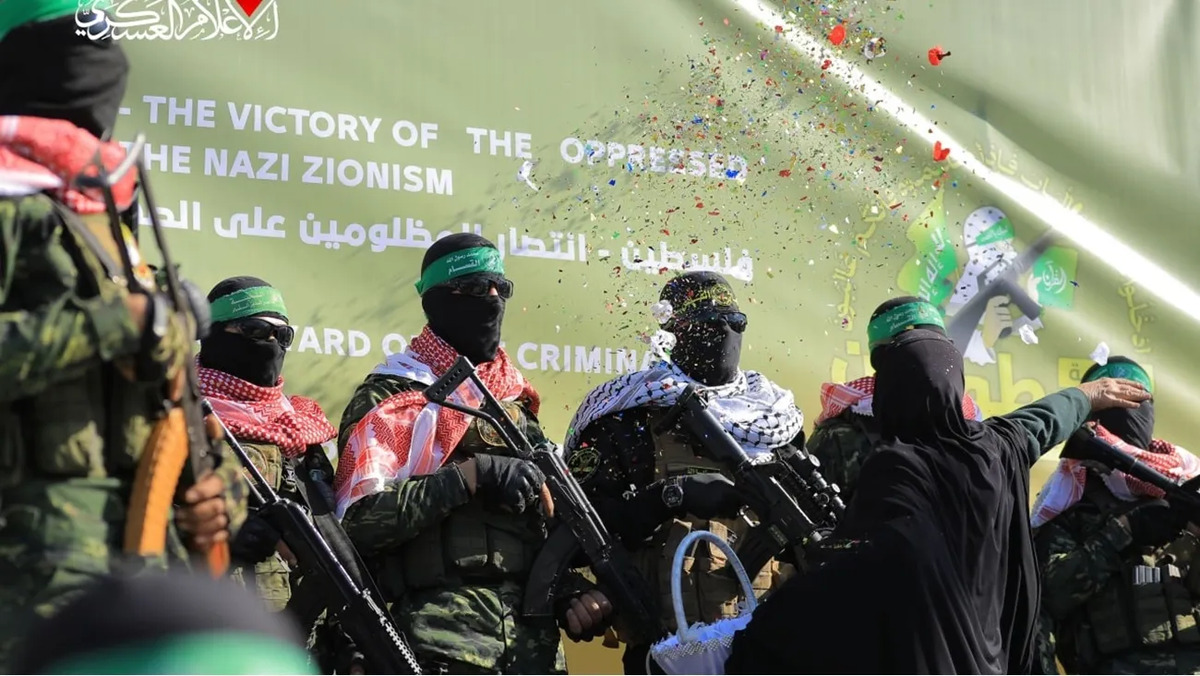
The plan proposed by U.S. President Donald Trump to end the war and reshape the Palestinian political landscape presents a complex test for Hamas, which holds a pivotal position on the ground and at the heart of political decision-making in Gaza.
The plan, welcomed by the Palestinian Authority as a strategic political opportunity, places Hamas before a dual challenge: meeting the pressure from Gaza’s street to stop the bleeding, while simultaneously preserving its political constants and leverage on the ground.
One of Hamas’s top priorities is to stop the war, as the ongoing conflict imposes a heavy burden on the population and poses a direct threat to the movement’s internal legitimacy.
Initial acceptance of the plan, even tactically, grants Hamas the image of a responsible force capable of protecting people and alleviating their suffering, blocking attempts to portray it as an obstacle to peace or a cause of the ongoing humanitarian crisis in Gaza.
However, acceptance will not be absolute. Hamas’s negotiation experience indicates adopting a “conditional acceptance” strategy, recognizing the general framework of the plan while ensuring a wide negotiating margin on key issues such as reconstruction, lifting the blockade, prisoner exchanges, and drafting new governing institutions in Gaza.
This approach allows Hamas to remain an active player and turns any implementation of the plan into a project in which it actively participates, rather than merely observing.
The Palestinian Authority’s welcoming of the plan presents an additional political challenge for Hamas, as outright rejection could portray it as an obstacle, while absolute acceptance diminishes its political distinction and weakens its negotiating power.
Therefore, Hamas will seek a middle ground: initial support for the plan with an emphasis on broader Palestinian participation and imposing a pivotal role for itself in the field arrangements in Gaza, ensuring influence and impact on the implementation phases.
Hamas will interact with the plan in a sensitive regional and international context. Egypt and Qatar, as key actors in the Gaza file, represent channels of pressure and incentives for Hamas to adopt balanced positions.
Cairo, aiming for border stability and preventing new military escalation, may encourage Hamas to conditional acceptance in exchange for a role in reconstruction and overseeing aid entry.
Doha plays the role of political and financial mediator, allowing Hamas to maintain its regional support networks without engaging in open confrontation with the Palestinian Authority or the international community.
Internationally, Hamas’s position gains strategic importance before the United States, the United Nations, and European countries, which closely monitor the plan’s implementation.
Explicit rejection by Hamas could lead to political and diplomatic isolation, while conditional acceptance grants maneuvering space and balances support between the local street and the demands of regional and international players.
At its core, Hamas’s stance on Trump’s plan tests its ability to maintain Palestinian legitimacy after the war.
The ability to present itself as a responsible force managing the political transition phase intelligently enhances its local and regional position and proves it is an indispensable partner in any future agreement.
Absolute rejection could lead to isolation amid Arab and international consensus around the plan and limit its strategic options in the medium term.
In summary: “Yes, with control over the details” Hamas is expected to adopt a composite strategy: initial acceptance of the plan to stop the war and provide a political horizon, while retaining a wide negotiating margin to control implementation details and its influence on the ground.
This stance ensures its continuation as a key player in the post-war path, balancing popular pressure, competition with the Palestinian Authority, and regional and international challenges, while maintaining its image as a responsible resistance movement before its local and international audience.

Recommended for you
Talib Al-Rifai Chronicles Kuwaiti Art Heritage in "Doukhi.. Tasaseem Al-Saba"
Exhibition City Completes About 80% of Preparations for the Damascus International Fair Launch
Al-Jaghbeer: The Industrial Sector Leads Economic Growth
Unified Admission Applications Start Tuesday with 640 Students to be Accepted in Medicine
Egypt Post: We Have Over 10 Million Customers in Savings Accounts and Offer Daily, Monthly, and Annual Returns
His Highness Sheikh Isa bin Salman bin Hamad Al Khalifa Receives the United States Ambassador to the Kingdom of Bahrain