









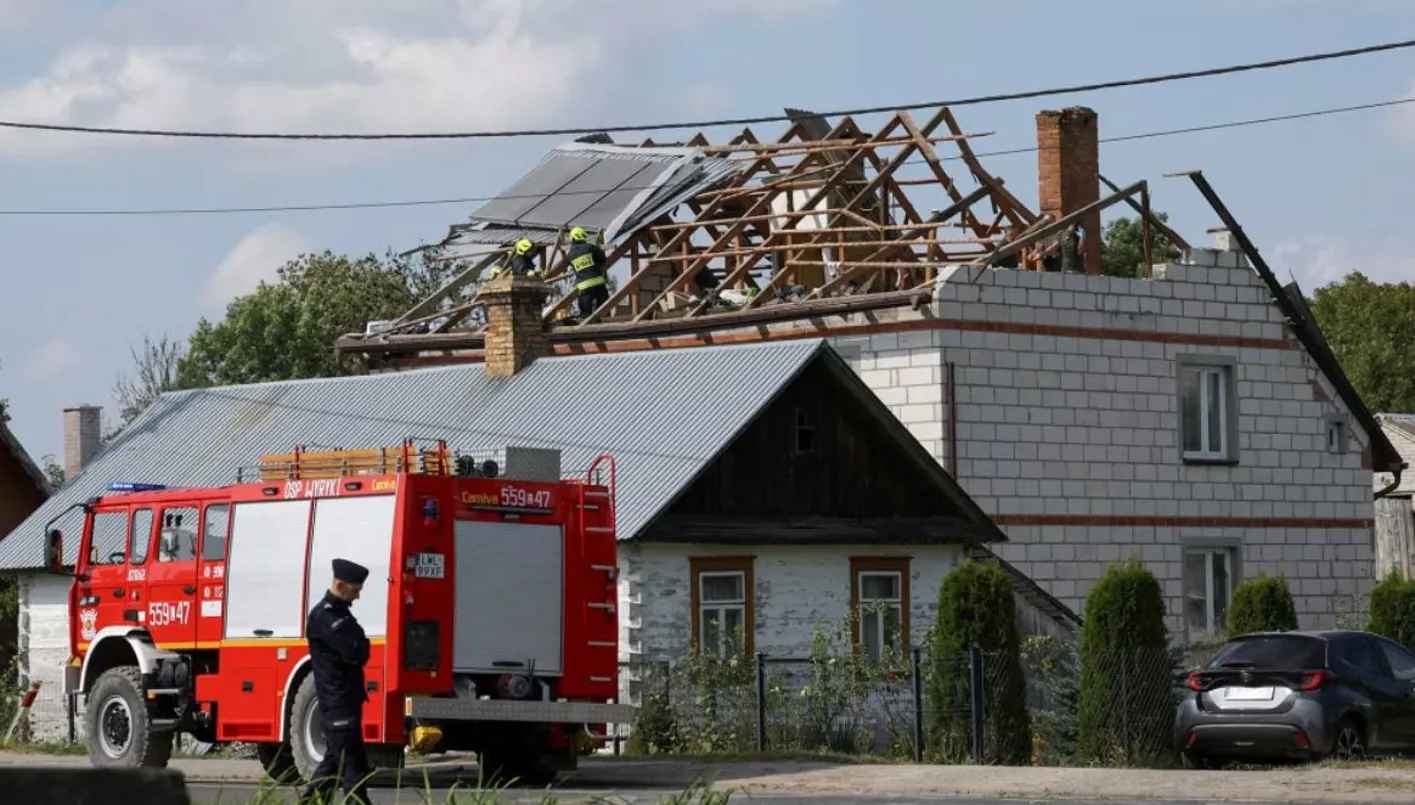
Firefighters at work hours after Russian drones violated Polish airspace during an attack on Ukraine (Agencies)
Russian drone incursions into NATO airspace, particularly in Eastern and Northern Europe, reveal vulnerabilities in the alliance’s defenses and highlight new challenges it faces. As NATO races to upgrade its capabilities, concerns grow over Russia exploiting these gaps to destabilize the region using unconventional tactics.
Foreign media reported that during these incursions, Russia obtained important intelligence for the future and tested NATO’s readiness and response to any breach or violation.
Some experts believe the recent increase in NATO airspace breaches is Russia’s attempt to gauge the alliance’s reaction to exploit any divisions or hesitation. Some think Russia hopes to divert NATO’s attention and resources from supporting Ukraine to defending member states’ territories, according to the Associated Press.
Nevertheless, these incursions serve as a stark reminder of how easily a crisis could erupt in Europe due to the war in Ukraine, testing American responses while Russia continues to arm itself, spending nearly 7 percent of its GDP on the military, according to The New York Times.
Unconventional Threats
Drones flying in NATO airspace have exposed gaps in the alliance’s defenses, which were designed to counter traditional military conflicts.
NATO, originally established to counter Soviet tanks and warheads, now faces new and increasingly different threats, including unconventional ones such as sabotage, cyberattacks, and drones.
Denmark reported a “hybrid attack” by a “professional entity” after drones were spotted over several airports, marking the second time in less than a week that drones disrupted air traffic in the Scandinavian country. The Danish Defense Minister said, “We do not know who is behind it. But everything points to a professional actor, given the systematic operation targeting multiple sites almost simultaneously.”
In Norway, Avinor, the operator of Brønnøysund Airport, reported on Sunday night that “drone activities” were detected in the airport’s airspace.
Drones have also recently penetrated the airspace of Poland, Estonia, and Romania.
These incidents have refocused attention on how NATO responds to drones and other unconventional threats, with NATO now rushing to adopt new technologies that can detect drones from afar and provide cost-effective defenses, according to The Wall Street Journal.
NATO’s Dilemma
Countering this new threat poses a dilemma for NATO. The war in Ukraine has shown that defending against drone attacks is difficult and costly. These aerial vehicles are usually small and fly at low altitudes, making them undetectable by current military radar systems. Weapons used to shoot down drones, such as Patriot interceptor missiles, cost far more than the drones themselves.
The war in Ukraine has given Russia over three years of experience in multidimensional warfare combining hybrid activities aimed at disrupting civilian life and military approaches using barrages of artillery and cheap, expendable drones to confuse enemy defenses.
NATO has largely continued preparing for the type of threats it was created to face: large-scale conflicts decided by heavy weapons and military forces. Drone warfare has only recently become a priority for alliance members.
The military response to the incursions revealed several points about NATO’s ability to handle this growing long-term threat.
The Russian drone incursions into Polish airspace were a very cheap experiment for Moscow. Poland said the drones were “Gerbera” models, and Ukrainian defense intelligence estimates the production cost of each at about $10,000. Meanwhile, NATO jets scrambled to intercept were F-16 and F-35 fighters worth millions of dollars. It was an effective show of force but likely cost tens of thousands of dollars in fuel and maintenance just to take off, according to CNN.
Experts point to an economic imbalance between attack and defense means, noting this approach is unsustainable.
After the Ukraine war, everyone has taken the drone threat seriously, but many NATO defense ministries are very slow to adapt. Even the U.S. Department of Defense is now racing to advance in the arms race for drones and anti-drone systems.
However, the biggest challenge is scale: Ukrainian intelligence estimates Russia produces thousands of drones monthly. Ammunition manufacturers are urged to increase production to supply cheap missiles to counter this flood and find a balance between cost and effectiveness.
U.S. forces and other NATO troops are currently testing anti-drone technologies for battlefield use, but efforts are still in early stages. Protecting civilian infrastructure from drones will take much longer and cost significantly more.
The repeated Russian drone incursions indicate an urgent need to reassess NATO’s defense strategies and develop fast, effective systems to counter unconventional threats before these vulnerabilities become strategic weaknesses threatening Europe’s collective security.




Recommended for you
Talib Al-Rifai Chronicles Kuwaiti Art Heritage in "Doukhi.. Tasaseem Al-Saba"
Exhibition City Completes About 80% of Preparations for the Damascus International Fair Launch
Al-Jaghbeer: The Industrial Sector Leads Economic Growth
Unified Admission Applications Start Tuesday with 640 Students to be Accepted in Medicine
Egypt Post: We Have Over 10 Million Customers in Savings Accounts and Offer Daily, Monthly, and Annual Returns
His Highness Sheikh Isa bin Salman bin Hamad Al Khalifa Receives the United States Ambassador to the Kingdom of Bahrain