









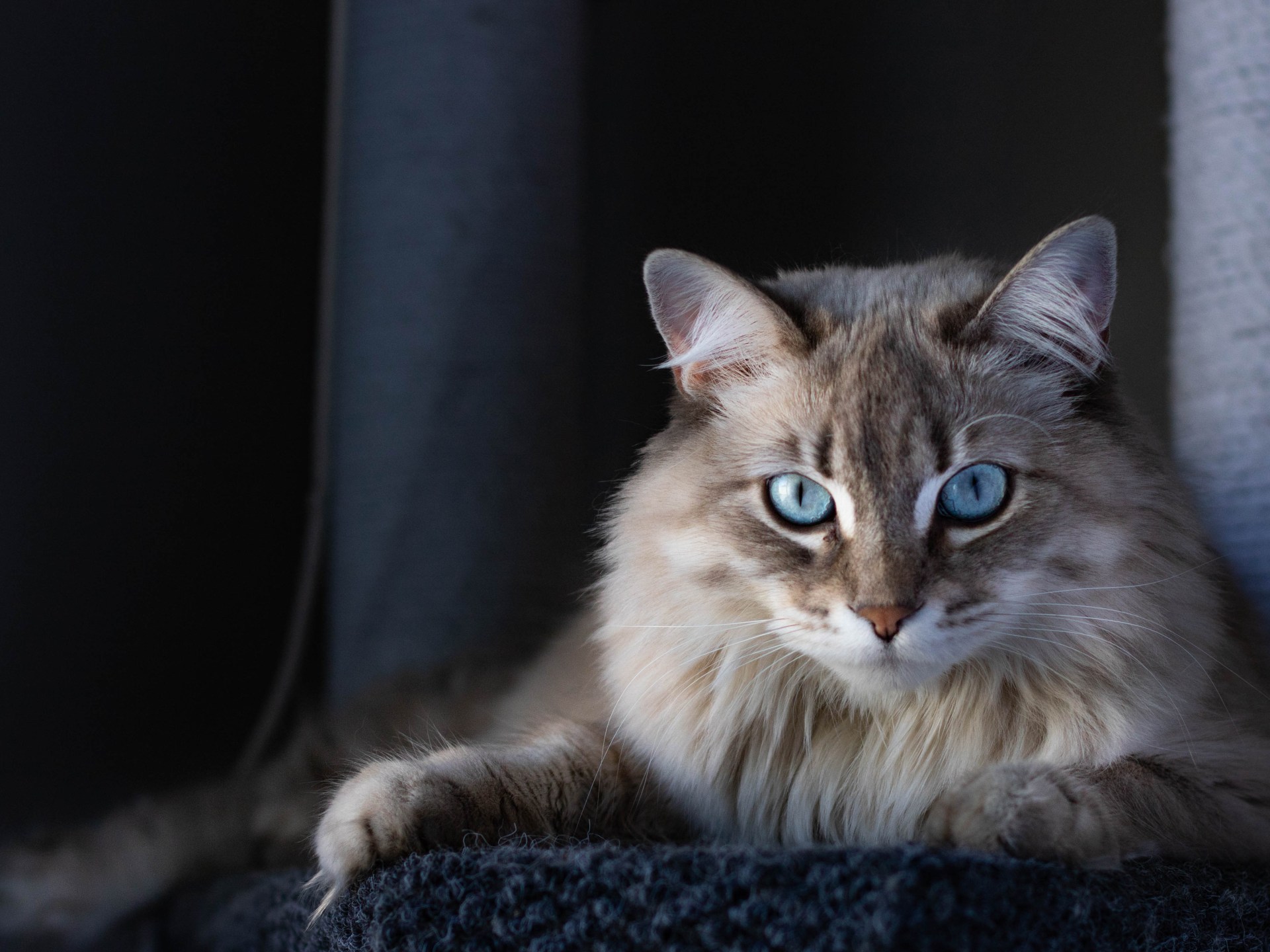
Cats, these creatures we are so used to seeing that they have become part of our daily lives, are not just ordinary pets. They carry in their small bodies a set of sensory and neurological abilities that place them astonishingly among living beings.
Just watch them walk on a narrow edge or jump from one height to another with flawless precision, and you realize you are facing a creature with a special relationship to the laws of balance and gravity.
The Art of Sensing
At night, when the city quiets down and sounds fade, the cat opens its eyes to begin its own sensory party. The world that seems silent and dark to us transforms in its perspective into a canvas full of movement, light, and hidden scents; it does not see the world as we do, but as it senses it.
The story begins with its long whiskers adorning its face, which some people think are just decoration or a means of expression, but in reality, they are advanced sensory devices far more precise than many human electronic tools.
These hairs are called “tactile whiskers,” connected to fine nerves that respond to any change in the air. When the cat passes near a wall or a narrow passage, these whiskers bend slightly due to air currents, sending instant signals to the brain that help it map a three-dimensional environment around it, like a highly sensitive biological radar.
Thanks to this system, the cat can move in the dark as if it sees and can accurately determine the distance between objects without touching them. Experiments have shown that a cat can pass through an opening just a few centimeters wider than its head because its whiskers tell it whether its body will fit through the passage or not.
Whispers We Can’t Hear
But whiskers are not its only weapon; there are also its ears, which work like independent antennas. Each ear can rotate up to 180 degrees, allowing it to pinpoint the source of a sound with extreme accuracy.
It hears not only what we hear but goes beyond our hearing limits. While human hearing stops at about 20,000 hertz, a cat can detect sounds up to 65,000 hertz, nearly four times our capacity. This means the squeak of a mouse walking in the grass or the wing of a tiny insect can create “noise” in its world that we never hear.
At the moment its ears catch that distant whisper, the head turns toward it with sniper-like precision, and the eyes fix the target in the blink of an eye. Here comes the role of night vision, one of the greatest gifts of cats.
From Sight to Smell
The retina of a cat’s eye contains a huge number of rod cells sensitive to light, far more than those in the human eye. These cells collect every available photon, no matter how weak, then a reflective layer behind the retina redirects the light back to the receptors, doubling the eye’s sensitivity. This is why cats’ eyes shine in the dark like jewels; they literally re-emit the light they gather.
As for the sense of smell, it is a whole different world; cats have many times more olfactory receptors than humans, meaning they don’t just distinguish smells but can “read” entire stories through them, knowing who passed by, what they ate, and where they went.
This ability makes them experts in tracking prey or marking their territory. Added to this is a special organ called the Jacobson’s organ, located on the roof of their mouth, which detects chemical molecules related to hormones and pheromones, giving them a “sixth sense” for social interaction and mating.
Through this complex mix of whiskers, ears, eyes, and nose, the cat forms a perceptual world completely different from ours. For it, darkness is not the absence of light but a rich stage of signals, and silence is not quiet but a symphony of vibrations, breaths, and scents.
Cats, these mysterious creatures that stealthily slip between worlds of light and shadow, remind us that perception is not just what our eyes see or ears hear, but what the combined senses build in our minds as an image of the world.
The Art of Falling
Among the most astonishing secrets of cats is their ability to fall from great heights and land on their feet, as if defying the laws of physics.
In a famous 1984 study in New York, 132 cases of cats falling from high buildings up to the 32nd floor were recorded, and 90% survived despite injuries. Other remarkable cases in subsequent years proved these creatures have a supernatural ability to survive.
Scientists’ interest in this phenomenon dates back to the 19th century when Frenchman Étienne-Jules Marey documented a cat’s fall with sequential photography in 1894, publishing the results in the journal “Nature.”
The images showed that the cat does not defy gravity but cleverly rearranges its body in the air, twisting around itself until it straightens before touching the ground. In 1969, two researchers from Stanford University mathematically analyzed this phenomenon and found that the cat relies on a precise physical principle: redistributing its body mass between its two halves to conserve angular momentum without violating it.
This innate behavior is called the “righting reflex,” an involuntary neurological response activated in less than 300 milliseconds, faster than a human blink.
The reflex depends on the harmony of the vestibular system in the inner ear, spinal flexibility, and the muscles’ ability to coordinate instantly. Even blind kittens show the same reflex within a few weeks of age, confirming it is neurologically programmed. With this mechanism, the cat resets its body in space to fall standing, turning a falling disaster into a lesson in the genius of natural balance.
This makes the legend of the “cat with nine lives” in various cultures closer to a scientific explanation than mere myth. The cat’s amazing ability to survive falls, thanks to the righting reflex that allows it to land on its four paws, has made people through the ages believe that cats do not die easily and “come back to life” after accidents that would be fatal to any other creature.




Recommended for you
Talib Al-Rifai Chronicles Kuwaiti Art Heritage in "Doukhi.. Tasaseem Al-Saba"
Exhibition City Completes About 80% of Preparations for the Damascus International Fair Launch
Al-Jaghbeer: The Industrial Sector Leads Economic Growth
Unified Admission Applications Start Tuesday with 640 Students to be Accepted in Medicine
Egypt Post: We Have Over 10 Million Customers in Savings Accounts and Offer Daily, Monthly, and Annual Returns
His Highness Sheikh Isa bin Salman bin Hamad Al Khalifa Receives the United States Ambassador to the Kingdom of Bahrain