






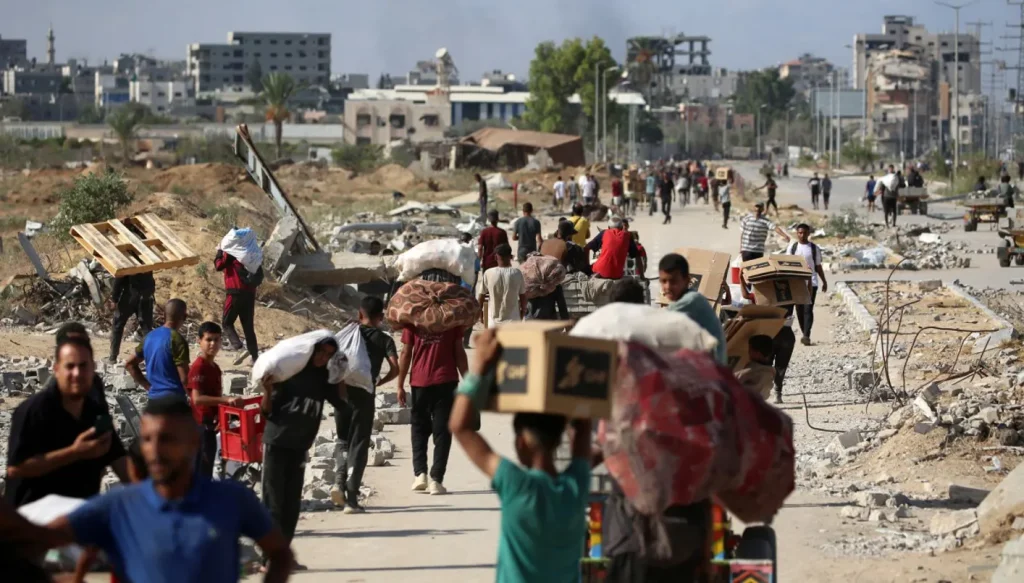
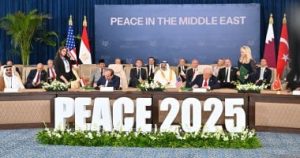
This week, attention turns to Sharm El-Sheikh in Egypt, where a new round of negotiations is taking place between Israel and Hamas based on U.S. President Donald Trump’s plan to end the war in Gaza, coinciding with the conflict entering its third year.
Last month, Trump introduced his 20-point plan to Arab and Islamic leaders, calling for a ceasefire and establishing a new phase centered on peace and a disarmed Hamas. After months of stalled negotiations and the setback in Doha, Trump’s initiative injects new momentum, with influential parties, notably Egypt and Qatar, seeking a single outcome: ending the war.
Amid these rapid developments, major powers are notably absent from the Middle East scene. The most prominent absence is China, especially after Trump’s plan. China’s declared positions since the war began are clear: it calls for implementing UN resolutions, an immediate comprehensive ceasefire, release of all detainees, and alleviation of the humanitarian crisis.
Many questions arise about China’s stance given its weight in global crises. Alongside Gaza’s war, Europe faces dangerous developments with Russia’s ongoing war on Ukraine, including drone incursions into several European countries’ airspace, potentially altering the conflict’s trajectory since 2022. So where does Beijing stand regarding Gaza’s developments and the U.S. plan? Are Chinese steps expected?
“Power of Peace”
Warf Qmeihah, President of the Arab-Chinese Dialogue and Communication Association, considers that “China follows what is proposed regarding Gaza from a fixed standpoint based on supporting justice and peace, but it does not engage in any plan imposed by force or ignoring the legitimate rights of the Palestinian people.” He adds: “The Chinese Foreign Ministry confirmed that Gaza is an integral part of Palestinian territories, and its future must be decided by the Palestinians themselves. Therefore, while China welcomed any international effort contributing to easing tensions, it clearly rejected Trump’s proposal that the U.S. take control of Gaza or impose external arrangements on the Palestinians.”
Tensions between the two giant countries escalated, with the latest round involving tariffs imposed by Trump on the Chinese dragon and Beijing’s retaliatory tariffs, until the two reached a “temporary” trade truce, alongside negotiations regarding the Chinese platform TikTok, where both countries agreed the platform would have an American owner.
Regarding the diplomatic race between the two, Qmeihah told “An-Nahar” that “the Trump administration seeks to restore American dominance in sensitive international files, including the Middle East and Gaza. But excluding China is no longer possible, as Beijing has become a recognized player in regional issues, maintaining balanced relations with various Arab and Palestinian parties as well as Israel, presenting itself as a power of peace rather than dominance.” He continues: “China is not a party to the conflict but a party calling for dialogue and justice. From this perspective, Washington’s attempts to sideline China have limited impact because Beijing has established an accepted and desired role among Arab and Islamic parties.”
In this context, the head of the Silk Road Institute for Studies and Research emphasizes that “China possesses significant diplomatic, developmental, and humanitarian capabilities that make it an effective partner in any genuine peace process, such as political and diplomatic initiatives through the United Nations and Security Council, or contributing to Gaza’s reconstruction, making it a key partner in the post-war phase, in addition to humanitarian and relief support through cooperation with international and regional organizations.”
“Palestinian Unity”
China led mediation between Palestinian factions known as the “Beijing Declaration” in July 2024, bringing together 14 Palestinian factions, including Fatah and Hamas, and signing a new national unity document.
Qmeihah confirms that “China is fully committed to this path, as affirmed by Foreign Minister Wang Yi during the signing ceremony, which was under Chinese auspices calling for ending the Palestinian division and uniting the national front under the Palestine Liberation Organization umbrella. It is clear that Beijing intends to continue this file through ongoing dialogue with factions and providing a diplomatic environment supportive of Palestinian internal rapprochement.”
He points out that “China believes Palestinian unity is an essential condition for the success of any genuine peace process and is ready to leverage its international status and balanced relations to support this noble goal. Clearly, China, in dealing with the Palestinian cause and Middle East crises, does not operate from narrow interest calculations but from a comprehensive vision based on justice, mutual respect, and non-interference in internal affairs.”
With all the ongoing developments, Qmeihah explains that “China, thanks to its balanced policy and credibility among all parties, is capable of being a true bridge for peace in the region and an active driver to restore hope for a more stable and just future for the Arab peoples, especially the Palestinian people.”
He concludes: “Beijing operates from the conviction that peace in the Middle East is the foundation for global stability, and the solution can only be political and just, away from the logic of force. It proposes a comprehensive vision based on respecting state sovereignty and non-interference in internal affairs, shared development through the Belt and Road Initiative, enhancing civilizational dialogue, and reducing tensions through mediation, as it did between Saudi Arabia and Iran in 2023.”
Recommended for you
Talib Al-Rifai Chronicles Kuwaiti Art Heritage in "Doukhi.. Tasaseem Al-Saba"
Exhibition City Completes About 80% of Preparations for the Damascus International Fair Launch
Al-Jaghbeer: The Industrial Sector Leads Economic Growth
Unified Admission Applications Start Tuesday with 640 Students to be Accepted in Medicine
Egypt Post: We Have Over 10 Million Customers in Savings Accounts and Offer Daily, Monthly, and Annual Returns
His Highness Sheikh Isa bin Salman bin Hamad Al Khalifa Receives the United States Ambassador to the Kingdom of Bahrain