








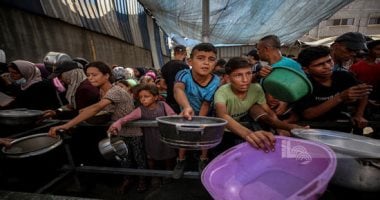
Dr. Hanan Hassan Balkhi, Regional Director of the World Health Organization (WHO) for the Eastern Mediterranean, stated during a video press conference that more than half a million people are trapped in famine-like conditions in Gaza.
During the press conference about the upcoming 72nd session of the WHO Regional Committee for the Eastern Mediterranean, which discusses two years of conflict in Gaza, she explained that in September she attended the high-level international conference on the two-state solution at the United Nations General Assembly, co-chaired by Saudi Arabia and France, which highlighted a positive path to end this tragedy in Gaza. Significant progress has been made towards recognizing the State of Palestine and advancing the two-state solution, which would greatly improve the ability to open humanitarian corridors and ensure the continued flow of aid to Gaza.
She added that she hopes this initiative’s progress continues and the momentum among member states endures. Now, after two years of war in Gaza, there is finally a glimmer of hope that the end may be near. However, when the fighting stops, a new struggle will begin to rebuild Gaza’s shattered health system and save all its residents from the brink of famine and despair.
She said WHO is planning for the day after the conflict ends and now has a clear vision of where and how to move forward. There will be a need to quickly transition from crisis response to recovery, as rebuilding Gaza’s health system will not only save lives now but also restore dignity, stability, and hope for the future.
She explained that hospitals must resume operations. Currently, only 14 out of 36 hospitals are functioning, and only partially, due to severe shortages of electricity, clean water, and medicines, as well as equipment failures and damaged infrastructure. Some facilities have been bombed and rehabilitated multiple times. WHO, which supplies fuel to all hospitals and ambulances, has delivered 17 million liters of fuel, maintaining surgical operations, newborn care, and vaccine cold chains. However, much more is needed, and essential supplies—from antibiotics to wound dressings—must reach all parts of Gaza immediately without delay.
She emphasized that hunger and malnutrition must be confronted simultaneously. It is already too late to save 455 people, including 151 children mostly under five years old, whose deaths due to malnutrition were announced by Palestinian health authorities since January. More than half a million people are trapped in famine-like conditions, over one million suffer from severe food insecurity, 7 out of 10 pregnant and breastfeeding women suffer from severe malnutrition, one in five children is born underweight or prematurely, and infectious diseases are rising sharply.



Recommended for you
Talib Al-Rifai Chronicles Kuwaiti Art Heritage in "Doukhi.. Tasaseem Al-Saba"
Exhibition City Completes About 80% of Preparations for the Damascus International Fair Launch
Al-Jaghbeer: The Industrial Sector Leads Economic Growth
Unified Admission Applications Start Tuesday with 640 Students to be Accepted in Medicine
Egypt Post: We Have Over 10 Million Customers in Savings Accounts and Offer Daily, Monthly, and Annual Returns
His Highness Sheikh Isa bin Salman bin Hamad Al Khalifa Receives the United States Ambassador to the Kingdom of Bahrain