









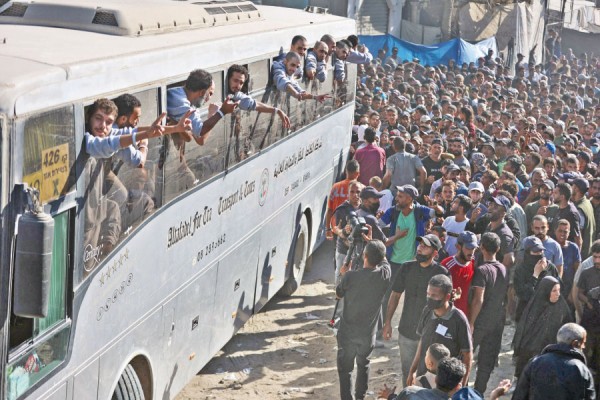
Les Brigades Al-Qassam, aile militaire du Hamas, ont mis en œuvre la première phase de l’accord d’échange de prisonniers en libérant lundi 20 prisonniers israéliens en deux vagues, qu’elles ont remis au Comité international de la Croix-Rouge dans le cadre de l’accord de cessez-le-feu à Gaza.
Par ailleurs, les autorités d’occupation israéliennes ont libéré 96 prisonniers palestiniens de la prison d’Ofer à l’ouest de Ramallah, dans le cadre de la première phase de la mise en œuvre du cessez-le-feu, qui comprend un échange simultané de prisonniers supervisé par la Croix-Rouge.
La liste des prisonniers libérés comprenait 24 détenus de la gouvernorat de Jérusalem, dont le plus ancien prisonnier de Jérusalem, Samir Abu Na’mah, détenu depuis 1986. Quinze de ces prisonniers seront expulsés de force vers l’Égypte, tandis que neuf retourneront dans leurs foyers à Jérusalem.
Les forces d’occupation ont tiré des balles réelles et des gaz lacrymogènes sur les Palestiniens célébrant près de la prison d’Ofer, provoquant plusieurs cas d’asphyxie.
L’échange de prisonniers nommé “Inondation d’Al-Aqsa” comprend la libération de 1 718 prisonniers arrêtés à Gaza pendant la guerre contre la bande, dont deux femmes et trois prisonniers jordaniens, portant le nombre total de prisonniers libérés à 1 966.
L’occupation a informé les familles des prisonniers de Jérusalem des restrictions sévères visant à limiter les célébrations, notamment l’interdiction d’organiser des événements, des rassemblements en dehors des maisons et de brandir des drapeaux ou des bannières.
Des véhicules du renseignement escorteront chaque prisonnier libéré jusqu’à son domicile afin de contrôler leurs déplacements et ceux de leurs familles.
Grâce à cet accord, le nombre de prisonniers condamnés à la perpétuité dans les prisons israéliennes est passé de 608 à 121, reflétant l’ampleur des libérations lors des trois échanges pendant la bataille d’Inondation d’Al-Aqsa.
Plus de 3 985 prisonniers palestiniens de diverses factions ont été libérés, dont 486 condamnés à la perpétuité, 319 avec de longues peines, 33 attendus pour recevoir des peines de perpétuité ou longues, 144 femmes et 297 enfants.
Les libérations comprenaient également 2 724 prisonniers de Gaza arrêtés après le 7 octobre, marquant un tournant important dans le dossier des prisonniers palestiniens et une réduction majeure du nombre de condamnés lourds dans les prisons israéliennes.



Recommended for you
طالب الرفاعى يؤرخ لتراث الفن الكويتى فى "دوخى.. تقاسيم الصَبا"
مدينة المعارض تنجز نحو 80% من استعداداتها لانطلاق معرض دمشق الدولي
الجغبير: القطاع الصناعي يقود النمو الاقتصادي
تقديم طلبات القبول الموحد الثلاثاء و640 طالبا سيتم قبولهم في الطب
البريد المصري: لدينا أكثر من 10 ملايين عميل في حساب التوفير.. ونوفر عوائد يومية وشهرية وسنوية
سمو الشيخ عيسى بن سلمان بن حمد آل خليفة يستقبل سفير الولايات المتحدة الأمريكية لدى مملكة البحرين